








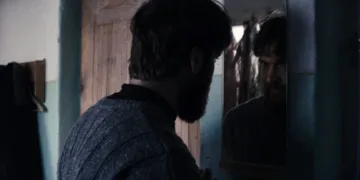













The Occupant begins with a premise familiar to global audiences: a desperate act for a loved one. Geologist Abby, portrayed by Ella Balinska, finds her life’s purpose distilled into a single, high-stakes mission. Her sister, Beth, is dying, and the only hope is an experimental treatment with a price tag that pushes Abby to the world’s edge.
She accepts a dubious mining job in the remote Georgian Taiga, a region whose stark, post-Soviet landscape serves as a potent backdrop for a story of transactional desperation. The inciting incident is swift. After finding a peculiar, valuable mineral, her transport helicopter goes down. She awakens alone, a solitary figure against the vast, unforgiving cold of the Caucasus mountains.
The setting becomes her primary antagonist, a character of immense, indifferent power. Her only connection to humanity is a disembodied voice on her radio, and the strange rock she carries hums with an unnatural energy, hinting that the threats she faces are not limited to the natural world.
The Anatomy of Endurance
The film’s weight rests squarely on the shoulders of Ella Balinska, who delivers a performance of profound physicality. So much of the narrative is told through her body: the strain of a climb, the shudder of cold, the sheer exhaustion etched onto her face. It’s a demanding role that eschews dialogue for long stretches, recalling a cinematic tradition where survival is expressed through action and reaction, not words.
Balinska makes Abby’s grueling journey palpable, capturing the primal transformation of a character pushed beyond all conceivable limits. Moments where she appears to be genuinely drowning in icy water or slipping from a mountainside are captured with a harrowing authenticity that grounds the film’s more abstract ideas.
Initially, Abby wears a hardened armor built from scientific pragmatism and a deep-seated denial born of love. As a geologist, she understands pressure and immense time, yet she cannot apply that understanding to her own emotional landscape. The wilderness, however, systematically strips this armor away, exposing the raw fear and sorrow beneath.
Director Hugo Keijzer uses flashbacks not as simple exposition, but as jarring intrusions of warmth and memory into the cold present. These glimpses of her sister break the visual monotony of the snow and articulate Abby’s internal world of guilt and love. This isolation is deepened by her radio contact with John, voiced by Rob Delaney.
His voice is a lifeline in the emptiness, a source of guidance that slowly curdles with suspicion. He becomes a confessor and an interrogator, an echo of her own hopes and fears, adding a sharp psychological tension to her physical ordeal. This dynamic explores a uniquely modern paranoia, where intimacy and trust are built without physical presence, leaving one dangerously vulnerable to manipulation.
The Landscape’s Uncanny Echo
The Occupant operates as a compelling fusion of survival thriller and existential science fiction, using the aesthetics of one to explore the ideas of the other. As a thriller, it is ruthlessly effective. Keijzer and cinematographer Robbie van Brussel masterfully weaponize the Georgian landscape.
Low-angle shots render the mountains as monolithic, oppressive judges, while high-angle perspectives emphasize Abby’s insignificance, a mere speck in an indifferent world. The sound design is spare, filled with the howl of the wind and the crunch of snow. This auditory minimalism, common in European art-house cinema, builds a suffocating psychological tension that contrasts sharply with the score-heavy approach often found in Hollywood.
Into this raw naturalism, the film introduces the sci-fi element of the black ore. Much like the mysterious “Zone” in Andrei Tarkovsky’s classic Stalker, this element turns the physical space into a psychological one where the rules of reality bend. The strange occurrences it triggers are less about external spectacle and more an externalization of Abby’s fracturing mind and her desperate wish for a miracle.
This reflects a more philosophical European tradition of science fiction, which uses the genre to pose questions rather than provide answers. The film’s rhythm, which fluctuates between slow, arduous trekking and sudden bursts of action, masterfully syncs the viewer’s experience with Abby’s subjective sense of time. The long, quiet periods capture the crushing monotony of survival and grief, while the frantic crises mirror the sudden panics that punctuate long periods of sorrow.
Metaphor in a Hostile Climate
Ultimately, Abby’s physical journey through the wilderness is a potent metaphor for her emotional pilgrimage through the stages of grief. Her relentless fight against the harsh environment is a direct parallel to her refusal to accept her sister’s mortality. Each obstacle functions as a symbolic trial. The desperate scaling of a sheer rockface can be read as the “bargaining” stage, an attempt to defy the impossible.

Her collapses into the snow reflect the crushing weight of “depression.” This is a story about the human impulse to conquer death, a drive that feels particularly rooted in a Western “fix-it” mindset. Her ordeal in the mountains forces a difficult realization that her quest to save Beth was also a flight from her own powerlessness. The film seems to suggest a different kind of wisdom, one based on yielding to forces beyond one’s control.
The film’s final revelations, which solve the mystery of John and the strange mineral, serve this thematic purpose above all else. The climax is not a plot resolution but a character resolution. The solution to the sci-fi mystery is secondary to the profound internal shift it forces in Abby, compelling her to finally confront the truth she has been running from: the necessity of letting go.
The Occupant is an impressive achievement, using the familiar framework of a genre film to map the complex, intimate territory of the human heart. It leverages the cold of its setting and the ambiguity of its conceit to tell a story about loss and the difficult, painful path to acceptance.
Full Credits
Director: Hugo Keijzer
Writers: Philip Michael Howe, Hugo Keijzer, Roelof Jan Minneboo, Xiao Tang
Producers: Raymond van der Kaaij, Isabel Freer, Jay Taylor, Kwesi Dickson
Executive Producers: Raymond van der Kaaij, Blair Ward, Anders Erdén, Lauren Case
Cast: Ella Balinska, Rob Delaney, Vanessa Ifediora, Stuart Graham, Sheena Kelly, Konstantine Roinishvili
Director of Photography (Cinematographer): Robbie van Brussel
Editors: Brian Philip Davis
Composer: Renger Koning
The Review
The Occupant
The Occupant is a haunting and intelligent psychological thriller that uses the vast, unforgiving Georgian wilderness as a canvas for a profound exploration of grief. Anchored by a tremendous physical performance from Ella Balinska, the film masterfully blends survival tension with ambiguous sci-fi to create a powerful metaphor for the internal struggle of letting go. While its deliberate pacing and genre fusion may challenge some, it's a deeply affecting and visually stunning journey into the human heart.
PROS
- A powerful and physically demanding lead performance from Ella Balinska.
- Stunning cinematography that turns the landscape into a formidable character.
- An intelligent and effective blend of survival thriller and psychological drama.
- A deeply affecting and nuanced exploration of grief, loss, and acceptance.
- Masterful use of atmosphere and sound design to create palpable tension.
CONS
- The uneven pacing, shifting between slow-burn and high-action, may not work for all viewers.
- Sci-fi elements, while thematically resonant, might feel underdeveloped to genre purists.
- The narrative's heavy reliance on a single character limits the scope of the story.
- Its ambiguous nature may leave those seeking concrete answers unsatisfied.