































Nintendo’s design philosophy has often treated the controller as a toy and the screen as a playground. From the Wii Remote to the cardboard creations of Labo, the company has consistently explored the boundary between physical action and digital result. Drag x Drive, a new sports title for the Switch 2, is the latest expression of this tradition.
It presents an unconventional hybrid of wheelchair basketball and skate park stunts, built entirely around the system’s new Joy-Con 2 mouse controls. Players are asked to physically propel themselves through its 3v3 online matches.
This focus on a novel hardware interface is distinctly Nintendo, promising a gameplay experience defined by motion. The game stands as a curious artifact, one that invites players to engage with its world through a demanding new physical language.
Kinetic Language
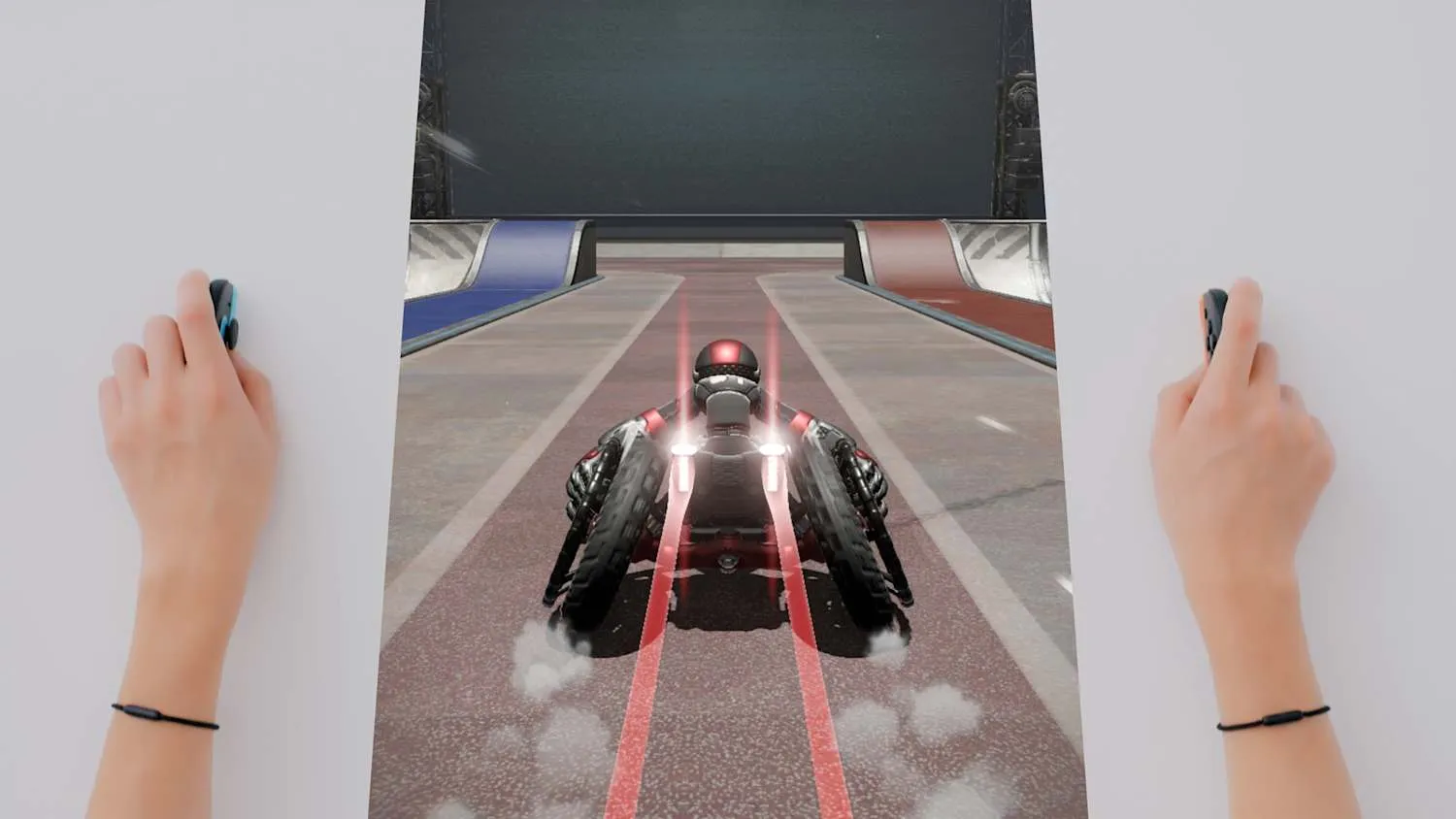
The interaction model of Drag x Drive is its most defining statement. It asks not for thumb dexterity but for full-arm commitment, a demand that redefines the relationship between player and avatar. You place the two Joy-Con controllers on a surface, and with rhythmic, sliding motions, you propel your digital self forward. Each controller corresponds to a single wheel, creating a direct, one-to-one relationship between physical effort and in-game locomotion.
The triggers act as brakes, allowing for abrupt stops or, when one is applied, sharp, momentum-preserving pivots. The initial phase of this learning process is one of profound awkwardness. It is a period of wrestling with the hardware, where the mind’s intent is betrayed by clumsy, tiring execution. This initial struggle is a form of unlearning, a shedding of the muscle memory accumulated over decades of standard gamepad use.
This process is reminiscent of the Zen concept of shoshin, or “beginner’s mind,” which requires an emptying of preconceptions to achieve true understanding. You must abandon the idea of a controller as a set of abstract inputs and embrace it as a physical tool. When mastery finally arrives, it feels less like learning a system and more like acquiring a skill.
The clumsy gestures are replaced by a fluid, almost unconscious grace. This is where the game’s design brilliance resides, in its successful translation of a complex physical act into a satisfying digital mechanic. The haptic feedback enhances this connection, with subtle clicks from the controllers simulating the tread of the wheels on the court. It is a pursuit of a deeper immersion, one that attempts to engage the player’s sense of touch as a primary medium.
This focus on physicality, however, opens a complex and contradictory dialogue. The game’s very premise is based on wheelchair basketball, an adaptive sport created to allow for athletic competition. Yet, Drag x Drive is intensely physically demanding. Extended sessions can lead to genuine arm and wrist fatigue. The system’s performance is also deeply dependent on the player’s physical environment.
The need for a perfectly flat, smooth surface creates a strange ritual; one must find the right desk, the right table, or even, as some have noted, the right pair of trousers to wear for optimal play. The game’s mechanics create a friction point with the real world that is both unique and problematic. It is in this friction that a deep irony emerges.
A game drawing inspiration from a symbol of accessibility becomes, through its own mechanical insistence, deeply inaccessible. It offers no alternative control schemes, no way for players with certain physical limitations to participate. This feels like a significant cultural blind spot, a relic of a design philosophy that prioritizes mechanical purity over inclusive design, a value that has become a major point of discussion and innovation in Western game development.
The Grammar of the Game
Once the physical language of movement is acquired, the player can begin to understand the game’s particular syntax on the court. Drag x Drive abstracts the sport of basketball into a set of clean, arcade-style rules that prioritize action over simulation. The system of offense is built on a fundamental dichotomy between efficiency and expression.
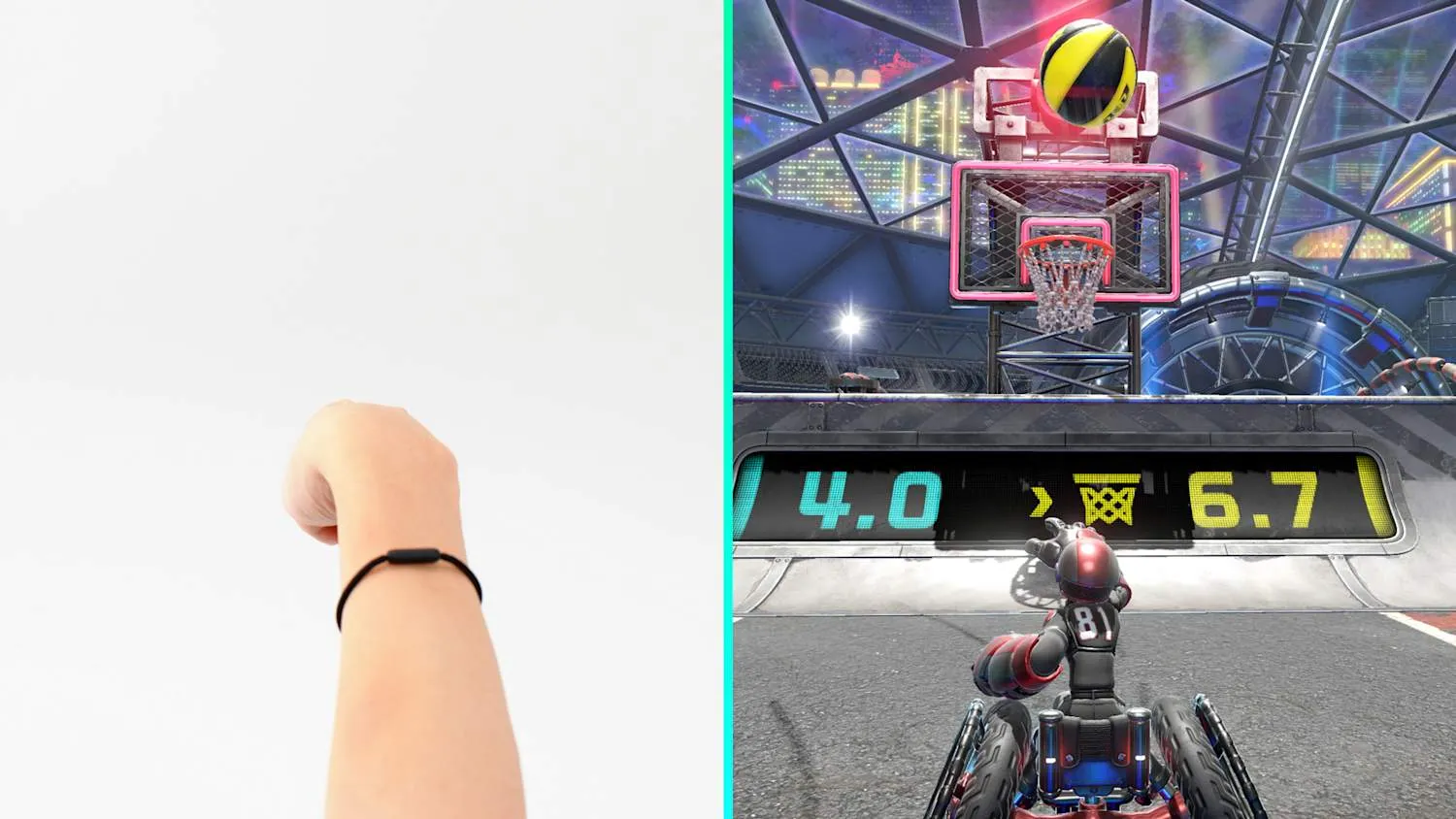
Basic two-point shots are strikingly simple to execute. A flick of the wrist while in the general vicinity of the basket results in a near-guaranteed score, the game’s aim-assist being remarkably generous. This design choice ensures a constant flow of action and keeps the score ticking, maintaining a high tempo. In contrast, the game offers a vocabulary of more expressive, stylish maneuvers. Players can launch off ramps for powerful dunks or execute complex spins and bunny hops for fractional point bonuses.
These advanced techniques, however, exist in a strange tension with the game’s core loop. While they are visually rewarding, their execution in the heat of a match is described as difficult and unreliable. The risk of fumbling a complex trick often outweighs the minor reward, meaning the most effective strategy is frequently the most monotonous: a repetitive cycle of gliding close to the net and flicking for an easy two points. This creates a mechanical dissonance.
The game teaches an expressive language but functionally rewards only its simplest phrases. A comparison to a game like Rocket League is revealing. In that title, advanced aerial maneuvers are a high-risk, high-reward proposition that becomes essential for top-tier play. In Drag x Drive, the tricks feel more like optional filigree than a core component of competitive strategy.
The approach to team play also reflects a specific cultural design sensibility. Communication is limited to a few preset text commands, simple affirmations like “Cool” or “No prob.” This eschews the open voice chat common in Western multiplayer games, favoring a system that fosters a more reserved, observational style of cooperation.
Teamwork becomes a “silent bond,” built on anticipating a teammate’s movement and reading the flow of the game rather than on explicit verbal commands. Defense is similarly precise and unforgiving. A steal requires a perfectly aligned, head-on collision with the ball carrier. Any slight miscalculation in angle results in a glancing blow or a complete miss, leaving you out of position.
This makes defense a demanding exercise in predictive geometry and precise control. The result is a gameplay experience that feels distinctly Japanese in its arcade DNA: fast, mechanically focused, and built around a system of simple rules that create a surprisingly deep well of strategic possibilities.
A World Without a Soul
A mechanical system, no matter how refined, requires a compelling context to give it meaning. It is here, in the world built around the on-court action, that Drag x Drive falters most profoundly. The game’s aesthetic is one of stark, almost clinical minimalism. The hub world, called “The Park,” and its lone basketball arena are rendered in a palette of flat grays and muted tones.
The environment evokes the sterile functionality of a newly built parking garage or a corporate plaza. This generic, placeless quality stands in sharp contrast to the vibrant, culturally saturated worlds Nintendo is known for creating. Compare this to the energetic Shibuya-inspired street culture of Splatoon or the exuberant character designs of Arms.
Drag x Drive feels culturally unmoored, as if its aesthetic was scrubbed clean of any specific identity to appeal to a nebulous global market. Its customizable avatars are featureless robots, blank slates upon which players can apply only the most superficial of changes.
This lack of identity is compounded by a near-total absence of meaningful progression. In many games, particularly those from Japan, the player’s journey of mechanical mastery is mirrored by a narrative of growth, signified by new gear, rising ranks, and unlocking new abilities. This structure gives the player’s effort a sense of purpose. Drag x Drive offers the path to mastery but provides none of the symbolic rewards.
The unlockables are limited to a handful of uninspired helmet designs and color swaps. There is no leveling system, no ranked ladder, and no compelling reason to engage with the side activities beyond their initial novelty. This failure to provide a rewarding meta-structure disconnects the player’s effort from any lasting sense of achievement.
The game’s structure hints at the foundations of a Western-style “live service” model, with a low entry price and a hub designed for ongoing social interaction. Yet, it lacks the content and compelling reward loops necessary to build and sustain the community such a model requires. It is a framework without a picture, a stage without a play. This creates a final, overarching paradox.
The game is a product of a distinctly Japanese hardware-centric design philosophy, resulting in a brilliant and unique mechanical core. This core, however, is encased in a culturally anonymous shell and supported by a progression system that fails to satisfy either Eastern or Western design expectations. It is a fascinating technological demonstration, an engine of immense potential, but one that is ultimately stranded without a compelling world to drive through.
The Review
Drag x Drive
Drag x Drive introduces a brilliant and physically engaging control scheme, a testament to Nintendo's legacy of hardware innovation. This remarkable mechanical foundation is squandered within a hollow package. A sterile aesthetic, a severe lack of content, and a nonexistent progression system strip away any long-term motivation. It is a fascinating proof-of-concept that tragically fails to become a complete game, feeling more like a tech demo than a lasting experience.
PROS
- Innovative and deep motion control scheme that is satisfying to master.
- Fast-paced and engaging core 3v3 match gameplay.
- Unique kinetic feel that differs from standard sports titles.
CONS
- Severe lack of content, including modes, maps, and unlockables.
- Sterile art style and generic presentation lacking any personality.
- Mandatory physical controls create a major accessibility barrier.
- Shallow progression systems offer little reason to continue playing.