

























“I’m scared, come and get me.” The voice is small, trembling, and belongs to six-year-old Hind Rajab. Her words, recorded on January 29, 2024, are not a reenactment. They are an artifact from the final hours of her life, and they form the unflinching center of Kaouther Ben Hania’s new film.
The Voice of Hind Rajab places its audience inside the Palestine Red Crescent Society call center in Ramallah, where emergency workers listened to Hind’s pleas from a car in Gaza, surrounded by the bodies of her family.
The film constructs a meticulous dramatization around this authentic audio, chronicling the team’s attempt to mount a rescue against a wall of procedural and military obstacles. It becomes an examination of institutional paralysis and a portrait of a modern tragedy, forcing a confrontation with the human toll of conflict by making us listen to a voice that was tragically lost.
The Evidence of Sound
The film’s foundation is the seventy-minute audio file of Hind’s calls, a raw document of escalating fear. Her real voice, unfiltered and unperformed, gives the work its devastating authenticity. The sonic texture is uncomfortably intimate; we hear not just her words but the very air in the car, the silences that stretch between her pleas and the responders’ attempts at reassurance.
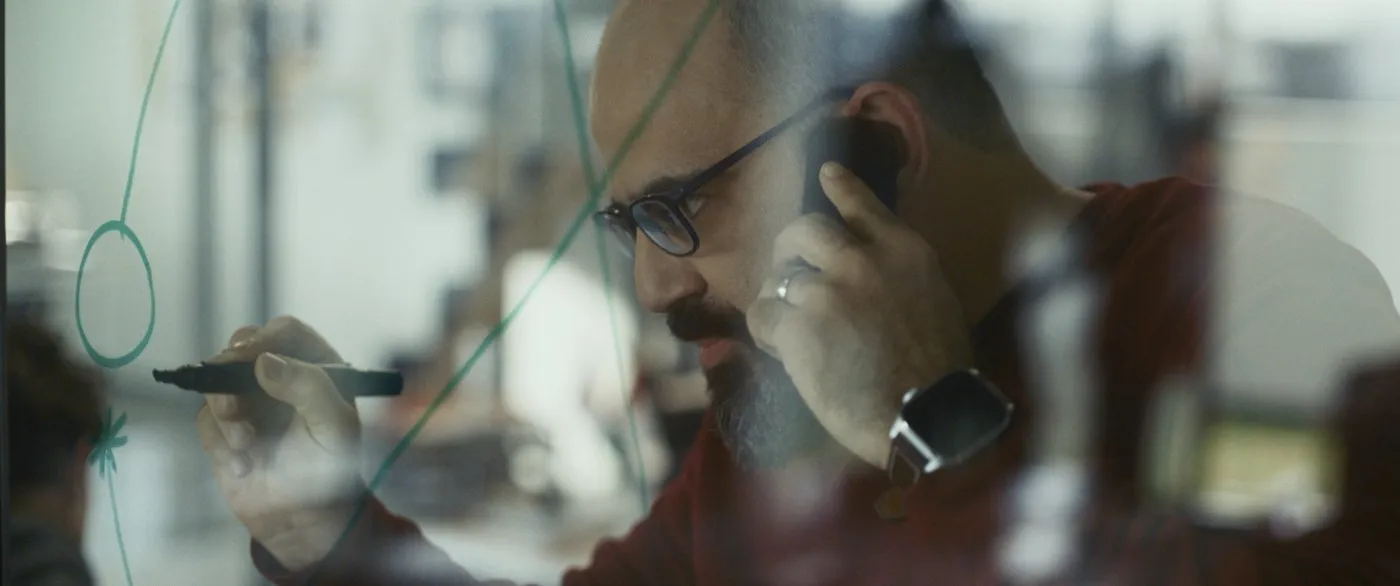
We hear the innocent cadence of a child who at first describes her relatives as “sleeping,” a statement that gives way to the stark clarity of “they’re all dead.” This is the documentary core around which the fiction revolves. Director Kaouther Ben Hania resists any impulse to visualize Hind’s ordeal. This deliberate restraint is the film’s most critical choice. When Hind speaks, the screen fills with the green pulse of abstract sound waves or holds on the faces of the responders.
The effect is profound; denied the spectacle of violence, the viewer is required to listen with an unnerving focus, to construct the scene from the terror in her voice alone. This choice transforms the audience from passive spectators into active participants in the act of listening. The recording functions as irrefutable evidence, a direct transmission that grounds the surrounding drama in a harrowing, undeniable truth.
The Clean Room of Despair
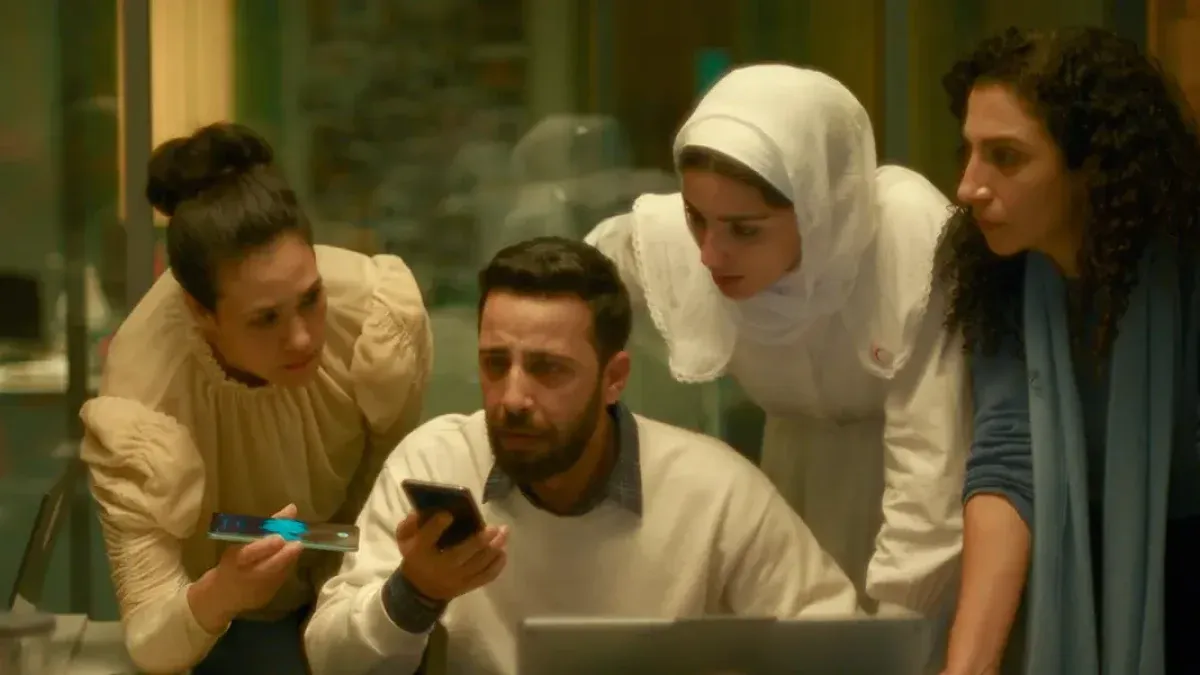
The action unfolds entirely within the Palestine Red Crescent Society office, a space of beige workstations, glass partitions, and blinking computer monitors. This pristine normality creates a sharp disconnect with the chaos filtering through the headsets. The office becomes a pressure cooker, its modern sterility a cruel counterpoint to the life-or-death situation at hand.
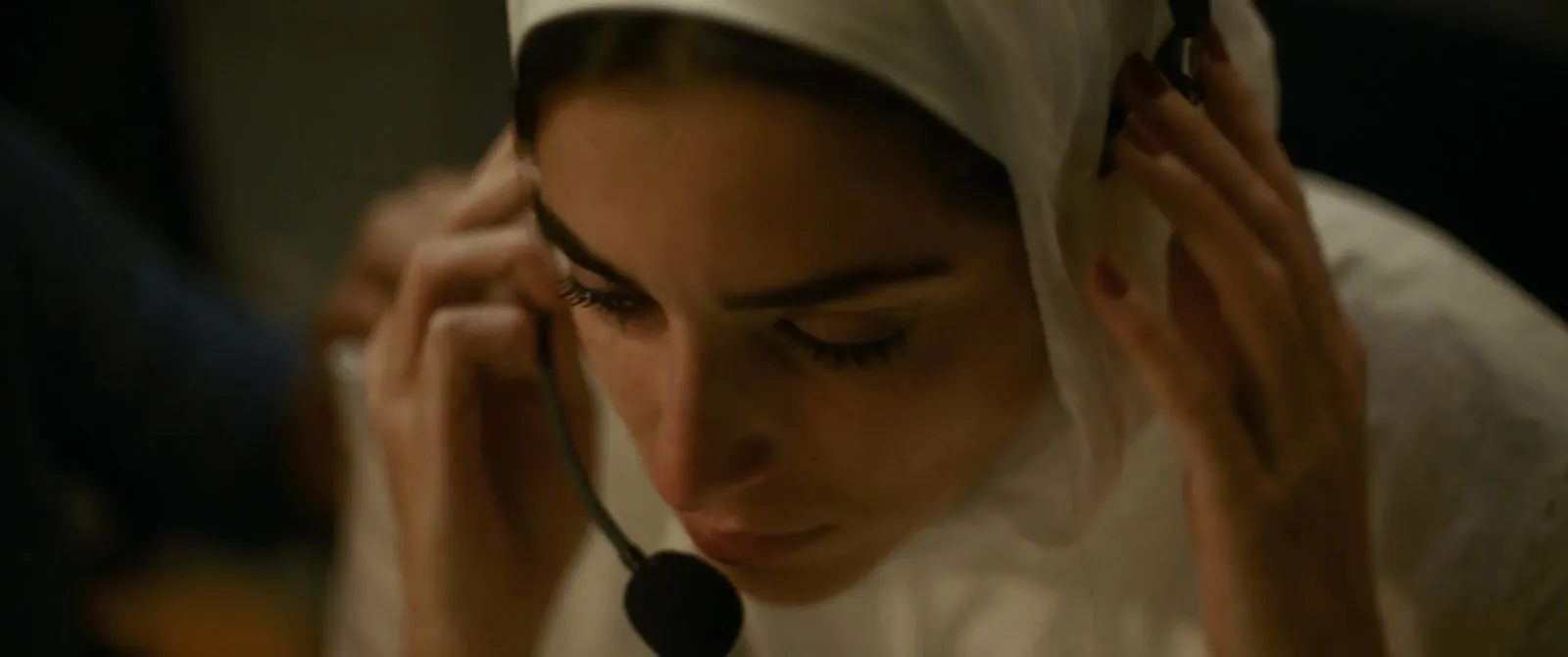
The responders become surrogates for the audience, able to hear the horror but trapped at a physical remove, their faces a canvas for the unseen events. The film introduces four key figures who represent different facets of the human response. Omar (Motaz Malhees) is the first to take the call; he embodies a fiery impatience and the desperate need to act, his frustration boiling over into rage.
Rana (Saja Kilani) takes over communication with Hind, her gentle tone a study in the immense emotional labor of providing comfort in an impossible situation. Their supervisor Mahdi (Amer Hlehel) is a pragmatist, his caution born from a deep, scarring understanding of the risks. He weighs the life of one child against the potential loss of a rescue crew.
Finally, Nisreen (Clara Khoury) attempts to manage the immense psychological strain on her colleagues with steady breathing exercises. The actors perform opposite a real voice, and their reactions of shock, grief, and fury must bridge the space between the staged drama and the documented event. Their pained expressions and tense arguments give a physical form to the disembodied tragedy.
An Infinity of Waiting
The film’s primary antagonist is not a person but an impassive, deadly system. The central conflict stems from the team’s inability to dispatch an ambulance, located just minutes away, without receiving clearance from the Israeli army. This procedural blockade forces the characters into a maddening cycle of phone calls and waiting, a bureaucratic labyrinth with fatal consequences.
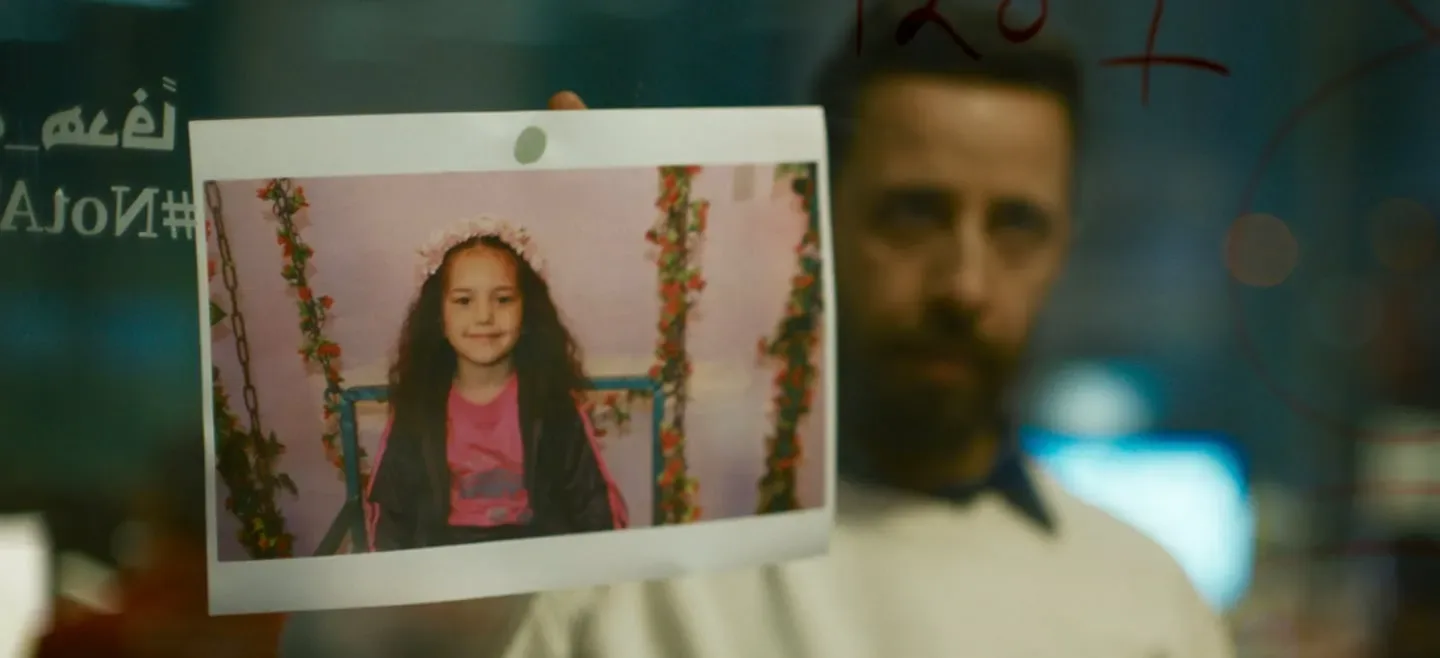
Mahdi maps out the approval chain on a whiteboard, the tangle of steps and sub-steps forming a pattern that resembles an infinity sign, a visual metaphor for their hopeless, looping situation. Tension builds not through action but through its agonizing absence. The camera lingers on digital maps showing an ambulance’s slow progress through rubble-strewn streets and on the numbers Omar writes on a glass wall, marking the passing hours.
This procedural focus is a direct commentary on the mechanics of control. The heated arguments between Omar, who yells that quiet compliance is the reason for their occupation, and Mahdi, who points to a memorial wall of fallen paramedics, articulate the impossible choices faced by those on the ground. Mahdi’s caution is not cowardice; it is the product of trauma, a defense against sending more people to their deaths.
A Discomfiting Instrument
The film’s visual language supports its urgent, nerve-shredding tone. Handheld cameras create a sense of immediacy and instability, mirroring the frayed state of the characters. Claustrophobic framing keeps the focus tight on the responders’ strained faces, trapping them within the confines of their office.
The harsh, flat fluorescent lighting strips the scene of any cinematic glamour, refusing to beautify the grim reality of the work. This formal approach, however, sits atop a difficult ethical question. Is it appropriate to place the authentic voice of a deceased child within the framework of a suspenseful drama?
The hybrid form makes Hind’s story accessible, giving it a narrative shape that a pure documentary might lack. Yet it also risks instrumentalizing a real tragedy, layering thriller tactics over material that requires no emotional amplification. The film is a blunt and discomfiting instrument, and the questions it raises about the responsibilities of representation are a key part of its complex, unsettling effect.
The Demand to Listen
The film functions as a memorial. Its purpose is to serve as an elegy for Hind and for the two paramedics, Yusuf al-Zeino and Ahmed al-Madhoun, who were killed attempting to save her. The inclusion of their photographs solidifies the work as an act of public mourning. Its lasting impression is one of profound sorrow. It insists that the world bear witness by listening.
“The Voice of Hind Rajab” is a 2025 docudrama film directed and written by Kaouther Ben Hania. The film, with a runtime of approximately 89 minutes and in Arabic, premiered at the Venice International Film Festival on September 3, 2025, followed by a screening at the Toronto International International Film Festival on September 7, 2025.
Full Credits
Director: Kaouther Ben Hania
Writers: Kaouther Ben Hania
Producers: Nadim Cheikhrouha, James Wilson, Odessa Rae, Lina Chaabane Menzli, Baptiste Leroy
Executive Producers: Brad Pitt, Joaquin Phoenix, Rooney Mara, Alfonso Cuarón, Jonathan Glazer, Dede Gardner, Jeremy Kleiner, Karim Ahmad, Samar Akrouk, Badie Ali, Hamza Ali, Sawsan Asfari, Farhana Bhula, Geralyn White Dreyfous, Sabine Getty, Frank Giustra, Jorie Graham, Ted Haddock, Ali Jaafar, Amed Khan, Jemima Khan, Mohannad Malas, Francesco Melzi d’Eril, Gabriele Bebe Moratti, Stephanie Nadi Olson, Hana Al Omair, Guillaume Rambourg, Sarah Rambourg, Michella Rivera-Gravage, Ramez Sousou, Tiziana Sousou, Elizabeth Woodward
Cast: Saja Kilani, Motaz Malhees, Clara Khoury, Amer Hlehel
Director of Photography (Cinematographer): Juan Sarmiento G.
Editors: Qutaiba Barhamji, Maxime Mathis, Kaouther Ben Hania
Composer: Amine Bouhafa
The Review
The Voice of Hind Rajab
The Voice of Hind Rajab is a profoundly difficult and essential film. Its use of real audio is a devastatingly effective choice that transforms the viewer into an active, implicated listener. While its hybrid docu-fiction form raises complex ethical questions, the film succeeds as a powerful act of witness. It is a harrowing, unforgettable experience that demands to be heard and felt, serving as a memorial that is both artistically constructed and terrifyingly real.
PROS
- The use of Hind Rajab’s authentic audio provides a raw, undeniable emotional core.
- Director Kaouther Ben Hania’s visual restraint is a respectful and effective choice, focusing on listening over watching.
- Strong, believable performances from the actors playing the call center staff.
- The film works as a sharp critique of bureaucratic paralysis in the face of human crisis.
CONS
- The docu-fiction structure raises complicated ethical questions about incorporating real tragedy into a suspenseful narrative.
- For some, the dramatized elements may feel manipulative or unnecessary given the power of the source material.
- The viewing experience is exceptionally sorrowful and emotionally grueling.