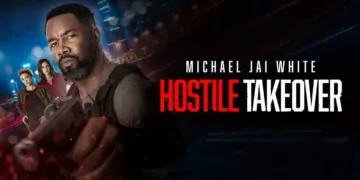


















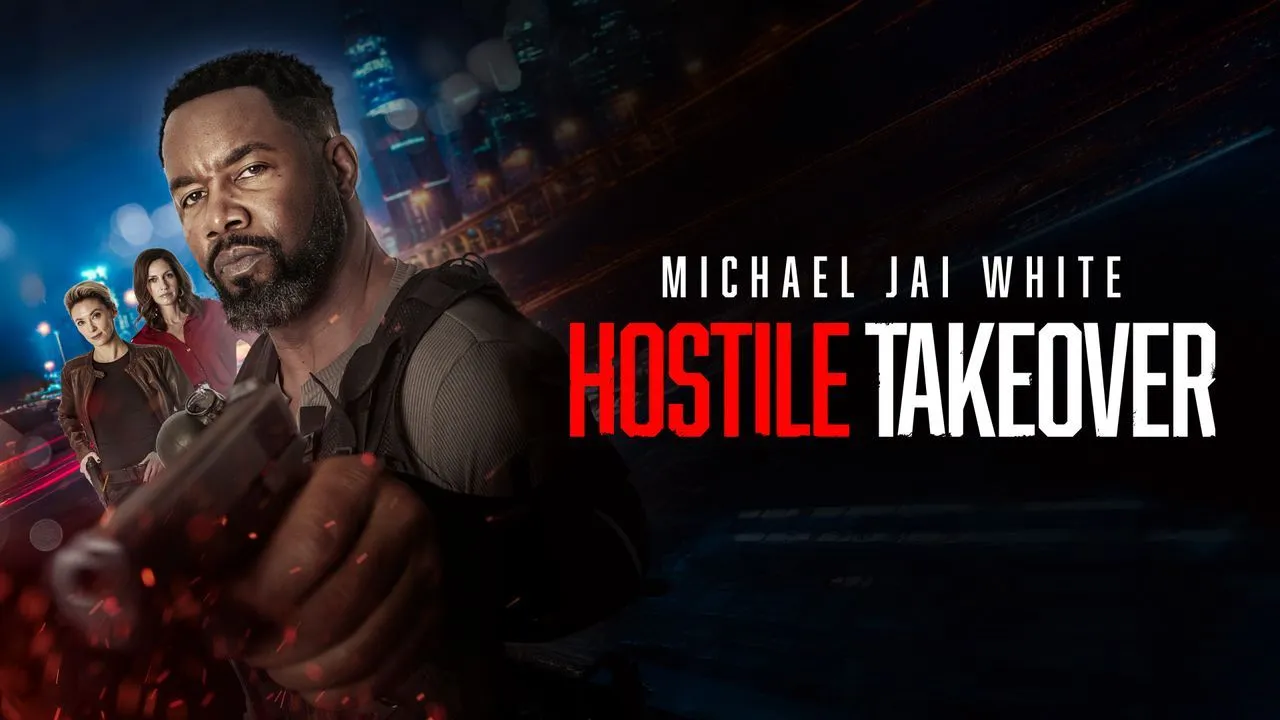

Hostile Takeover plays the action genre with a breezy tone, following Pete, an aging professional hitman portrayed by Michael Jai White. Pete loves his work and says it keeps him alive. From the opening scenes the film signals a self-aware, cult-adjacent vibe, using meta narration and playful, video-game-style interstitials to introduce characters.
The emotional center sits with Pete’s search for a workable routine that lets him build a relationship with his boss’s daughter, Mora. His decision to attend “Workaholics Anonymous” meetings kicks off the plot. A listening device turns up in mob boss Matteo Arcado’s office, the boss suspects Pete is informing, and a bounty lands on Pete’s head.
Co-workers and rival assassins move from colleagues to threats. The film frames itself as a casual take on hyper-stylized hitman stories and leans on Pete’s ordinary domestic hopes in stark tension with the brutality of his day job.
Narrative Misalignment and Pacing
The story pivots away from the hard-hitting action that Michael Jai White often anchors and aims for a pseudo-comedy. That mix wobbles. Practical gore, cheeky self-references, and running jokes about Pete’s accent mimicry or missed social events appear throughout, yet the laughs rarely land.
The film never embraces an out-and-out comedy approach in the spirit of Black Dynamite, so the tone drifts. Plot functions as a thin scaffold. A minor misunderstanding keeps the stakes low and mainly strings together a route for Pete to meet and then fight colleagues across a lineup of set pieces.
This structure mirrors a level-based game loop. Pete arrives, trades quips, confronts a grievance, and enters combat. Assassins such as Reaper, Mingjue, and Thanatos act like boss gates rather than fully realized characters. The pattern gives the film a clear mechanical rhythm, yet it drains urgency. The romance with Mora remains underdeveloped, so the emotional meter stays flat. Pacing suffers because the beats feel queued rather than earned. The experience becomes a checklist of obstacles where advancement replaces escalation.
The Strain on Cinematic Technique
The direction struggles to stitch together slapstick tone and action delivery. Choreography moves at a slower tempo than fans expect from White. His form stays precise and controlled, yet the measured speed foregrounds his age, described as nearly 60, and that brief dissonance can pull attention from the fight. White performs his own stunts, which avoids the kind of chopped-up editing that hides action in many vehicles for older stars. The choice respects viewers who want to read technique in the frame.
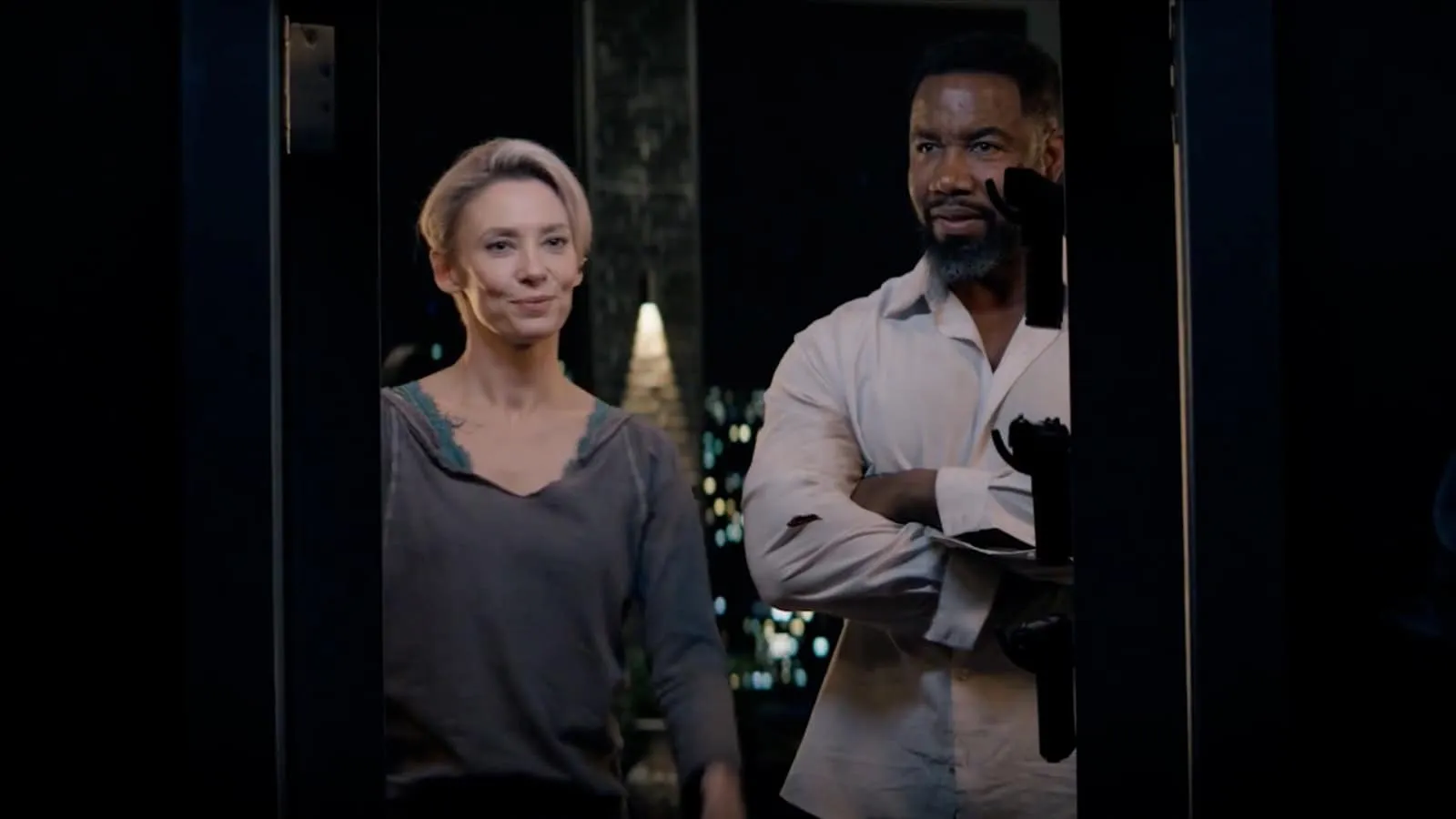
Image and sound do not provide the same lift. Lighting and shot choices sit in a generic register, which leaves a faint low-budget sheen. Blood effects look unconvincing and computer work varies in quality. The sound mix leans on stock hits, while the music cues resemble copyright-free filler.
Production design tries to sell a Canadian soundstage as New York City. The idea works on paper, yet the execution stays simple and unremarkable. The result is a film whose mechanics are visible, whose intentions are clear, and whose craft often feels functional rather than expressive.
Performance and Character Depth
Michael Jai White carries the film with a committed turn that plays a hitman’s domestic headaches for light comedy. He steps into the timing and gives Pete a steady center. The ensemble operates as a gallery of types, and that design suits the game-like progression even as it limits dimension. Aleks Paunovic’s dodgeball-obsessed Reaper provides a welcome spark, and scenes between White’s Pete and Aimee Stolte’s Mora have easygoing banter that fits the movie’s lighter aim.
Most of Pete’s opponents register as single-note personalities that function as hurdles or punchline engines. They deliver a theme-park sense of variety without deepening the narrative path. Pete’s core conflict remains relatable. He wants a life outside contracts and a schedule that fits love and routine. White’s earnest work keeps that thread visible and readable even as the script leaves little room to expand his interior world. He holds the frame and supplies the movie’s balance point, while the surrounding scenes often treat character as a mechanic that sets up the next exchange and the next fight.
Hostile Takeover reads like a designer’s sketchbook where structure borrows from game loops and character introductions pose as splash screens. That approach can build momentum when the loop rewards progress with fresh emotion. Here the loop favors repetition. The piece still offers a clear path for viewers who enjoy watching White’s clean technique and a handful of playful beats. The film’s heart sits in the wish for work-life equilibrium, and that simple target gives Pete a readable motive even when the style, pacing, and technical package struggle to match it.
Hostile Takeover is an action-comedy film that premiered in the US in a limited release on August 8, 2025. The movie centers on Pete (Michael Jai White), a professional hitman who finds himself targeted by his own crime syndicate after his attendance at “Workaholics Anonymous” meetings leads his boss to mistakenly suspect him of disloyalty. This misunderstanding kicks off a kinetic thriller blended with dark humor. The movie is available on various platforms; for instance, it was scheduled to stream on STARZ starting November 1, 2025.
Credits
Director: Michael Hamilton-Wright
Writers: Michael Hamilton-Wright, Burton L. Warner
Producers and Executive Producers: Michael Hamilton-Wright, David Cormican, Jaclyne Bohn, Juliette Hagopian, Jeffrey Giles, Lawrence Greenberg, Christina Laughlin, Michael Lurie
Cast: Michael Jai White, Aimee Stolte, Dawn Olivieri, Aleks Paunovic, Alex Mallari Jr., Damon Runyan, John Littlefield
Director of Photography (Cinematographer): Dante Yore
Composer: Kevon Cronin
The Review
Hostile Takeover
Hostile Takeover attempts to fuse action and comedy but struggles with commitment to either genre. Michael Jai White’s dedicated effort to play the aging hitman seeking balance is the strongest element. The plot is thin, acting mainly as a vehicle for predictable fight sequences. While the choreography is admirable for White’s age, the inconsistent pacing, generic visuals, and weak comedic payoffs prevent the film from achieving the cult status it aims for. It offers sporadic moments of charm but mostly remains a mediocre experience.
PROS
- Michael Jai White’s dedicated performance and visible commitment to stunts.
- The lighthearted, self-aware tone offers moments of charm.
- Some supporting characters (like Reaper) are quirky and memorable.
CONS
- The comedy aspect is inconsistent and frequently falls flat.
- The action choreography is noticeably slowed, often feeling strained.
- Generic and forgettable cinematography and visual effects (CGI blood, stock sounds).
- The central plot is thin, lacking dramatic urgency or depth.