













A shared existence does not fracture; it hollows out from within. The structural supports corrode in silence over years, until the edifice of a relationship stands only by habit. Bradley Cooper’s Is This Thing On? understands this quiet entropy. It foregoes the explosive demolition for a patient survey of the wreckage. We are introduced to Alex (Will Arnett) and Tess (Laura Dern) not in the heat of conflict, but in the sterile calm of its aftermath, their decision to separate announced over the mundane ritual of dental hygiene. Their long marriage ends with the whir of an electric toothbrush.
This is a film that begins in the void, after the life has been lived. Alex drifts into a city apartment, a blank canvas of bachelorhood that feels more like a cell. Tess remains in the suburban home, now a mausoleum of shared histories. From this state of profound dislocation, Alex makes a choice born of absurdity and thrift: to avoid a fifteen-dollar cover charge, he signs up to perform stand-up comedy. The act is a flicker of defiance against the encroaching emptiness, an attempt to find a new vocabulary for a self that has become a foreign country.
The Spotlight as Scalpel, The Court as Ghost
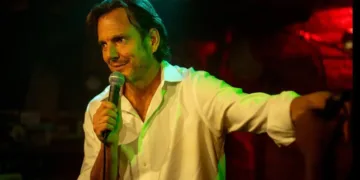
Will Arnett has long perfected a persona of the articulate sad sack, and here he refines it into a vessel of genuine existential ache. His Alex is a man whose sardonic armor has been stripped away, leaving only the raw nerve of bewilderment. The comedy club stage becomes his confessional, a starkly lit platform where he can perform a public autopsy on his own life. The microphone is a scalpel with which he lays bare the private agonies and absurdities of a dying union.
This is not comedy as catharsis, but comedy as a desperate philosophical inquiry, an attempt to make sense of the self by deconstructing its recent history for the amusement of strangers. Every strained laugh he earns is a temporary proof of his own existence. Laura Dern’s Tess follows a divergent, quieter path toward reclamation. Her journey is one of somatic rediscovery. She returns to the volleyball court, a domain of physical certainty and instinctual movement.
Where Alex uses words to map his internal chaos, Tess uses the percussive rhythm of a ball against a wooden floor to reconnect with a version of herself that predates the compromises of partnership. It is a dialogue with her own body, a non-verbal search for an identity forged in sweat, not sentiment. Their scenes together are heavy with the ghosts of intimacy. They navigate conversations with the lethal precision of two people who know each other’s deepest vulnerabilities, their shared language a tapestry of remembered affections and carefully stored resentments.
A Gaze Held Too Close
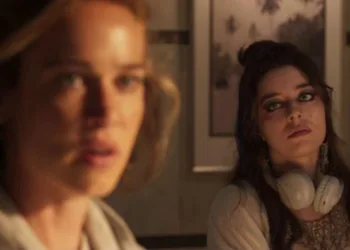
Bradley Cooper, as director, sheds the operatic scale of his earlier films for something far more unnerving: a sustained, unflinching intimacy. His aesthetic here is one of patient, almost forensic observation. With cinematographer Matthew Libatique, he crafts a visual language of claustrophobia.

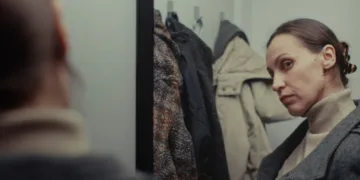
The camera is a persistent interrogator, pushing into tight, invasive close-ups that deny the characters any refuge. It maps the geography of their faces, searching the subtle shifts in expression for the tectonic movements of unspoken grief. Cooper favors long, unbroken takes that stretch time, forcing the viewer to marinate in the awkwardness and the heavy, unarticulated spaces between words. This is not the comfort of naturalism; it is the discomfort of the real.
He balances this starkness with a tone of profound gentleness, locating a strange, sorrowful humor in the small indignities of separation. The film suggests that life’s most painful moments are often shadowed by the absurd.
Cooper’s own supporting role as the oafish stoner friend, “Balls,” serves a specific purpose. He is the court jester in a tragedy, a figure of such simple-mindedness that he throws the complex suffering of Alex and Tess into sharper relief. It is a choice that speaks to a mature filmmaker, one willing to deploy the grotesque to highlight the sublime weight of ordinary pain.
The Orbit of Others
Alex and Tess do not exist in a vacuum. Their personal dissolution sends ripples through a small cosmos of friends and family. This supporting cast, including Ciarán Hinds and Christine Ebersole as Alex’s parents, functions as a gallery of marital possibilities, from steadfast companionship to simmering discontent. They are living arguments for and against the institution that has failed the central couple, their own relationships serving as distorted mirrors.

Alex, meanwhile, finds a new, temporary community in the purgatorial world of the New York comedy scene. The club is rendered as a liminal space, a haven for the emotionally dispossessed. Populated by real comedians, it possesses a gritty authenticity, a place where private suffering is the common currency. The single spotlight on stage creates a stark arena for truth-telling, where the price of connection is total, unflattering exposure.
The film ultimately drifts toward a contemplation of the self as a fluid, ever-changing entity. It does not offer the false promise of repair or reconciliation. It proposes something more difficult and honest: that a great love does not vanish, but transforms into something else, a haunting presence that must be integrated. The journey is not about rebuilding what was lost, but about learning to stand within the new architecture of its absence and discover who is left.
Is This Thing On? is a 2025 American comedy-drama film that explores the complexities of a marriage unraveling, focusing on the main characters, Alex and Tess, as they navigate middle age and divorce. The film is loosely inspired by the life of British comedian John Bishop, with the story following Alex as he seeks new purpose by diving into the New York stand-up comedy scene. Directed by Bradley Cooper, the movie had its world premiere as the closing film of the 2025 New York Film Festival on October 10. The film is scheduled to be released in the United States by its distributor, Searchlight Pictures, on December 19, 2025, with a theatrical release.
Full Credits
Director: Bradley Cooper
Writers: Bradley Cooper, Will Arnett, Mark Chappell, John Bishop
Producers and Executive Producers: Bradley Cooper, Will Arnett, Weston Middleton, Kris Thykier, John Bishop
Cast: Will Arnett, Laura Dern, Andra Day, Bradley Cooper, Amy Sedaris, Sean Hayes, Christine Ebersole, Ciarán Hinds
Director of Photography (Cinematographer): Matthew Libatique
Editors: Charlie Greene
Composer: James Newberry
The Review
Is This Thing On?
Is This Thing On? is a quiet, unflinching study of marital dissolution and the strange, hollow spaces it leaves behind. Bradley Cooper's intimate direction, coupled with profoundly raw performances from Will Arnett and Laura Dern, elevates a simple story into a contemplative portrait of transformation. The film avoids easy answers, offering instead an honest, sometimes uncomfortable look at how we reconstruct ourselves from the wreckage of a shared life. It is a work less about love's end and more about the difficult, uncertain rebirth that follows.
PROS
- Will Arnett and Laura Dern deliver layered, emotionally honest performances that ground the film.
- Bradley Cooper’s use of close-ups and long takes creates a powerful, naturalistic feel.
- The history and complicated connection between the lead characters feel authentic and lived-in.
- The film skillfully navigates between genuine sadness and gentle, character-driven humor without resorting to melodrama.
- The depiction of the New York stand-up scene feels credible and adds texture to the story.
CONS
- The deliberate, slow pace may feel lethargic or tedious to some viewers.
- The stakes can feel low, and the plot leans into a gentle, sometimes predictable trajectory.
- Certain plot points, particularly how and where the main characters reconnect, stretch believability.
- Some notable actors in supporting roles are given little to do.