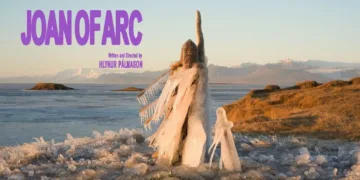



















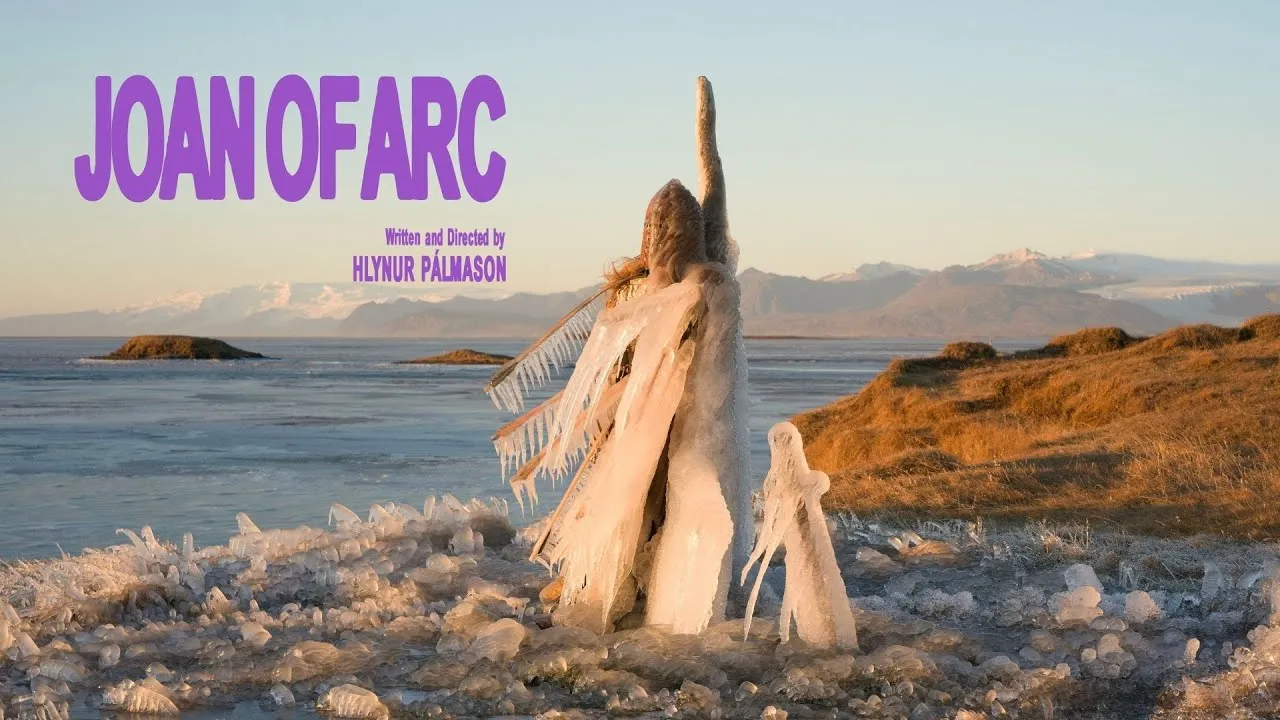

What is a name when it is detached from its body, from its history? It becomes a vessel, an empty shape waiting to be filled with new meaning, or new violence. This is the space Hlynur Pálmason’s film occupies. It begins not with a story but with a location, a desolate shore in Iceland that feels like the edge of the world. Into this tableau walk three children.
They are not characters in a conventional sense; they are small agents of an obscure will. With the gravity of priests performing a rite, they work the cold earth. They dig, they plant a wooden spine, they give it flesh made of scraps. This creation, this effigy, is then burdened with a famous name: Joan. The title is not a subject. It is an accusation, a question asked of a silent, watching landscape.
An Indifferent God’s Eye
The film’s vision is dictated by a singular, unblinking eye. A camera, fixed in one position, stares at the shore as if it were part of the geology, a witness for whom human timescales are a fleeting curiosity. This static gaze forces a severe understanding of time. There is no gentle flow. Instead, time fractures. Abrupt cuts leap across unseen months, annihilating the gradual process of change.
One moment, the land is a white sheet of snow, frozen and still. The next, it is a mire of brown mud, and then later, a shock of green under a pale sun. We are shown only the results, the stark states of being. The light conspires in this elemental vision.
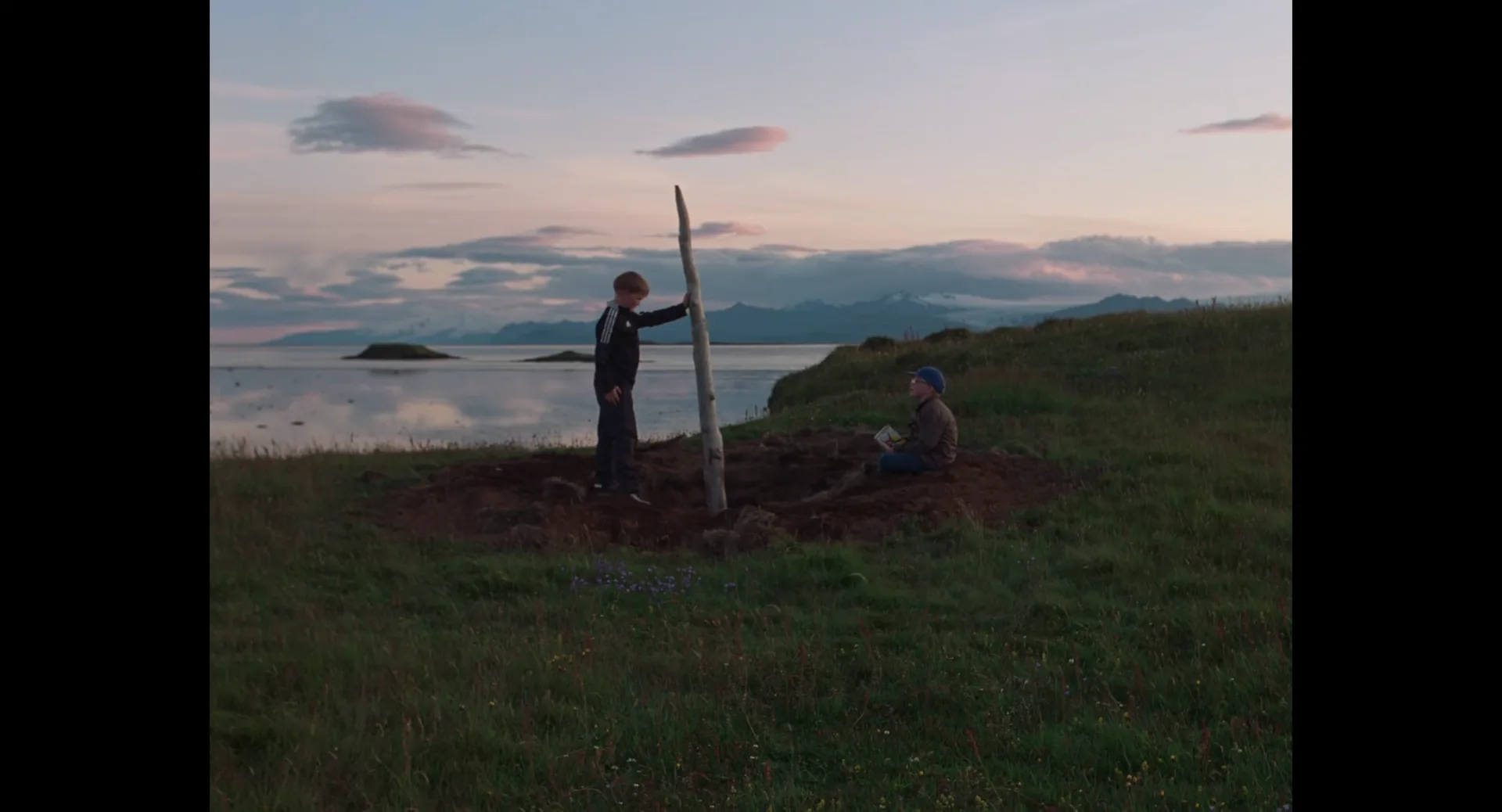
As the sun sinks, the children and their silent totem are burned into black silhouettes against a bleeding sky. They lose their individuality, becoming archetypes in a recurring drama. The nearly square frame tightens this world, a formal prison that admits no reality beyond its borders, reinforcing the claustrophobia of this endless, cyclical performance.
The Savage Garden
Within this fixed frame, a microcosm of human ritual unfolds. The children’s first act is one of sacred creation. They are builders, artisans of a new idol, and their focus is absolute. They shape their Joan with a purpose that seems to come from a deep, pre-linguistic place.
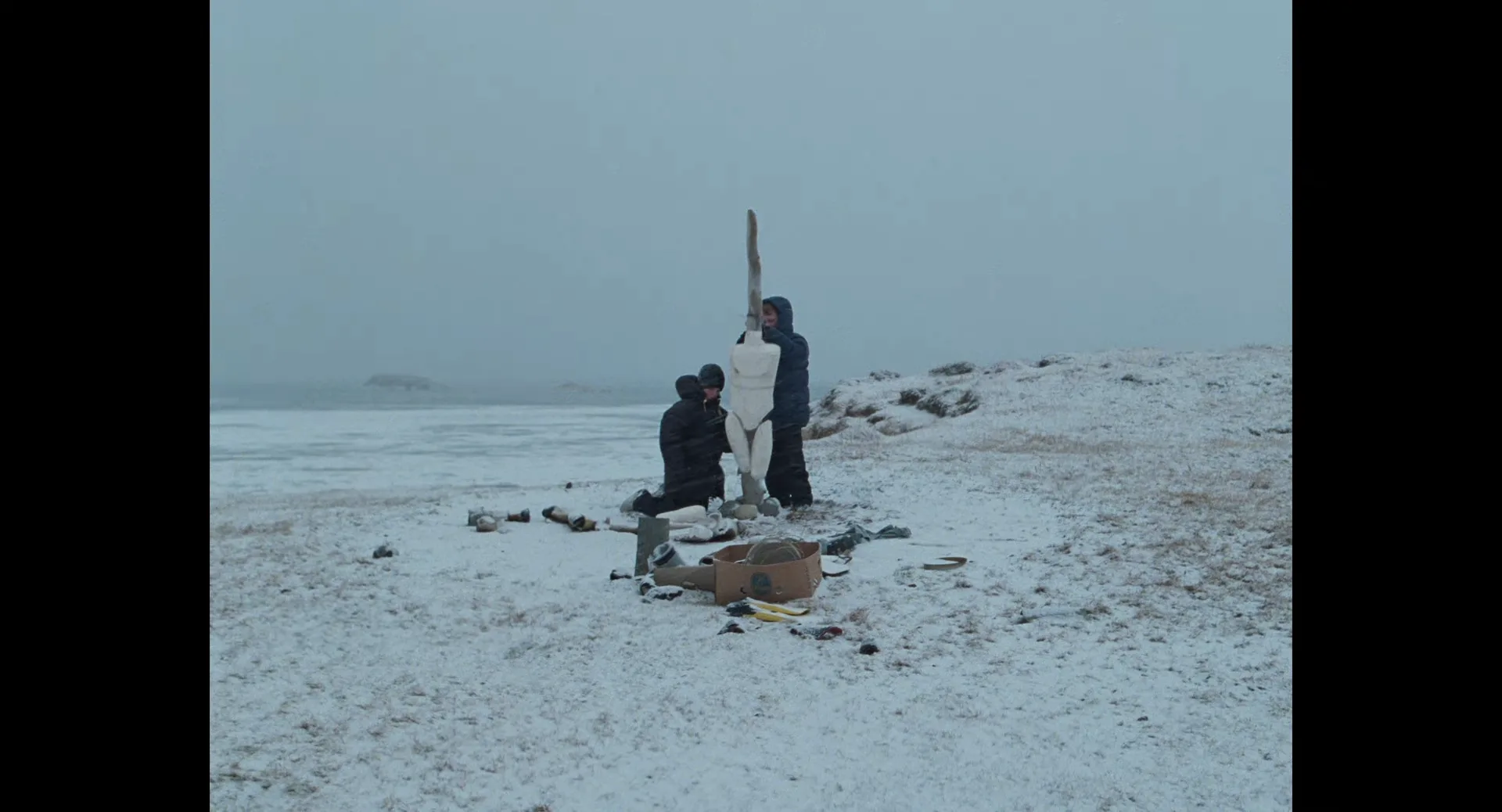
But idols exist for a dual purpose: to be worshipped and to be desecrated. The children’s reverence soon sours into a different kind of attention. The effigy, once a project, becomes a target. Their hands, which built the form, now send stones and arrows to unmake it. This is not simple play; it is a rehearsal of a dark human impulse. Their dialogue, overheard in fragments, provides a startling counterpoint. It is a raw stream of consciousness, a mix of the profound and the profane.
They discuss the violent mythologies of their viking ancestors, a heritage of conquest they are only beginning to comprehend. They speak with blunt curiosity about the mechanics of their parents’ love life. These ancient themes of identity, violence, and biology are spoken in a modern tongue, laced with English slang that feels both jarring and perfectly honest. Here is innocence and cruelty, living in the same breath.
The Hum of Existence
The film is filled with the sound of a world that does not care. There is the piercing cry of the wind, the wet suck of mud, the distant murmur of the sea. These are the acoustics of indifference. In the near total absence of a musical score, this physical world is all we hear, its presence amplified by the silence.
The children’s voices are small, transient events within this larger, nonhuman soundscape. This quiet is deliberately broken twice, at the film’s opening and its close, by the strange, synthetic notes of Isao Tomita’s electronic Debussy. The music does not belong to the landscape; it is an intrusion, an artifact of a different world. It is the sound of observation itself, framing the raw, natural scene with a sense of cold distance.
The experience of watching requires a similar distance. We are placed in the position of the static camera, unable to intervene, only to witness. The film offers no emotional release, only the hypnotic presentation of a pattern. It functions less like a narrative and more like an object for extended thought, a patient and unsettling meditation on the small, fierce cycles of creation and destruction that play out under an empty sky.
Joan of Arc (Jóhanna af örk) is a 2025 Icelandic short film directed by Hlynur Pálmason. A conceptual companion piece to his feature film The Love That Remains, it lyrically explores the Icelandic landscape and the themes of construction and demolition through the changing seasons. The film follows three siblings—the director’s own children—as they craft a knight-like figure and then use it as a target for archery practice. The short had its world premiere in the Zabaltegi-Tabakalera section of the San Sebastian Film Festival in September 2025. Information regarding a general streaming release is not yet available as it is primarily circulating the festival circuit.
Full Credits
The Review
Joan Of Arc
Joan Of Arc is not a film to be enjoyed, but an experience to be absorbed. Its unflinching, static gaze forces a confrontation with the cyclical nature of creation and destruction, locating these grand human dramas within the unthinking games of children. A hypnotic and deeply unsettling work of pure cinema, it offers no comfort, only a stark, memorable vision of existence.
PROS
- A powerful and singular formal vision, using a fixed camera to expertly manipulate time and landscape.
- Explores profound philosophical ideas about nature, ritual, and the roots of human violence.
- The observational style creates a deeply atmospheric and immersive mood.
- Authentic and naturalistic depiction of childhood, with dialogue that feels entirely unscripted.
CONS
- Its extremely patient pace and lack of a traditional narrative will prove alienating for many viewers.
- The minimalist approach may feel sparse or uneventful for those accustomed to conventional cinema.
- Requires a significant amount of focus from the audience, feeling more like a gallery installation than a film.
- Frequent use of silhouettes, while artistic, can obscure the on-screen action.