


























The village fête has long served as a reliable engine for dramatic upheaval. Santosh Davakhar’s first feature, Gondhal, seizes that potential right away and plants its psychological thriller inside a sacred Maharashtrian ritual. The result feels like a meticulous, culturally rooted experiment in Marathi cinema, precise in form and quietly ambitious.
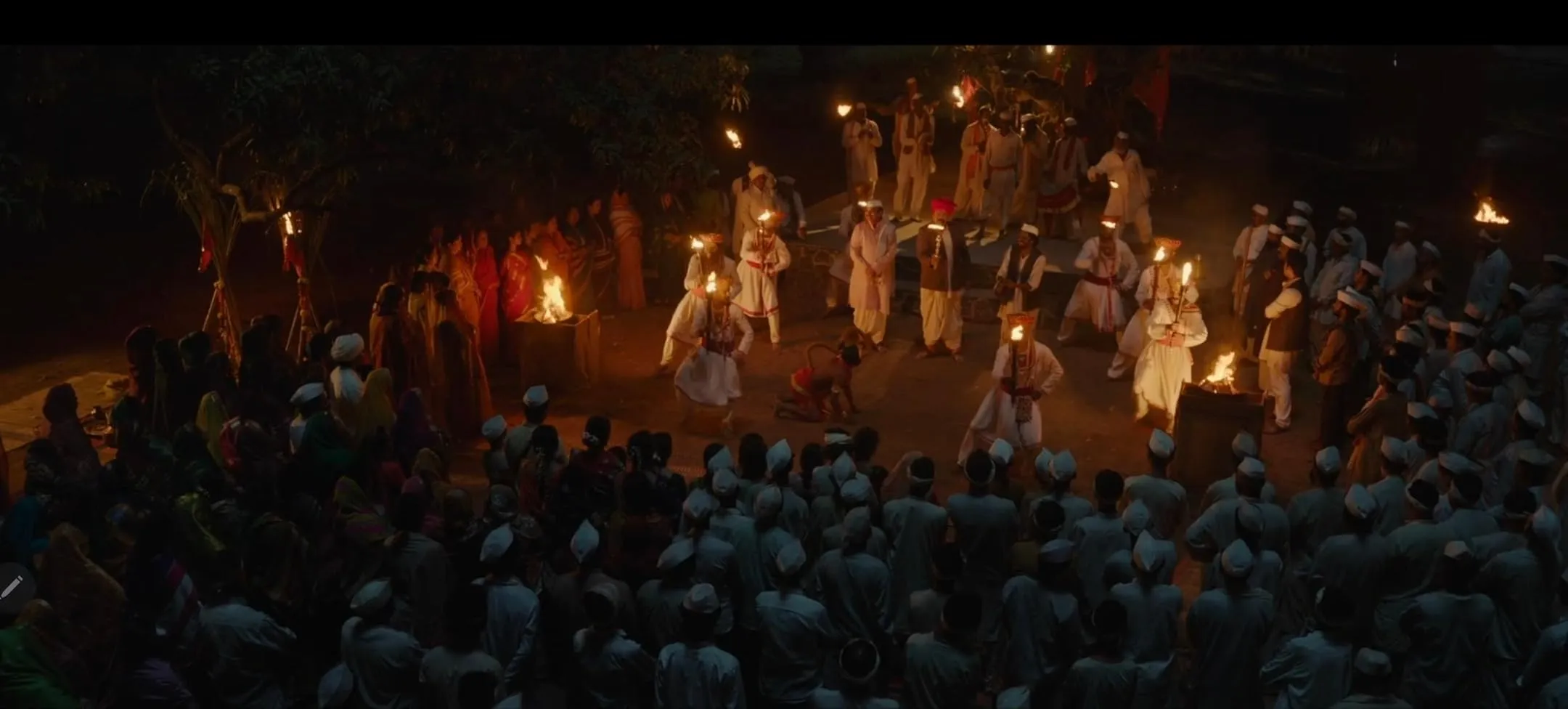
The premise sounds almost plain spoken: the story plays out over a single night during a “gondhal” performance, a ritual of music and dance that blesses a new marriage and drives away malign forces. Compression does the heavy lifting here. One night, one space, an entire moral universe squeezed into a courtyard until it begins to sweat.
Davakhar builds immersion with disarming confidence. The opening stretch moves in an unbroken, steady flow, carving out atmosphere and sketching the village’s social hierarchy with care. That early density of detail gives the film a firm base for the chaos that follows.
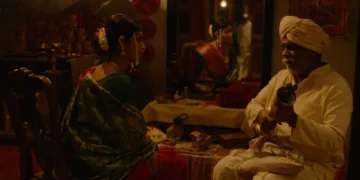
The sacred ceremony gradually reveals itself as a finely lit stage for very human vanity and fear. Under the chants and percussion beats runs a familiar melodrama of secrets, romantic resentment, ego, and corrupt power clustered around the bride Suman, who finds herself hemmed in by three would-be partners. Gondhal announces a filmmaker with a sharply defined sensibility.
Archetypes, Allegory, and the Social Contract
Davakhar works with the classic machinery of romantic melodrama and treats it like a philosophical test case. A direct story, set from dusk to dawn, becomes a pressure experiment in which every look and half-sentence carries immediate weight. The one-night structure behaves like a social contract written in real time (with no appeals court), then stressed to breaking point.
The characters arrive as purposeful figures in this design. Suman, the beautiful bride, stands as the coveted object of desire and negotiation. Andya, the groom, appears gentle and unassuming, a man others underestimate. Sarjerao, the patil’s entitled son, bristles with wounded pride and vengeful anger.
Saheba, the performer who represents Suman’s doomed love, carries the romantic and moral ache of the film. These people feel less like intricate psychological portraits and more like carved icons, designed to collide in precisely orchestrated ways. Their interactions sketch a miniature of village hierarchy, patriarchy, and hereditary power, with very little need for overt explanation.
The film’s pacing mirrors this methodical approach. The first half settles into careful observation, with long, sustained shots that map the political and social terrain and patiently bring each major player into focus. This stretch functions like coursework on how this community arranges itself.
Occasionally, scenes repeat an emotional beat or informational point, a choice that keeps the sense of real time and risks thinning the dramatic charge. The payoff arrives later, once the narrative moves into a sharper tempo. The second half applies the pressure, releases the stored tension, and lets the themes grow denser.
The central opposition gives the film its philosophical bite. A ritual meant to bless a marriage and ward off harmful energy becomes the setting for greed, corrosive privilege, betrayal, and bruised masculinity. Gondhal proposes an uncomfortable idea: collective rituals that claim purity often sit beside acts of cruelty and control.
The unspoken history between figures like the patil and the respected matchmaker Bhivada hangs over their scenes, a cloud of implication that deepens each confrontation without a single expositional line. Suman’s quiet strategies, her urgent search for a path out of a forced destiny, trace a sharp line of individual resistance through a crowd that insists on duty.
The Ritual, Illumination, and Sonic Authenticity
Gondhal presents a unified sensory design. Amaledu Chaudary’s cinematography leans into darkness with rare commitment. The action plays out in low light, with fire lamps casting a trembling, amber glow that guides the eye. This choice feels less like stylistic decoration and more like a philosophical stance: an insistence that the viewer share the villagers’ restricted vision. Faces surface from pools of black, catch the flame for a heartbeat, then slide back into obscurity. The frame closes in, and the night begins to feel like a spiritual pressure chamber.
Sound carries out a parallel project. Traditional music, chant, and specific instruments from the Gondhal folk form give the sound design a strong spine. Ilaiyaraaja’s score threads through this texture and feels closely tuned to the folklore, so that the sonic world registers as both ancient and immediate.
The music works as a kind of public prayer and private commentary at once, filling the square with rhythm and memory. A single romantic song, introduced gently within the traditional soundscape, offers a brief, lyrical pause that humanizes the ritual intensity without breaking it. The space starts to function like a village chapel shaped entirely from voices, percussion, and story.
Davakhar’s relationship to the material arrives from study as much as instinct. Two years of research into Maharashtrian ritual patterns lie behind the film, and that work appears in the way he uses performance motifs and icons. Tales of Khanderaya and related deities frame the onscreen actions, giving them allegorical charge and connecting private decisions to mythic precedent. The ritual behaves as a participant in the plot, active and responsive, a presence far beyond decorative scenery. The finished film feels polished on a technical level and rigorously faithful to the cultural textures it depicts.
Observational Empathy and the Price of Control
The performances carry a demanding brief, since the actors must express intricate mental states while the image often withholds clear visibility. Subtlety becomes a survival skill. Ishita Deshmukh, as Suman, and Yogesh Sohoni, as Andya, hold the emotional core of the film. Deshmukh traces hope and fear across her face in small, carefully controlled shifts, and that restraint builds toward a raw outburst of grief and terror as dawn arrives, when the light finally exposes everything the night tried to contain.
Yogesh shapes Andya with a gentle vulnerability that keeps the character from becoming a simple type. Nishad Bhoir, as Sarjerao, and Kishor Kadam, as Bhivada, add force in support; Kadam’s screen presence hints at reserves that the script touches only briefly. The single-night frame leaves little room for extended history, so the cast often works through urgent reactions, and longer arcs stay implied, never fully spelled out.
Gondhal also plays as social analysis. Themes of wounded male ego, political performance, and the hypocrisy of public virtue filter through the ritual action without lecture-style explanation. Questions about duty to the group, and the cost of stepping outside communal expectations, emerge inside the ceremony itself. Davakhar observes, records, and rarely points a finger in a direct way. Village life appears with its harsh edges intact, including moments of unsettling violence and what the film suggests as the discarded waste of tradition, the “societal litter” that no one wants to claim. The camera witnesses.
Gondhal stands as a sincere, musically attentive, and quietly audacious work. The film runs on understatement and coded glances, yet it leaves a heavy emotional echo. The lingering idea that faith and love sometimes continue in conditions of ambiguity gives the experience a haunting quality. Confidence in patient, quiet storytelling shapes every section, and the film enters contemporary Marathi cinema as a significant and self-assured statement.
Gondhal is a 2025 Indian Marathi-language drama thriller film that premiered on November 14, 2025. Written and directed by Santosh Davakhar, the film centers on a suffocating young bride who uses a traditional Maharashtrian Gondhal ritual as the backdrop for a dangerous plot to escape her fate. The film was nominated for the Golden Peacock Award at the 56th International Film Festival of India. As of today, November 29, 2025, the film is primarily being screened in cinemas across India, and its official online streaming platform has not yet been widely announced, though it may be available through certain VOD services in the near future.
Full Credits
Title: Gondhal
Distributor: AA Films
Release date: November 14, 2025
Rating: UA16+
Running time: 120 minutes (2 hours)
Director: Santosh Davakhar
Writers: Santosh Davakhar
Producers and Executive Producers: Santosh Davakhar, Diksha Davakhar
Cast: Kishor Kadam, Ishita Deshmukh, Yogesh Sohoni, Nishad Bhoir, Anju Prabhu, Suresh Vishwakarma, Maadhavi Juvekar, Kailash Waghmare, Vitthal Kale
Director of Photography (Cinematographer): Amalendu Chaudhary
Editors: Ashish Mhatre
Composer: Ilaiyaraaja
The Review
Gondhal
Gondhal is a masterclass in atmospheric density, trading fast-paced action for intense, single-night observation. Davakhar uses the sacred frame of the ritual to expose the raw, volatile nature of human desire and political maneuvering in the village structure. The film is visually arresting, utilizing low light to heighten emotional impact, and sonically rich, anchored by the traditional music. While its deliberate pace demands patience, its technical sophistication and thematic boldness confirm its substantial value. This is powerful, resonant cinema that operates on its own rigorous terms.
PROS
- High-level cinematography, especially the low-light aesthetic and single-take opening.
- Profound exploration of the dichotomy between sacred ritual and human corruption.
- Deeply rooted in Maharashtrian culture, using ritual as a structural device.
- Exceptional sound design and musicality that elevates the tension.
- A bold, uncompromising vision that avoids pandering.
CONS
- The first half is noticeably slow and deliberate, demanding patience from the viewer.
- The single-night structure means some character backstories feel underdeveloped.
- Some talented supporting actors could have been given greater opportunity.