






















Praveen Morchhale’s fifth feature, White Snow, begins in the stark altitude of the Kargil/Ladakh region, where every ridge seems to carry the memory of conflict. The film presents Amir, a young director whose short film, also titled White Snow, triggers a punishing backlash. His unsentimental depiction of childbirth, filmed with clinical precision and the viscera of birth, is judged religiously offensive by a local cleric.
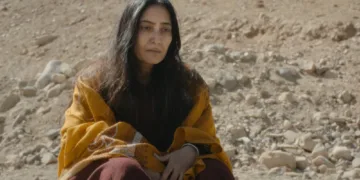
That single accusation hardens into systematic persecution. Local officials arrest Amir, cut off his lines of communication, and move to erase his work from public view. The state’s pressure creates a void that calls for an answer. From that void steps Amir’s elderly mother, Fatima, at first a quiet presence at the edge of the frame. She hoists a heavy old television set and a DVD player onto her yak, Riri, and sets out on a difficult road trip.
Her purpose remains disarmingly clear: she will carry her son’s forbidden images into Himalayan villages and let them breathe. Morchhale lays out his central field of inquiry here, where censorship tightens like a noose, state control turns into absurd theatre, and the stubborn need to express lived experience takes on the weight of a moral obligation.
Exile and the Road to Truth
The film arranges itself into two distinct halves, each tracing a different face of modern loneliness and spiritual strain. The first section follows Amir inside a closed, hostile space. Fanatics and local administrators wall him in, creating an atmosphere that feels short of oxygen. Authority appears both petty and monstrous in the tragicomic sequence with the Commissioner, whose logic for insisting on silence collapses under its own absurdity.

Morchhale shapes a precise critique of a system that punishes the artist for the simple act of showing reality. The object of fear is a modest, low-profile short film, and that detail exposes the deep anxiety of censors who panic at even the smallest shift away from an officially approved story.
The narrative then moves into a leaner road film. Fatima’s trek, echoing classic cinema of wandering figures, becomes a single-minded act of endurance against institutional repression. Her passage through the demanding terrain of Kashmir/Ladakh opens a quiet commentary on the material strain of life there, from erratic electricity to the weight of patriarchal codes. The thematic movement grows more expansive.
The focus widens from the persecution of one artist to a celebration of the quiet, persistent force of moving images themselves. In remote villages, the short film, drawn from Fatima’s own experience of giving birth, finds unexpected recognition, especially among women and younger spectators who respond fiercely to the sight of their own realities acknowledged on a screen. Fatima’s stubborn procession moves toward a shared recognition, where art becomes a fragile but vital mirror for those who rarely see their lives reflected.
The Aesthetics of Endurance
Cinematographer Mohammad Reza Jahanpanah frames Fatima’s act of dissent against a landscape of apparently indifferent peaks. Long shots shape extended observational passages of the Himalayas, aligning a stripped, documentary-like clarity with an almost lyrical visual scale. The visual language feels striking and assured, at times recalling traditions of humanist landscape cinema without direct quotation.
The film’s emotional axis rests on Madhu Kandhari’s performance as Fatima. Her work traces a slow, resonant metamorphosis. She begins as a woman seemingly detached from her son’s artistic hunger, then gradually becomes the embodiment of a fierce, unornamented resolve. The harsh trek presses on her body and spirit, shaping her into a reluctant activist. Kandhari suggests a dense interior life, an alloy of weary acceptance, tightly held anger at injustice, and a quiet but unshakable sense of dignity.
Bhavya Khurana, as Amir in the opening movement, carries his scenes with conviction, most strikingly in his tense encounter with the Commissioner, even as the film gradually shifts its weight onto the mother’s path. Anthony Joseph’s editing threads the two halves into a continuous arc, though the modest budget can be felt in the sparer sound design, which sometimes leaves the sonic world thinner than the images invite.
The Cost of Illumination
Morchhale’s film sits comfortably within his line of politically engaged stories, keeping his attention on forms of empowerment inside marginalized worlds. White Snow works with a quiet, accumulating power. Its measured storytelling examines the alliance between state power, religious judgment, and the calculated erasure of social experience. The film suggests that whoever controls the image reaches into the mind, shaping the space where perception and memory form.
The director resists an easy release of tension. The closing sequence remains a question that refuses to settle, directing the gaze back to the pain that resistance carries. The sight of the police jeep, the yak Riri left alone on a bridge, and the absence of Fatima’s body invites immediate, existential speculation about her fate. The unresolved, unsentimental ending leaves a mixture of sorrow and fire. White Snow offers a sharp critique of systemic repression and a deeply personal chronicle of maternal devotion as it moves toward something like spiritual clarity in the face of an irrational, suffocating order.
White Snow (2025) is an Indian drama directed by Praveen Morchhale. It had its premiere on the festival circuit and is an independent production. Due to its status as a recent festival film, a universal content rating (like PG-13) and a specific wide distribution company are not as readily available as they would be for a major studio release. The film, which has a running time of 81 minutes, focuses on a mother’s arduous road journey through the Himalayas to screen her son’s short film after it is banned by local religious and state authorities. Based on festival and review dates, the film premiered in 2025, with early screenings beginning in the fall.
Full Credits
Title: White Snow
Distributor: Barefoot Pictures (Production/International Sales), Wooz Pictures (Production)
Release date: 2025 (Festival Premiere)
Running time: 1 hour 21 minutes (81 minutes)
Director: Praveen Morchhale
Writers: Praveen Morchhale
Producers and Executive Producers: Praveen Morchhale
Cast: Madhu Kandhari, Bhavya Khurana, Kachoo Ahmad Khan, Kaneez Fatima, Haji Mohd Sadiq
Director of Photography (Cinematographer): Mohammad Reza Jahanpanah
Editors: Anthony Joseph
Composer: Nalin Vinayak
The Review
White Snow
White Snow is a vital, compelling political drama. Morchhale crafts a dual-layered narrative that is both a sharp critique of censorship and an emotionally resonant, philosophical study of maternal defiance. The film achieves a profound power through its observational realism, the harsh beauty of its setting, and the outstanding portrayal of Fatima's transformative journey. It is essential viewing for its powerful commentary on artistic freedom and the relentless human will to truth.
PROS
- Effectively combines a critique of artistic censorship with a powerful, personal road saga.
- Deeply resonant exploration of political oppression, patriarchal structures, and the persistence of art.
- Breathtaking, realist visuals capturing the immense scale and stark beauty of the Himalayan setting.
- Madhu Kandhari’s portrayal of Fatima is a transformative, deeply moving centerpiece.
- The complex, open-ended final sequence encourages genuine viewer reflection and engagement.
CONS
- Some technical elements, specifically sound design and music, appear constrained by a low budget.
- The performance of the son, Amir (Bhavya Khurana), is less consistent than the lead.
- The two distinct halves create an intentional shift in rhythm that some viewers might find abrupt.