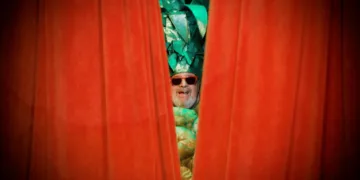



























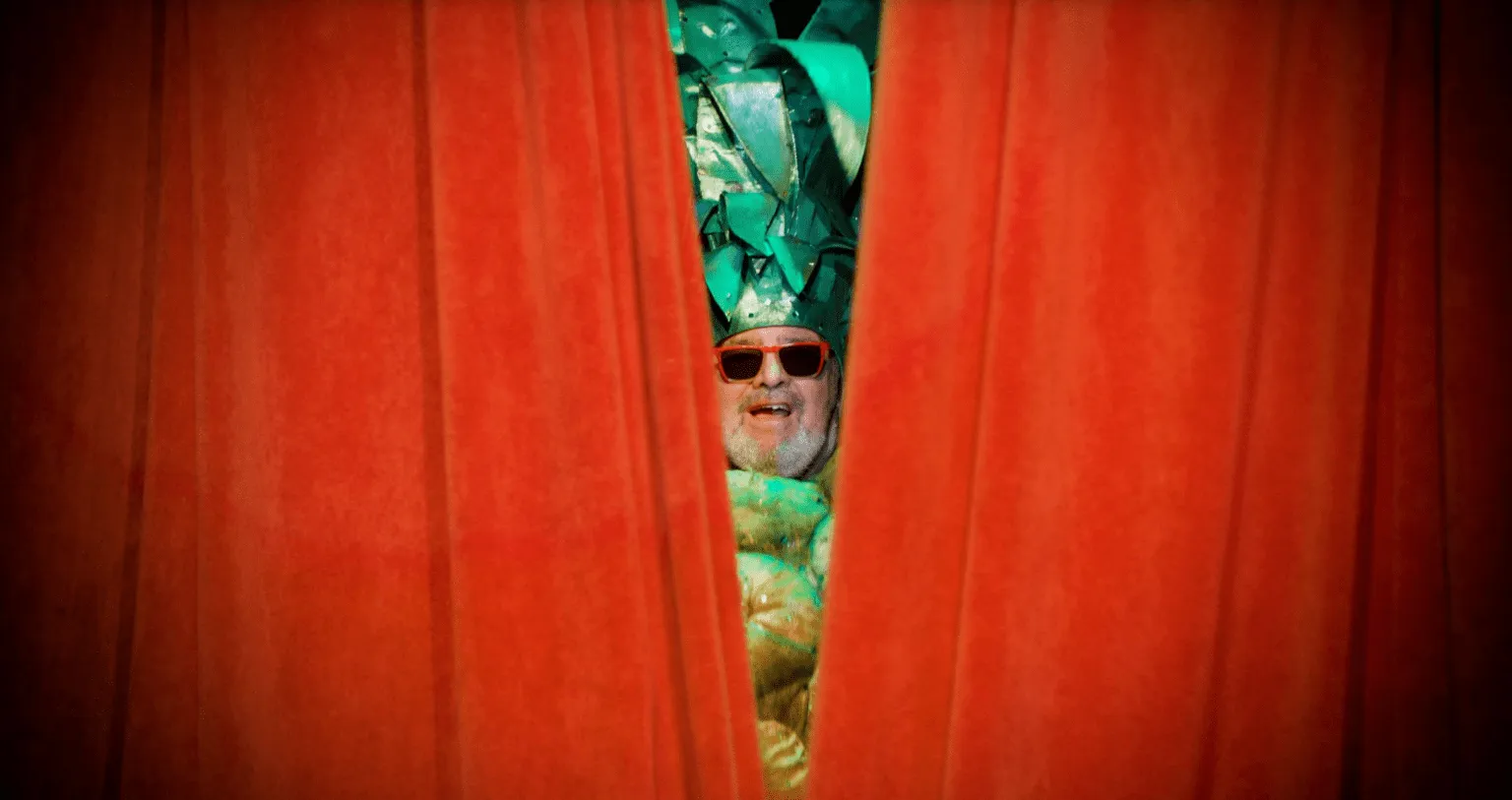

You can see how stubborn pop culture can be by listening for the odd little echoes that never quite disappear. For many people in Britain, one of those recurring sounds is “Agadoo,” the relentlessly catchy, often mocked party hit from 1980s band Black Lace. Kim Hopkins’ documentary Still Pushing Pineapples takes that scrap of pop history and reshapes it into a surprisingly tender character portrait.
The film follows Dene Michael, a former frontman of the group, who has spent forty years on the road performing the same song thousands of times. The track once carried the infamous label “the worst record of all time,” yet the film insists that the man attached to it deserves careful attention.
What emerges is a melancholy but affectionate road movie that starts from the absurd image of a middle-aged man in a pineapple costume. From that opening idea, Hopkins builds a portrait of someone who has lived in the shadow of a brief flash of fame. The film sets up a striking tension between the silliness of novelty pop and the quiet anxiety of an artist staring down an uncertain future.
The narrative stakes revolve around Dene’s effort to hold on to his established musical legacy while trying to build a new, independent career, all as he manages the demands of his personal life. The structure mirrors that tension: the film loops between stage, home, and the open road, and that repetition echoes the way one song has shaped a whole adult life.
The Man in the Fruit Suit: Character and Personal Story
One of the great pleasures of Hopkins’ observational approach lies in how quickly she moves past the cartoonish “Mr. Agadoo” image and reveals Dene Michael as a warm, generous figure. The film treats him as more than a pop footnote and instead treats him as a son, a partner, and a friend. He comes across as someone marked by kindness, resilience, and a quiet, unforced charm. Years spent working inside an unforgiving entertainment industry have not stripped him of that basic decency, and the camera keeps returning to small, human gestures that underline this.
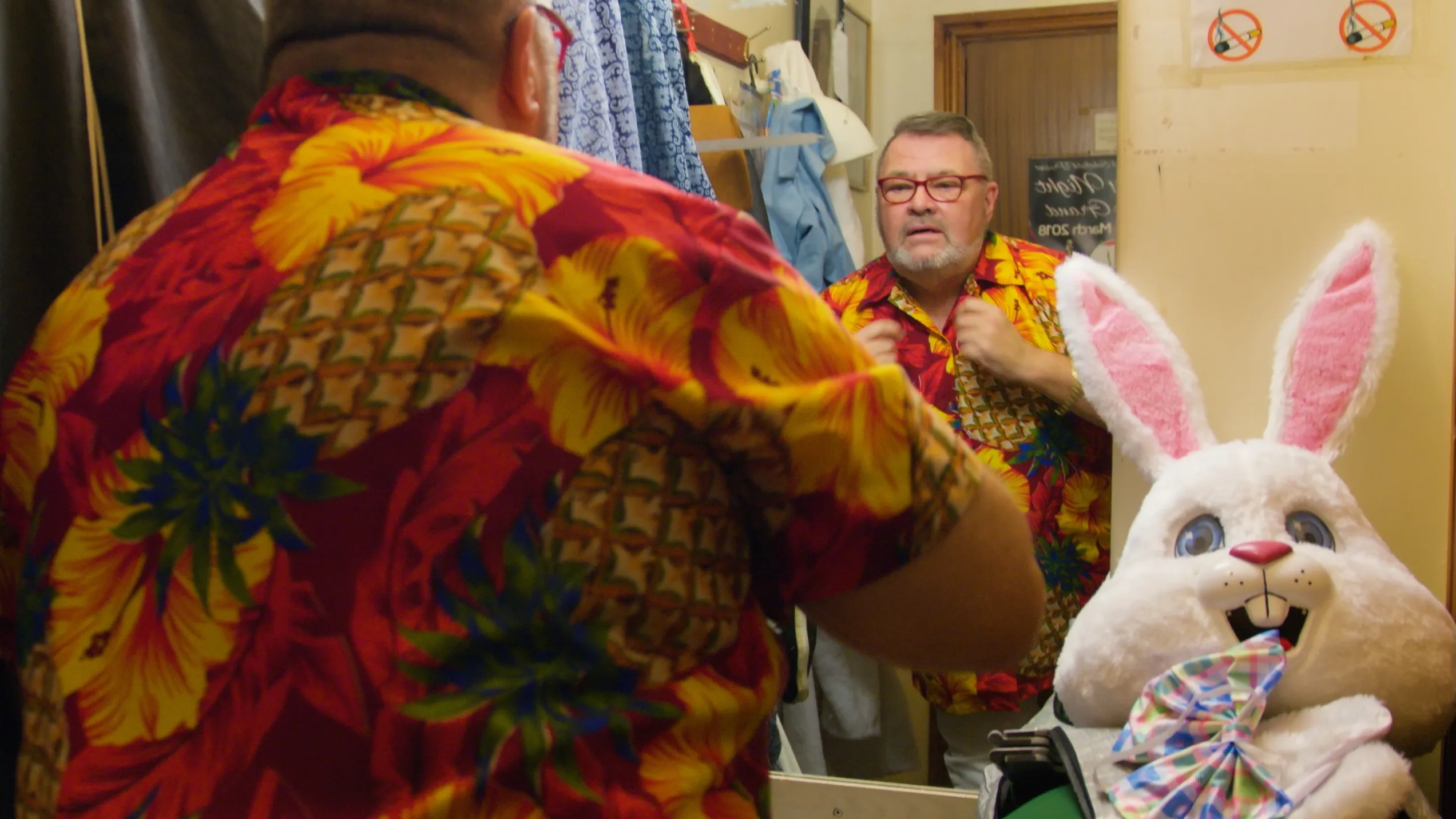
The documentary spends long stretches with the relationships that keep Dene going. Foremost is his bond with his mother, Anne. She is now elderly, yet she remains his fiercest supporter. On screen, Anne radiates a kind of everyday joy, with a glass-half-full outlook that gives the film a gentle emotional heartbeat. Her unwavering belief in her son sits beside a business that can quickly discard people once their moment passes, and that contrast adds weight to each interaction between them.
Dene’s new partner, Hayley, adds a further layer to this personal portrait. She first appeared in his life as an “Agadoo” superfan and now stands beside him as an active, supportive companion. The film shows her urging him to break out of the tight professional box he has lived in for decades. She nudges him toward his own voice, encouraging him to claim his current life and ambitions instead of living entirely through a single old hit. Together, Anne, Hayley, and Dene form the emotional core of the film.
Their shared story frames the documentary’s road-movie structure, which carries shades of Little Miss Sunshine in its mix of domestic detail and heightened stakes. Because Anne’s health rules out flying, the trio set off on an extended caravan trip to Benidorm, a place tied to happier memories and former regular gigs for Dene. The film frames this excursion as a last big item on Anne’s bucket list, and the caravan itself becomes both a literal vehicle and a narrative container for family history, hope, and fatigue.
Even while the film highlights Dene’s warmth, it refuses to smooth away the economic and professional realities that shape his life. The camera occasionally reveals his modest terraced house in Leeds, an image that sits alongside the flash of a Bentley parked outside, a hint of show-business glimmer that never quite fits with his present circumstances.
That visual dissonance captures the absence of any real safety net for working-class performers once their peak moment fades. The film repeatedly shows Dene grinding through small jobs, hunting for minor roles, and performing at low-paying events such as Christmas lights switch-ons. The repetition of those gigs confirms how fragile his financial footing has become and how hard he has to work for each paycheck.
Themes of Nostalgia, Class, and Survival
As a critic, I pay close attention to how a film transforms into a cultural artifact, and Still Pushing Pineapples succeeds by tying its intimate character portrait to questions of nostalgia, class, and labor in Britain. Dene Michael’s livelihood rests entirely on a nostalgic attachment to “Agadoo.” The constant touring and repetition of that one song supplies vital income, a kind of financial safety net that many working-class artists never receive. At the same time, his dependence on that hit locks him into a past version of himself. He lives inside a professional loop that keeps pulling him back to the same chorus, the same costume, the same expectations.
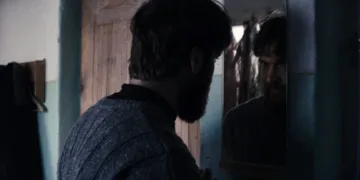
The documentary lays out that trap in ways that feel quietly painful. One telling moment comes when his manager insists he shave his beard to match the look he had in 1986, a gesture designed to satisfy fans who want to see the younger version of Dene they remember. The film makes clear that audiences pay for a memory shaped decades earlier, not for the man who has aged and changed since then. In that world, reinvention hardly feels possible; financial survival depends on holding on to a single, frozen image.
Hopkins, already an established name in Northern English documentary work, uses Dene’s story to explore working-class life in Yorkshire. She motions to a landscape where creative talent and energy feel plentiful, yet stable careers that allow real control over one’s art remain scarce.
Still Pushing Pineapples quietly underlines the sheer effort demanded of ordinary people who try to keep going in an industry that can treat them as disposable. Dene repeatedly has to step on stage and bring a party atmosphere, even on nights when he appears tired or preoccupied, and the film frames that routine as a kind of emotional and physical labor. Without a financial cushion to soften failure, every gig matters.
The film also broadens out to the idea of an entertainment culture, and a wider society, that leaves many people on the margins. Hopkins herself finds echoes of her own life in Dene’s situation, particularly the shared struggle of an independent filmmaker searching for funding and stability. That parallel shapes the film’s central concern: the challenge of sustaining a creative life on one’s own terms while money, expectation, and nostalgia press in from every side.
Through all of this, Dene never comes across as bitter. The documentary frames his story as a tribute to those who keep moving forward, stressing how his love of music fuels him even when his career path looks uncertain. Survival becomes a quiet kind of victory, and the film treats that endurance as something worth honoring.
Style and Direction
Kim Hopkins builds this story with a careful, low-key visual and narrative style that keeps the focus on the person rather than the pop myth. Working as director, producer, and cinematographer, she crafts a film that feels close and unforced. Her camera observes rather than commands, which gives the documentary a sense of closeness that many highly managed star vehicles never achieve. The film sits comfortably inside the empathetic documentary tradition of Northern England, and that grounding helps it feel connected to real places and lives rather than media spin.
The structure refuses a neat, commercial arc. Instead of a clean climb and fall, the film moves in a looser fashion between Dene’s home life, his time on the road, and fragments of his past. Scenes shift across locations and moods without a rigid timeline, and that slightly clunky rhythm mirrors the messiness of the life on screen. The pacing can feel irregular, but that quality pulls the viewer into Dene’s chaotic day-to-day routine and steers the film away from the polished pattern found in many celebrity documentaries.
Visually, Still Pushing Pineapples leans into a mix of melancholy and warmth. Hopkins cuts between archival material, such as brief clips of old Top of the Pops performances, and stark images of Dene’s current gigs and surroundings. That interplay strengthens the sense of distance between the peak of 1980s fame and the present reality of small venues and thin crowds. Her camera often lingers on fading seaside resorts, tired ballrooms, and the worn settings of what the film calls the “sad disco circuit.” Those specific, sometimes run-down locations give the film a clear social setting and connect Dene’s personal story to a wider picture of economic decline and entertainment work on the margins.
Still Pushing Pineapples works as a detailed study of show business from the underside and as a carefully made piece of independent filmmaking. Its technical strength lies in its calm, empathetic attention to one man’s life inside a pineapple suit and the choices that led him there. Hopkins uses Dene Michael’s career to create a funny, irreverent, and deeply sincere portrait that locates the human being inside the costume. The film stands as a quiet triumph for independent cinema and as a reminder that even the most unlikely one-hit wonder can carry a whole life story with it.
Still Pushing Pineapples is a feature-length documentary that premiered at the Sheffield DocFest in June 2025. The film follows the life of Dene Michael, a former frontman of the 1980s novelty pop band Black Lace, as he navigates his continued performing career while caring for his elderly mother and new partner. The documentary is set for a limited theatrical release in the UK and Ireland starting on November 28, 2025. It is the second film in a trilogy by director Kim Hopkins focusing on northern working-class cultural life.
Full Credits
Title: Still Pushing Pineapples
Distributor: Tull Stories (UK/Ireland theatrical release)
Release date: November 28, 2025 (UK/Ireland Limited)
Rating: PG, 12A
Running time: 93 minutes
Director: Kim Hopkins
Writers: Kim Hopkins
Producers and Executive Producers: Margareta Szabo, Nan Davies, Nikki Parrott, Luke W. Moody, Mark Thomas, Dani Carlaw, Kiah Simpson, Kim Warner, Caroline Cooper Charles, Herbert Lockwood
Cast: Dene Michael, Anne Betteridge, Hayley
Director of Photography (Cinematographer): Kim Hopkins
Editors: Leah Marino
Composer: Terence Dunn
The Review
Still Pushing Pineapples
The documentary is an unexpectedly warm, authentic portrait that uses a ridiculous novelty hit as a lens to examine profound themes of legacy, class, and the resilience of the human spirit. Kim Hopkins crafts a truly empathetic film that finds deep humanity in the struggle to survive long after fame has faded, affirming the enduring connection between a man, his family, and his music. It is a necessary counterpoint to curated celebrity biographies.
PROS
- Offers a genuine, empathetic look at Dene Michael beyond his stage persona.
- Effectively explores complex issues like working-class survival, the nature of nostalgia, and the music industry's indifference.
- The bond between Dene and his mother, Anne, is genuinely touching and the film's emotional core.
- Successfully avoids cliché, presenting an anti-celebrity documentary about a man defined by a throwaway hit.
CONS
- The deliberate lack of a rigid timeline may feel disjointed to some viewers expecting a traditional linear biography.
- The decision to omit difficult personal history (like the jail sentence) creates a slightly incomplete portrait.
- The film’s pervasive melancholy, though earned, might be too heavy for those expecting a purely celebratory piece.