









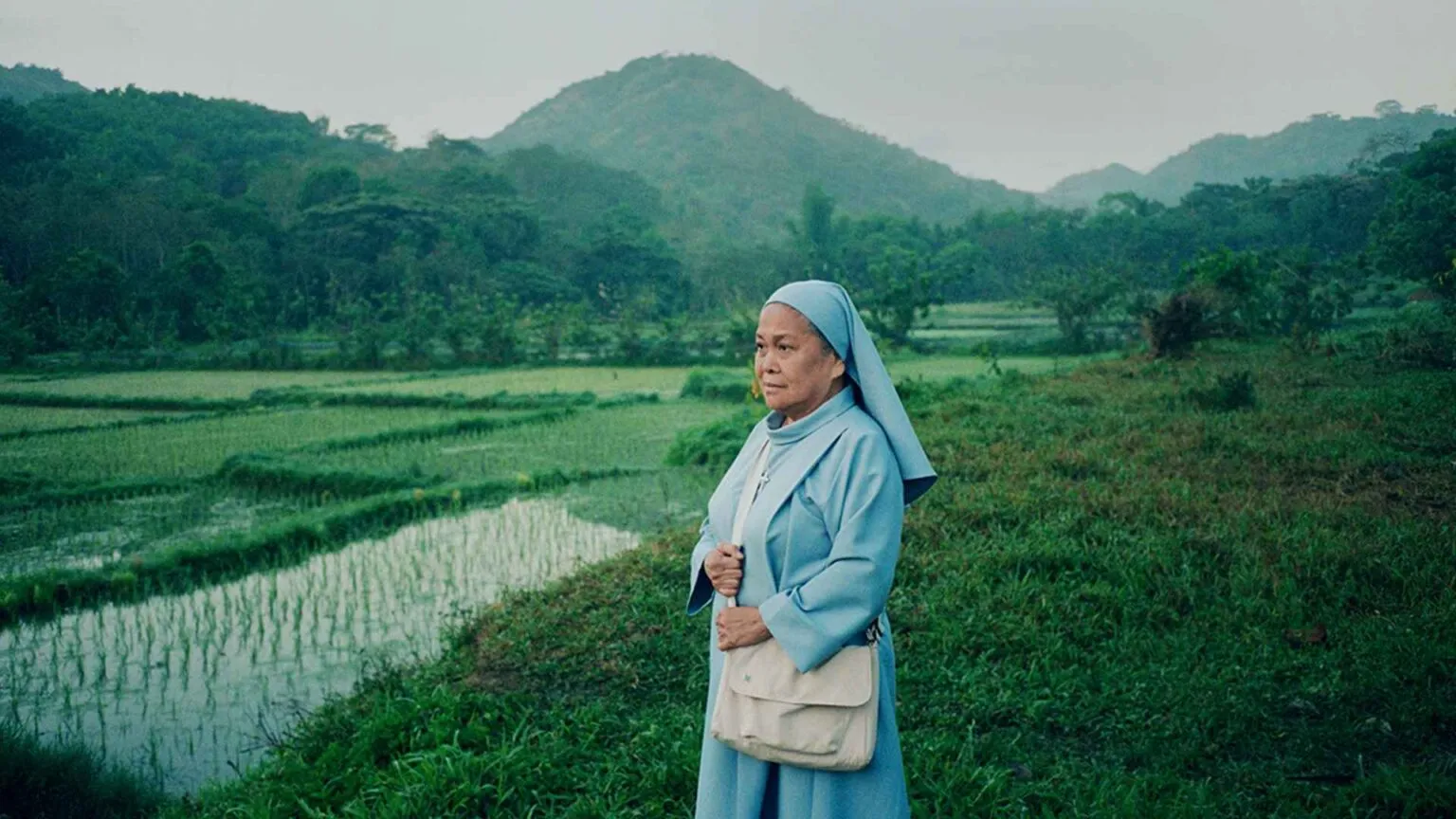

The stillness arrives first. A heavy, humid quiet settles over the screen, carrying the scent of damp stone and persistent, untended flora. This is the first texture of First Light, the remarkably assured debut feature from filmmaker James J. Robinson. The film chooses immersion over velocity, sinking into a specific world, a centuries-old Catholic convent on Luzon in the Philippines, held apart from the modern noise that surrounds it. The location refuses to sit as simple background; the striking natural beauty forms a kind of crucible.
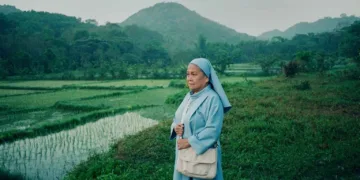
We meet Sister Yolanda (Ruby Ruiz), a middle-aged nun whose life plays out as a studied practice of selfless commitment. Her days follow a strict pattern of visiting the sick, tending to the dying, and guiding the young novice Sister Arlene. This measured devotion shapes the film’s core. First Light tells its story as a sustained meditation on ethics, mortality, and the heavy weight of blind faith. It traces the friction between spiritual certainty and the brutal social inequalities that often define the profane world.
Yolanda’s sheltered life ruptures around a single demand: she is summoned to comfort Angelo, a construction worker clinging to life after a grievous accident. He faces death with an unsettling fear. This visit becomes a fulcrum, the moment that forces Yolanda to look past the convent’s sanctuary and face the complex, unjust realities that press in from outside. The experience carries a quiet, contemplative gravity, constructed with care to provoke persistent, uncomfortable thought.
Shadow and Illumination
Robinson, whose professional history includes significant work as a photographer, brings an immediate, meticulous and painterly sensibility to the film’s visual design. The images follow a distinct visual grammar, rooted in a strict attention to framing and in a deliberate, echoing use of color. Cinematographer Amy Dellar realizes this rigorous aesthetic with clarity. Together they shape a strong visual system defined by intense contrast between settings.
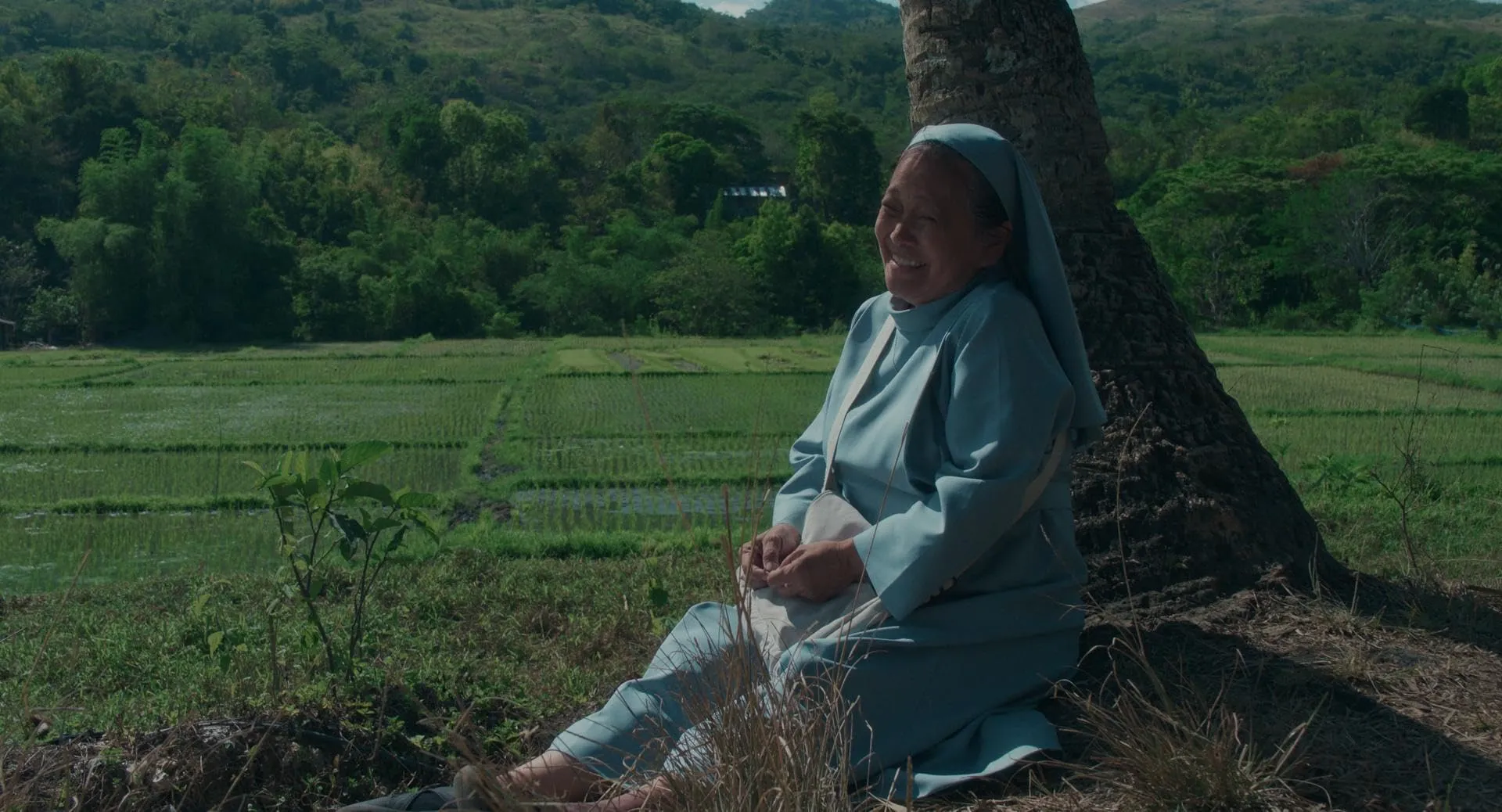
The convent appears in a state of stillness and warm decay. Low light and small marks of neglect define it: dripping water, power cuts, and the soft, steady abrasion of time. This “crumbling” exterior hints at a slow existential rot within a place that claims devotion to the eternal. The same stillness sits beside a harsher outside world.
The hospital, in particular, carries an aesthetic cruelty; it glows in sickly green, an uncanny and almost alarming luminescence that feels entirely profane. Blood red smears across this antiseptic surface stress the trauma and physical chaos that confront Yolanda. Her sky blue habit functions as a deliberate visual anchor, a solitary point of spiritual clarity set against the harsh artificial lighting of industrial society and the vast, humbling presence of the land.
The Luzon landscape holds significant narrative weight. The terrain behaves like an active character, the deep earth grounding the film’s philosophical questions. Dellar frames the azure skies, the soft flow of the river, and the dramatic sunlight that filters through clouds over the mountains. These images of nature, together with the close glow of dozens of votive candles, form a counterpoint to the institutional shadows. The visual world comes across as both deeply grounded and quietly dreamlike, sustaining an atmosphere of solemn reflection and unease. Nearly every composition feels self-contained, a shot that can carry its own fragment of story.
The Architecture of Doubt
Ruby Ruiz’s performance as Sister Yolanda shapes the film’s lasting, silent core. Her acting remains deeply reserved, gentle, unassuming and profoundly human, and reaches a layered complexity without leaning on mimicry or theatrical display. The performance feels dense with inner life. The character arc follows a slow, quiet dissolution. Yolanda begins rooted in selfless certainty, a model of devotion, then moves toward crisis, a shaking of faith and a loss of innocence, as she confronts burdens she recognizes she cannot hope to change.
The film avoids simple, aggressive condemnation of belief. Its approach to organized religion and its institutions carries a forgiving and contemplative tone. The story exposes the painful discrepancy between stated Catholic values and the compromised actions of the Church as a temporal, corporate institution. This conflict appears with sharp clarity in the uneasy, quiet exchange with Father Claridad (Soliman Cruz), a scene that reveals the church’s role in sustaining a world that systematically favors the wealthy. The size and ornament of the church building stand in stark visual tension with the humble, sometimes worn living quarters of the nuns.
First Light renders this social commentary through a study of disparity. The film places Yolanda’s modest, austere convent existence beside the shocking opulence and guarded comfort of Ms. De la Cruz’s (Maricel Soriano) in-home care for her ailing mother. The comparison presses an existential question: what does it mean to be good? The film asks which acts of morality retain meaning when faith, used as a spiritual shield, proves weak against the grinding reality of institutional and social injustice. The protagonist’s quiet reckoning points to the burden of a world where compassion strains against entrenched power.
Meditations on the Dawn
The film’s measured pacing forms a key part of its force, reinforcing the tranquil, repetitive cycles of convent life. This controlled tempo gives the spiritual and moral questions ample space to breathe and to settle in the viewer’s mind. The work stands as deliberate meditative cinema, shaped by contemplation and quiet observation. Its rhythms allow the slow, difficult growth of Yolanda’s doubt to feel fully earned and deeply credible, and they steer the film away from “campy genre conventions” or cheap dramatic shocks.
Robinson’s command of his material feels striking for a debut feature. The quiet, affecting sequence of the nuns walking along the bank of the silken river captures this careful pacing; the slowness sharpens every sensory detail and permits genuine, deep contemplation between the characters. The finished film feels fully shaped and highly accomplished, proof of Robinson’s confident control of style and substance. Ana Roxanne Recto’s delicate score deepens the contemplative mood, using the subtle textures of guitar, cello, clarinet and harp.
The title, First Light, carries several layers of symbolic meaning. It names the evocative opening image of nuns lighting candles inside a cavernous darkness. On a more philosophical level, it signals the possibility of continuation and the persistence of hope that can follow a severe spiritual or moral crisis.
The words also suggest a sudden, difficult enlightenment, a dawning awareness of spiritual majesty entwined with the profound, sobering truth of institutional corruption. Robinson emerges as an exciting new voice in meditative cinema, an artist whose work offers audiences the lingering necessity of questions and a quiet, enduring state of contemplation.
First Light is a compelling 2025 Filipino-Australian co-production and the feature debut of director James J. Robinson. The film premiered at the Melbourne International Film Festival on August 10, 2025, and has since played at other international festivals. Starring veteran Filipino actress Ruby Ruiz as a nun whose faith is tested by a tragedy, the film is a meditative drama exploring morality, institutional power, and societal disparity set against the stunning backdrop of the remote mountains in Luzon, Philippines. While the theatrical release in Australia and New Zealand is handled by Bonsai Films, broader distribution details for watching the film after its festival run are expected to be announced soon.
Full Credits
Title: First Light
Distributor: Bonsai Films (Australia/New Zealand), Independent Entertainment (International Sales)
Release date: August 10, 2025 (World Premiere, Melbourne International Film Festival)
Rating: Unclassified 18+
Running time: 118 minutes
Director: James J. Robinson
Writers: James J. Robinson
Producers and Executive Producers: Gabrielle Pearson, Jane Pe Aguirre, Christelle Dychangco (Producers), Virginia Whitwell, Nick Batzias (Executive Producers)
Cast: Ruby Ruiz, Kare Adea, Maricel Soriano, Emmanuel Santos, Rez Cortez, Soliman Cruz, Kidlat Tahimik, Lui Manansala
Director of Photography (Cinematographer): Amy Dellar
Editors: Geri Docherty
Composer: Ana Roxanne
The Review
First Light
First Light is a profoundly meditative and visually commanding debut that successfully translates spiritual doubt into cinematic form. It confronts the silent agony of conscience facing institutional corruption, offering a slow, purposeful descent into existential questioning. The film excels in its assured visual language and Ruby Ruiz's complex, human performance, leaving the viewer with resonant, difficult questions rather than comfort.
PROS
- Exceptional cinematography by Amy Dellar; striking use of light, color, and natural landscapes.
- Ruby Ruiz delivers a quiet, deeply human, and complex portrayal of Sister Yolanda.
- Engages maturely with existential themes of faith, doubt, morality, and systemic social inequality.
- James J. Robinson maintains a contemplative, measured pace that enhances the philosophical weight.
- Ana Roxanne Recto's delicate score perfectly underscores the film's meditative mood.
CONS
- The deliberate, unhurried pace, while essential to the themes, may be perceived as slow by audiences expecting a faster narrative.
- The film purposefully offers difficult questions rather than satisfying narrative closure, which might frustrate some viewers.