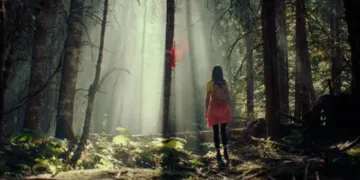












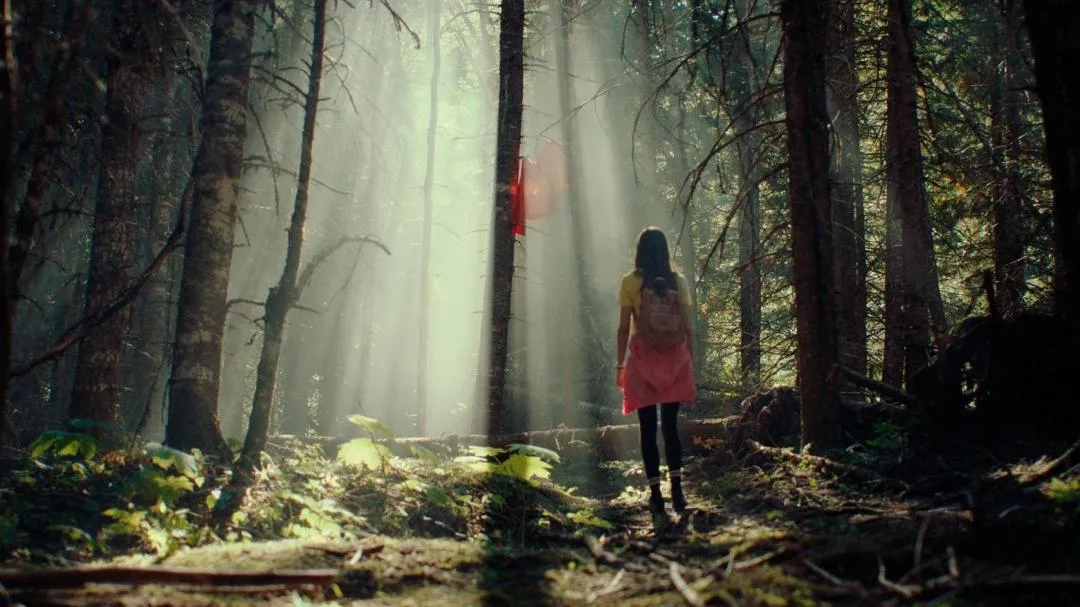

Dense, emerald forests in British Columbia set the stage for Kourtney Roy’s debut, a film that treats wilderness like a living archive. We first meet Kay Hall, a quiet woman who has joined a group of female enthusiasts. They hike in matching pink windbreakers, moving through the trees with the steady purpose of people chasing folklore.
Their mission is simple on paper: find proof of creatures people whisper about. The woods carry a heavier story, though. A cryptozoologist named Barb Valentine vanished here three years earlier, and that absence hangs over every step the group takes.
On a hike, Kay breaks away from the others and comes face to face with a strange bipedal entity called the Suka. The encounter knocks her off balance. She ends up disoriented, with her memory wiped clean. When she’s found, the film drops its first genuinely jolting reveal: Kay looks exactly like Barb. From there, Roy tracks Kay’s attempt to recover her own history by retracing the vanished researcher’s path, turning the search into something intimate and uneasy.
The film plays as a psychological mystery where the monster hunt functions like a trapdoor, opening into the question of who Kay is, and who she has been made into. It treats the unknown as a personal problem inside a vast, silent landscape, and it leans into uncertainty, letting an internal fog echo the mist that clings to the Canadian woods.
A Palette of Slime and Stillness
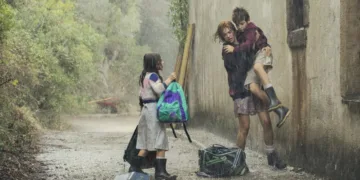
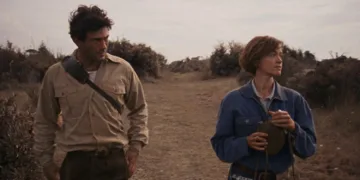
Roy’s background in professional photography shows up in the way she frames bodies against space. Composition stays tight and deliberate, and color becomes a kind of grammar. The candy-pink uniforms pop against the forest’s deep greens, a contrast so sharp it feels like the world has slipped slightly out of alignment. Shots often land like still photographs, held long enough for you to feel the pose, the distance, the quiet pressure of the trees closing in.
That sense of control makes the film’s rougher textures stand out even more. Roy leans into a lo-fi look that took me back to early paranormal TV and the grainy home-movie vibe of late-night channel surfing. During the creature sightings, handheld camcorder footage steps in and echoes famous Bigfoot recordings like the Patterson-Gimlin film. The effect is less about proving what we’re seeing and more about placing us inside Kay’s confusion. The image wobbles, information slips away, and certainty never settles.
The physical effects push the film into a sticky, sensory kind of horror that feels rooted in biology. The imagery gets actively gross in the best way: sticky white fluids, reaching tentacles, and mounds of organic mass press up against the pastoral calm of the landscape. That shift lands hard, because Roy has already taught us to read the forest as serene and watchful. When the slime and bodies arrive, they feel like a violation of that calm, an eruption that the film refuses to sanitize.
Sound does a lot of the heavy lifting here. Cayne McKenzie’s electronic score pulses with mechanical energy, and it creates a strange mysticism against the old-growth trees, like something alien has learned how to breathe in the same air. The audio work stacks details carefully. Squishes, hums, and low vibrations sit in the mix long enough to become part of the environment, and the dread they create never really leaves the frame. Roy’s attention to texture, both visual and sonic, gives the horror a lived-in, tactile presence that lingers on the skin.
Domestic Shadows and the Study of the Hidden
The film takes the literal meaning of cryptozoology, the study of the hidden, and turns it into a metaphor for the female experience. Kay’s journey becomes a search for the concealed self, the parts of a life that get buried or rewritten until a person can’t name them anymore.
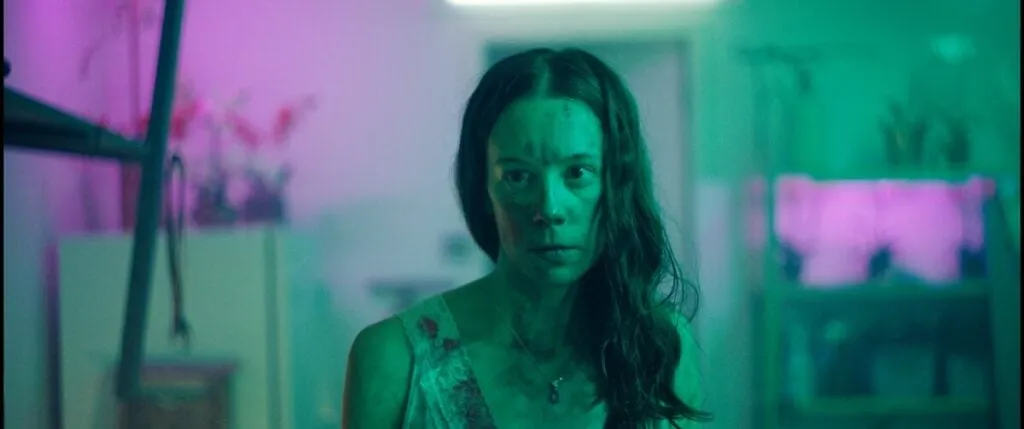
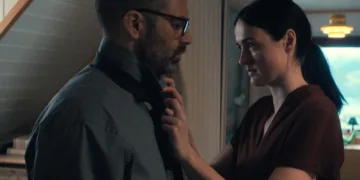
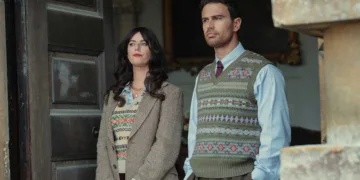
That metaphor sharpens when Morgan enters the story. He is Barb’s husband, and his controlling behavior turns domestic life into a site of repression. His insistence onz on having a “good girl” pushed Barb into dissociation long before she disappeared into the woods, framing the vanishing as the last visible step in a long process of being erased.
The film points its fear toward the men Kay meets. They register as the real threat, with the forest creatures operating on a different wavelength. That choice shifts the film’s moral map. Instead of treating the unknown as the primary danger, Roy uses it to expose the familiar dangers that thrive indoors, in relationships, in expectations dressed up as care.
The Suka, in particular, functions as a catalyst. Its presence pushes Kay toward breaking free of social expectations and reclaiming her body. Encounters with other people reinforce the film’s sense of social alienation, the feeling of moving through the world slightly out of phase with it. Sasha voices the idea plainly when she says outsiders have to stick together. It’s a small line that carries a lot of weight, because the film keeps returning to community as survival, especially for people marked as lost or strange.
Roy also treats getting lost as part of the process of being found. The film examines sexual encounters as experiences that can feel invasive and transformative when they crack through repression. In that light, the natural monster becomes a form of connection, offering something the human monsters never provide.
It’s a pointed shift in how predatory behavior gets framed in horror: the threat lands in the domestic sphere, in the quiet routines where identity can be worn down by the demands of others. The forest stays dark and imposing, yet the home is the place where the slow erasure happens.
An Odd Odyssey of Identity
Chloe Pirrie anchors this intentionally confusing narrative with sheer presence. She gives Kay a wide-eyed energy that makes the bewilderment feel honest, and that honesty becomes the film’s handhold. Pirrie plays both Kay and Barb, and she differentiates them through small, readable choices in posture and voice, the kind that register without calling attention to themselves. She also has a sharp instinct for deadpan comedy, especially in the moment when Kay learns she is supposed to be a veterinarian, a detail that lands with the absurd shock of waking up inside someone else’s résumé.
Structurally, the film moves in episodes, like a wandering path that keeps changing direction. Kay drifts through lonely places, including a roadside motel and a trailer park, and each stop introduces eccentric local characters who bring situational humor into the story.
One scene built around a drunken marital dispute among neighbors plays like a bizarre comedy of manners, a detour that still fits the film’s larger mood of social discomfort. That swing between horror and humor marks the movie as a piece of independent experimentation, willing to risk tonal whiplash to keep the viewer unsettled.
Roy keeps the nature of the entity unresolved, and she lets the doppelgänger mystery hang in the air without spelling out the mechanics. The finale gives Kay a final act of transformation that reads as a reclaiming of agency, with Pirrie finding a strange power in Kay’s new state of being. The film’s satisfaction comes from movement and mood, from watching a person reshape herself while logic stays opaque. By the time the credits roll, the story has shifted into a study of a woman standing on the edge of her own existence, surrounded by trees that never explain what they’ve seen.
Kryptic is a Canadian psychological horror-thriller that explores themes of identity and obsession through a surreal lens. It officially premiered at the SXSW Film Festival on March 10, 2024, before reaching a wider audience through its digital and VOD release on May 9, 2025. The film follows a woman who wanders into the wilderness to find a missing monster hunter, only to lose her memory and discover a strange, visceral connection to the very creature she was tracking. As of today, January 5, 2026, the film is available to stream or rent on major platforms including Amazon Prime Video, Apple TV, Google Play, and The Roku Channel.
Full Credits
Title: Kryptic
Distributor: Well Go USA Entertainment, XYZ Films, Game Theory Films
Release date: March 10, 2024 (World Premiere), May 9, 2025 (Digital/VOD)
Rating: R
Running time: 96 minutes
Director: Kourtney Roy
Writers: Paul Bromley
Producers and Executive Producers: Josh Huculiak, Amber Ripley, Sophie Venner, James Tocher, Michael Bassick, Michael Laundon
Cast: Chloe Pirrie, Jeff Gladstone, Jason Deline, Ali Rusu-Tahir, Kamantha Naidoo, Jenna Hill, Pam Kearns, Jane Stanton, Sara J. Southey, Jennifer Copping, Patti Allan
Director of Photography (Cinematographer): David Bird
Editors: Tommaso Gallone
Composer: Cayne McKenzie
The Review
Kryptic
Kryptic is a challenging and visceral exploration of identity that successfully pivots from a simple creature hunt to a deep psychological study. While its refusal to provide clear answers might frustrate those seeking traditional horror beats, the atmospheric direction and Chloe Pirrie’s grounding performance create a memorable experience. It treats the search for the unknown as a mirror for the interior life, making it a bold addition to independent Canadian cinema.
PROS
- Chloe Pirrie delivers a nuanced and commanding lead performance.
- The cinematography captures the haunting beauty of the British Columbia wilderness.
- Creative and effective practical body horror effects.
- A unique, non-linear approach to the mystery genre.
CONS
- The episodic structure leads to some pacing issues in the middle.
- The lack of narrative closure may feel unsatisfying to some viewers.
- Certain side characters and subplots remain underdeveloped.