




















Stranger Things reaches its final chapter after nearly a decade of defining the landscape of modern streaming television. The Duffer Brothers return to Hawkins, Indiana, to resolve the conflict between the small-town heroes and the malevolent entities of the Upside Down. This final season centers on the immediate threat posed by Vecna and the Mind Flayer as they attempt to merge their decaying dimension with reality.
Eleven stands at the center of the conflict, balancing her immense power with the heavy burden of her origins as 001’s successor. The finale, titled The Rightside Up, functions as a massive cinematic event, shifting from high-stakes supernatural warfare to a lengthy, reflective look at the lives of the survivors.
It remains rooted in the 1980s aesthetic that made the show a global phenomenon, focusing on the bonds of friendship that have sustained the characters since the disappearance of Will Byers in 1983. As the Party prepares for their final campaign, the stakes move beyond simple survival, focusing instead on the permanence of loss and the inevitable transition from childhood into an uncertain future.
Tactical Nihilism and the Mechanics of the Abyss
The structural pacing of this finale suggests a show wrestling with its own bloat. We see the group splintered into specialized strike teams, a move that mirrors the “calculated fragmentation” often found in late-stage Cold War cinema. Their mission to infiltrate the Abyss and Dimension X carries a desperate urgency. The Duffers attempt to reconcile a decade of lore by forcing the worlds to collide physically.
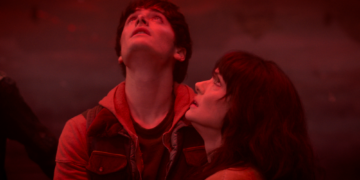
The confrontation between Eleven and Henry Creel serves as the narrative anchor. It is a deeply personal duel that avoids the pitfalls of generic energy blasts by integrating Henry’s distorted history. This is a battle of memory and trauma. Eleven does not fight a monster; she fights the physical manifestation of institutional abuse.
Joyce Byers provides the necessary grounding. Her role in the climax is vital. When she delivers the final strike against Vecna, it feels like a rejection of the “overprotective mother” trope the season flirted with earlier. It is an act of violent catharsis. She hacks away at the phantom that has haunted her family for years, reclaiming her agency in a way that feels earned and necessary.
The conflict with the Mind Flayer provides the expected visual scale. The “Boss” entity is a kaiju-sized nightmare that the Party meets with Molotov cocktails and bullets. There is something delightfully primitive about using fire and lead against an interdimensional god. It highlights the “MacGyver-esque” ingenuity of the Hawkins crew.
The pacing shifts dramatically after the first hour. The action-heavy sequence gives way to a slower, more deliberate exploration of the aftermath. This transition might feel jarring to those seeking a nonstop adrenaline rush, but it allows the narrative to breathe. The tension moves from the external threat to the internal reality of survival.
The Iconography of the Outsider and Emotional Finality
This finale provides a sense of finality that avoids the “everyone must die” trap of modern prestige drama. Steve Harrington’s survival is the most notable subversion. The tension at the radio tower suggested a tragic end for the beloved babysitter, but Jonathan’s intervention preserves him. This rescue acknowledges their shared history and cements a brotherhood that supersedes their old rivalry for Nancy’s affections. It is a quiet victory for the “reformed jock” archetype.
Dustin’s graduation speech serves as a eulogy for the “outsider.” By honoring Eddie Munson, Dustin validates the subcultures that the mainstream often ignores or vilifies. This moment reflects the show’s enduring focus on those who live on the margins. It is a sincere, slightly awkward tribute that captures the essence of a John Hughes protagonist growing up in a world that is anything but a romantic comedy.
Mike Wheeler reclaims his position as the “heart” of the Party. As the narrator of the final Dungeons and Dragons campaign, his voice shapes our understanding of the story’s conclusion. Mike has been a passive figure for several seasons, but here he functions as the emotional glue. His perspective transforms the supernatural chaos into a coherent myth.
The Byers family dynamic remains the show’s bedrock. Joyce’s protective nature finally yields to a sense of peace, evidenced by her engagement to Hopper at Enzo’s. Will’s journey, while still shadowed by his connection to the Mind Flayer, finds a resolution in his contribution to the final fight. He is no longer just a victim; he is a participant.
The secondary antagonists, Dr. Kay and Lt. Akers, represent the “grounded” obstacles. The military’s presence provides a cynical counterpoint to the kids’ idealism. These characters are less interesting than the monsters, yet they serve to remind us that the state is often as dangerous as any interdimensional horror.
Technostalgia and the Sonic Landscape of Ruin
The move toward a movie-like format is palpable. With a two-hour runtime and a massive budget, the production values are staggering. However, this cinematic shift comes with a cost. The finale occasionally lacks the distinct visual language of the earlier seasons. The first three seasons, often lensed by Tim Ives, possessed a tactile, grainy warmth. Here, the digital environments of the Abyss and the Upside Down feel slightly cluttered by CGI.
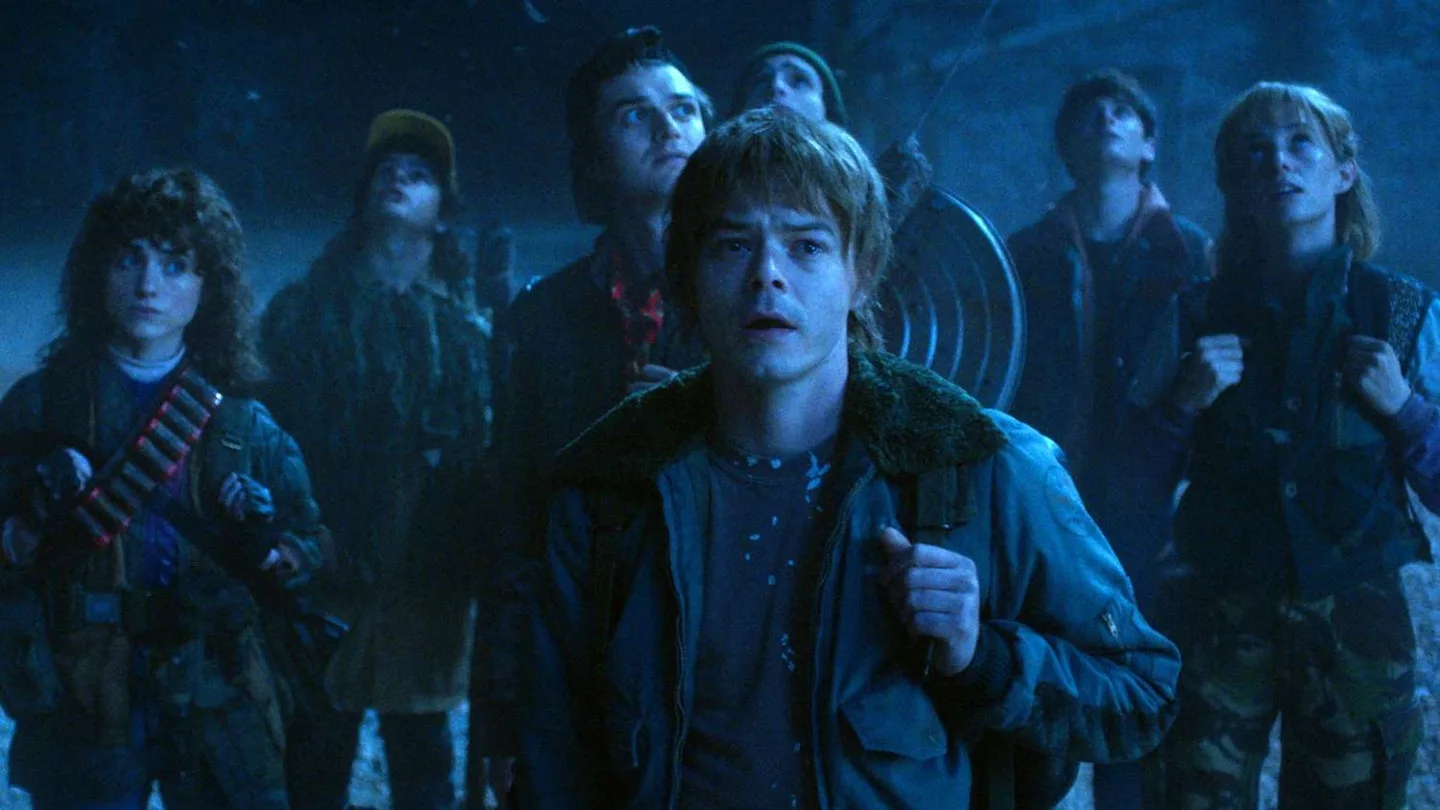
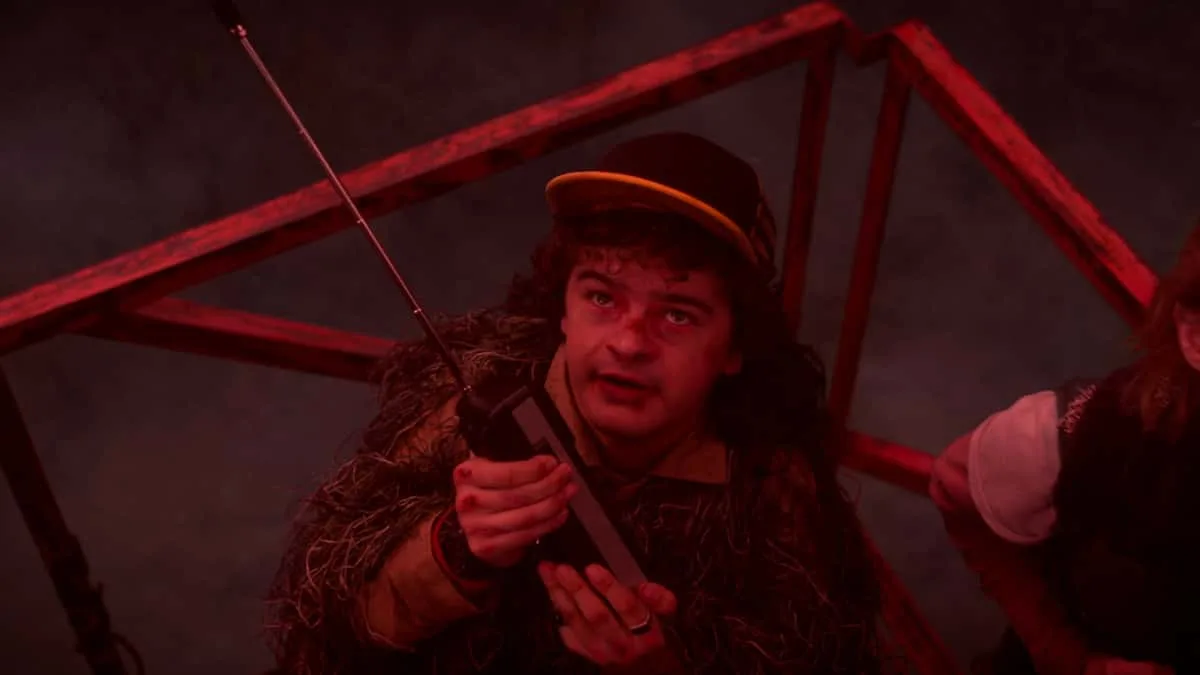
The dreamlike spaces of Dimension X lack the practical horror of a creature chasing a child through a grocery store. There is a “digital cleanliness” to some of the sequences that reduces the visceral tension. Despite this, the scale remains impressive. The Mind Flayer is a technical marvel, even if it feels less intimate than the threats of the past.
The soundtrack remains the series’ strongest asset. The inclusion of Prince’s “When Doves Cry” and “Purple Rain” is a masterstroke. These tracks do not just provide background noise; they heighten the emotional weight of the Upside Down’s destruction. The licensing of “Purple Rain” is a rare feat that signals the cultural weight of this show. The music captures a sense of mourning and reflection.
The final needle drop is David Bowie’s “Heroes.” This choice is both obvious and perfect. It frames the group’s legacy not as world-beaters, but as friends who showed up for each other. It is a song about endurance in the face of inevitable decline. The lyrics resonate with the idea that being a hero is a temporary, local act of defiance.
The visual direction struggles with lighting in the more CGI-heavy scenes. The “bad lighting” mentioned by some observers is likely a result of trying to hide the seams of the digital world. It is a minor gripe in an otherwise polished production. The show’s aesthetic remains a “VCR-filtered” love letter to the era of practical effects and synth-wave scores.
The Icelandic Paradox and the End of Enchantment
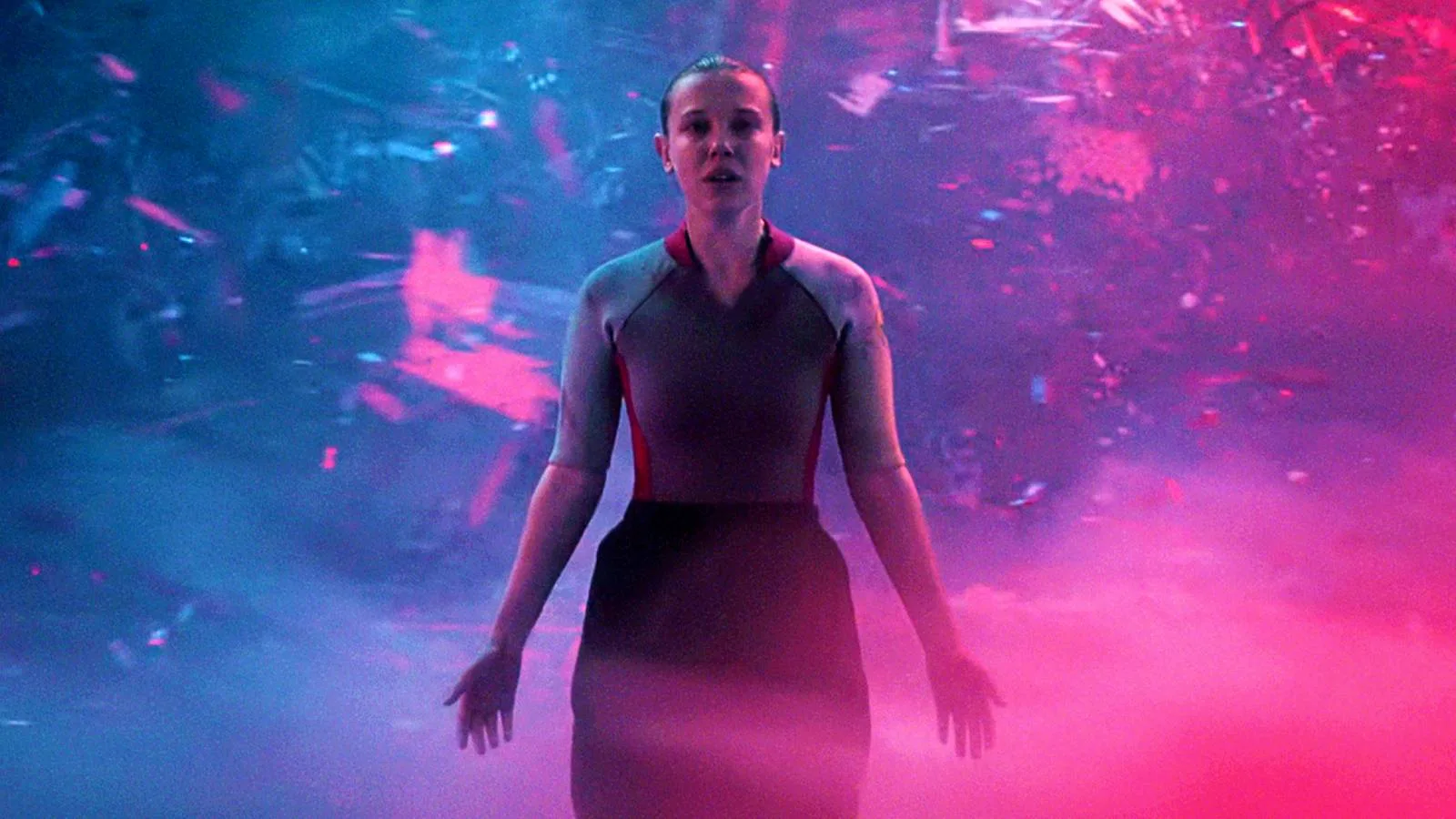
Eleven’s sacrifice is the defining thematic moment. She chooses to end the cycle of institutional abuse by preventing her blood from being used to seed new “super-children.” This is a heavy, selfless decision. She recognizes that her existence is a product of a violent system and decides to break the chain. It is a rejection of her status as a “weapon of the state.”
The “Icelandic Mystery” introduces a layer of ambiguity. Mike’s version of events—where Kali uses her powers to fake Eleven’s death—offers a glimmer of hope. The image of Eleven hiking in the mountains of Iceland is haunting. We are left to wonder if this is reality or a necessary fiction Mike created to cope with loss. It is a “Schrödinger’s Hero” scenario that allows the audience to choose between realism and optimism.
Kali’s role is significant here. Her sacrifice is driven by a desire to give Eleven a life outside of their shared trauma. It is an act of sisterly devotion that adds purpose to a character that many felt was a narrative outlier in earlier seasons.
The 18-month epilogue provides the “closure of the mundane.” We see the characters moving on, scarred but functional. The time jump acknowledges that the conflict was not just a weekend adventure; it was a life-altering event. The scars on Hawkins are permanent, yet the town persists. This mirrors the way real-world communities recover from systemic trauma.
The final D&D game serves as the ultimate metaphor. The “magic” has to leave Hawkins for the kids to grow up. Moving from childhood to adulthood involves putting away the campaign books, even if you keep them on the shelf for later. The story is passed on, and the monsters are defeated. The bonds formed around the table are the only things that truly matter in the end. The campaign is over, but the players remain.
The series finale of the cultural phenomenon Stranger Things premiered on Netflix on New Year’s Eve, December 31, 2025. This highly anticipated episode, titled “The Rightside Up,” serves as the final chapter in the story of Hawkins and the Upside Down. Fans can currently stream the entire fifth season on Netflix, where the finale was released as a standalone global event to conclude the saga. The episode was also featured in select theater screenings across the country, allowing audiences to experience the end of the Party’s journey on the big screen.
Full Credits
Title: Stranger Things Season 5 Episode 8: The Rightside Up
Distributor: Netflix
Release date: December 31, 2025
Rating: TV-14
Running time: 120 minutes
Director: Matt Duffer, Ross Duffer
Writers: Matt Duffer, Ross Duffer
Producers and Executive Producers: Matt Duffer, Ross Duffer, Shawn Levy, Dan Cohen, Iain Paterson, Curtis Gwinn
Cast: Winona Ryder, David Harbour, Finn Wolfhard, Millie Bobby Brown, Gaten Matarazzo, Caleb McLaughlin, Noah Schnapp, Sadie Sink, Natalia Dyer, Charlie Heaton, Joe Keery, Maya Hawke, Brett Gelman, Priah Ferguson, Jamie Campbell Bower, Linda Hamilton
Director of Photography (Cinematographer): Caleb Heymann, Ricardo Diaz
Editors: Dean Zimmerman, Kevin D. Ross, Nat Fuller, Katheryn Naranjo, Casey Cichocki
Composer: Kyle Dixon, Michael Stein
The Review
Stranger Things Season 5 Finale
Stranger Things Season 5 Finale delivers an emotionally resonant, if occasionally overstuffed, farewell to the citizens of Hawkins. While the narrative sometimes buckles under the weight of its own mythology and heavy digital artifice, the Duffer Brothers prioritize the internal lives of their characters. The finale succeeds as a "bittersweet transition" from the magic of childhood to the stark realities of adulthood. It offers closure without sacrificing the series' core identity. Despite some predictable beats and pacing issues, the finale remains a triumphant, sincere conclusion to a decade-defining phenomenon.
PROS
- Deeply moving and authentic resolutions for the core cast.
- Iconic needle drops that heighten the emotional stakes.
- Mature exploration of trauma, legacy, and the end of childhood.
CONS
- A jarring shift between high-stakes action and a lengthy epilogue.
- Occasional over-reliance on digital environments over practical horror.
- Some origin reveals felt redundant or less impactful than previous seasons.