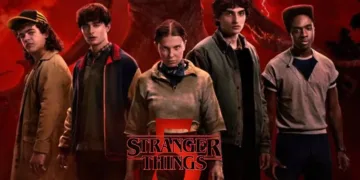











The fifth season of Stranger Things reaches its penultimate arc with a palpable sense of inevitability. In this second volume, Hawkins exists in fragments. The narrative divides itself among the town’s physical rot, the biological nightmare of the Upside Down, and the psychological detritus of Henry Creel’s consciousness. Twelve children have vanished into the dark geometry of Vecna’s design. The stakes are existential.
Will Byers functions as a tragic conduit in this schema. The revelation that he possesses powers akin to Eleven’s supplies a blunt instrument, and yet that instrument behaves like a spiritual parasite. Will must touch the hive mind to act. That requirement renders him continuously exposed and painfully vulnerable. The sequence reads like a moral parable about youth forced to interface with vast, toxic networks in order to claim agency.
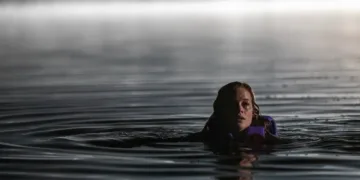
The clock becomes a literal force. Max and Holly Wheeler drift through a mental purgatory while their bodies wait in the world. The Duffer Brothers have recast the idea of home as contested territory. The younger characters carry the accumulated damage of a world that was already broken. They are tasked with stitching a torn reality back together before the seams give.
The Architecture of the In-Between
Volume 2 occupies what I call the “Narrative Perigee.” It is a three-episode arc where the story circles the drain of its ending without quite falling in. Each installment runs over an hour. That length lets the season act as a bridge between an initial spark and an approaching conflagration. It reads like a middle chapter written in slow motion.
Pacing here rejects the frantic energy of the previous volume. The rhythm favors a methodical accrual of facts. Much of the season is exposition: characters sitting in basements or ruins talking through the “how” of survival. Viewers who want an immediate payoff may feel impatient. The show has spent nearly a decade constructing its mythology, and this accumulation feels necessary to clarify stakes and mechanics. Episodes advance the plot while withholding closure.
Netflix’s split-release strategy produces an odd cultural afterimage. Dividing the finale into three parts intentionally stalls momentum. The effect is what I label “Chronological Frustration.” Tension remains high, and the gaps between releases force the audience to live with dread. It is efficient franchise management; it is also exhausting.
The atmosphere has darkened. Hawkins no longer functions as a cozy Spielbergian backdrop. Hawkins is a decaying corpse. The show’s visual grammar insists on doom. That aesthetic evokes the late Cold War’s ambient anxiety, when the threat of erasure hummed under family life.
Vessels, Sisters, and the Forgotten
The ensemble negotiates a Darwinian battle for screen time. Some performances arrest the attention. Sadie Sink continues to anchor the emotional reality of the series as Max. She acts opposite Nell Fisher’s Holly Wheeler; Fisher is a revelation, bringing a genuine unspoiled curiosity to a group hardened by trauma.

Gaten Matarazzo gives his most mature performance to date. As Dustin, he carries the ghost of Eddie Munson in each scene; his grief functions as a tangible weight. Maya Hawke and Natalia Dyer emerge as leaders who have moved beyond the adults around them. Their independence highlights the fraying of traditional parental authority during crisis.
Linnea Berthelsen’s return as Kali adjusts the series’ own history. The depiction of Kali’s sisterly bond with Eleven complicates the moral ledger of their powers. Kali articulates a stance I label “Traumatic Pragmatism.” She questions whether a happy ending can exist for those who began life inside a laboratory.
The script does not serve every character equally. Eleven feels oddly sidelined; in these chapters she resembles a symbol more than a person. Hopper and Joyce recede toward the margins, awaiting the children’s labor. Linda Hamilton’s Dr. Kay arrives as an unresolved presence. The role reads like a promising cameo without a clear purpose, which is an underuse of a genre icon.
The Physics of the Nightmare
The show finally demonstrates the mechanics of the Upside Down. I call this material “Quantum Lore.” Characters such as Mr. Clarke and Dustin unpack the abyss’s rules. Exotic matter appears as the adhesive between dimensions, a touch that grounds the supernatural in a pseudo-scientific frame that feels intentionally 1980s.

Wormholes are shown functioning as literal bridges between our reality and the mirror world below. The intellectualization of the horror increases menace by implying Vecna’s plan adheres to a kind of physical logic. The Creel House’s history within the mindscape receives further excavation. The sequence serves as a reminder that major evils often have domestic origins.
The season leans heavily on the stage play The First Shadow. Several revelations about Henry Creel are drawn from that medium. For viewers who have not seen the London production, some of these moments land as abrupt mythology. The choice assumes a degree of transmedia devotion that not every audience member will possess.
Storylines circle back to first-season mysteries. The government’s number program expands on-screen. The lab’s experiments are cast in a clearer light. The structure acts as a “Circular Narrative” device: the past furnishes the tools for the future, and old secrets function as the only remaining weapons.
The Aesthetic of the End
Production values are undeniably massive. Distinct directorial voices provide textured variation across episodes. Frank Darabont injects a “Claustrophobic Thriller” energy into Chapter Five; his experience with prison narratives translates into a sustained feeling of entrapment in a dying town. Shawn Levy takes on the mythic heft of Chapter Six with an expansive, cinematic approach.

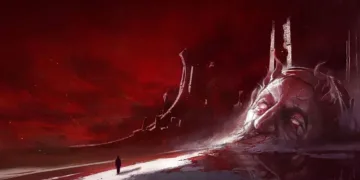
Visual effects underline the scope of decay. The transformation of Hawkins Lab into a biological slurry stands out. The sequence is at once repulsive and beautiful. The Upside Down has moved beyond flat blue filters; it now reads as a tangible, moist environment. I call it a “Living Necropolis.”
Action peaks are grand and lack the guerilla texture of earlier seasons. Sieges on hospitals and telekinetic showdowns unfold like high-budget blockbusters. Those wide frames emphasize scale but sometimes shrink characters to figurines on an expensive set. The intimacy that earlier battles possessed is occasionally absent.
Nostalgia receives a surgical calibration. Neon and pop songs are more restrained. The series places emphasis on its own visual legacy rather than on cultural pastiche. The contrast between a vibrant, sunlit real world and monochromatic mindscapes is stark, a color code that orients the viewer to each character’s subjective reality. The effect is not fond retrospection. It is the portrait of a world in decline.
Stranger Things Season 5 Vol. 2 premiered on Netflix on December 25, 2025. This installment consists of three episodes that continue the final season’s narrative as the group prepares for their ultimate confrontation with Vecna. The volume is currently available for streaming exclusively on Netflix, leading into the series finale scheduled for release on December 31, 2025.
Full Credits
Title: Stranger Things Season 5 Vol. 2
Distributor: Netflix
Release date: December 25, 2025
Rating: TV-14
Running time: 68 minutes (Episode 5), 75 minutes (Episode 6), 66 minutes (Episode 7)
Director: Frank Darabont, Shawn Levy, Matt Duffer, Ross Duffer
Writers: Matt Duffer, Ross Duffer, Curtis Gwinn, Kate Trefry
Producers and Executive Producers: Matt Duffer, Ross Duffer, Shawn Levy, Dan Cohen, Iain Paterson
Cast: Winona Ryder, David Harbour, Millie Bobby Brown, Finn Wolfhard, Gaten Matarazzo, Caleb McLaughlin, Noah Schnapp, Sadie Sink, Natalia Dyer, Charlie Heaton, Joe Keery, Maya Hawke, Priah Ferguson, Brett Gelman, Cara Buono, Jamie Campbell Bower, Linda Hamilton, Nell Fisher, Jake Connelly, Amybeth McNulty, Linnea Berthelsen, Alex Breaux
Director of Photography (Cinematographer): Tim Ives, Tod Campbell, Lachlan Milne, David Franco, Ricardo Diaz, Caleb Heymann, Brett Jutkiewicz
Editors: Dean Zimmerman, Kevin D. Ross, Nat Fuller, Katheryn Naranjo, Casey Cichocki
Composer: Michael Stein, Kyle Dixon
The Review
Stranger Things Season 5 Vol. 2
This volume serves as a somber transition. It trades earlier spectacle for a heavy, academic study of its own lore. The focus on younger characters like Holly Wheeler brings a raw honesty to the screen. Some leads fade into the background. Still, the visual scale and emotional weight remain significant. It is a necessary, if dense, path toward the final curtain.
PROS
- Exceptional performances by Sadie Sink and Nell Fisher.
- Clearer explanations of the Upside Down and exotic matter.
- The return of Eight provides a meaningful arc for Eleven.
- High-level production design and atmospheric tension.
CONS
- Excessive exposition that slows the narrative flow.
- Main characters like Eleven and Hopper are underutilized.
- Heavy reliance on external stage play knowledge.
- Fragmented storytelling that stalls momentum.