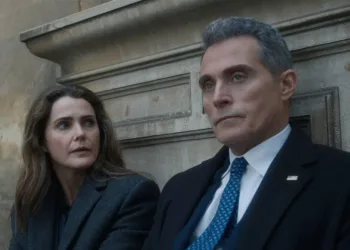





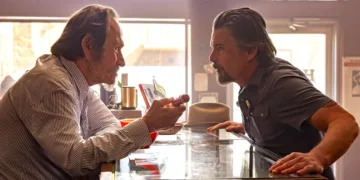








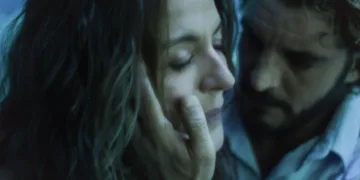
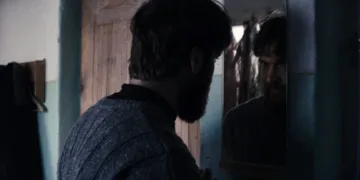









British television has a habit of treating prison as pure spectacle: bodies in pain, lives stacked like inventory, the state’s mess filed behind locked doors. Waiting for the Out takes prison seriously in a different way. Across six episodes, it treats confinement as a pressure chamber for ideas, where thought becomes a survival tool and philosophy turns into a form of self-interrogation.
Dan, an academic, arrives with a familiar contemporary ambition: he wants to connect university theory to the daily conditions of people written off as disposable. Teaching philosophy to inmates becomes his chosen collision of social worlds. His presence also carries private stakes. His family history is marked by incarceration, so every lesson doubles as a professional act and a personal accounting.
That emphasis on interior crisis speaks to a rising current in global storytelling, especially on streaming platforms, where character psychology can feel as hazardous as any physical setting. The series anchors its debates in John Locke and René Descartes, asking viewers to look at incarcerated men as thinking subjects with the capacity for deep reflection. The show’s politics land through attention and insistence: it frames the prison population as people with minds worth hearing, then asks why society so often prefers its “undesirables” quiet, simplified, and spiritually absent.
The Intellectual Battlefield of the Prison
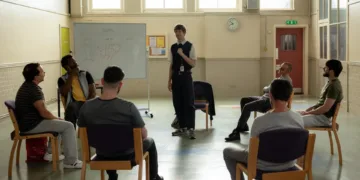
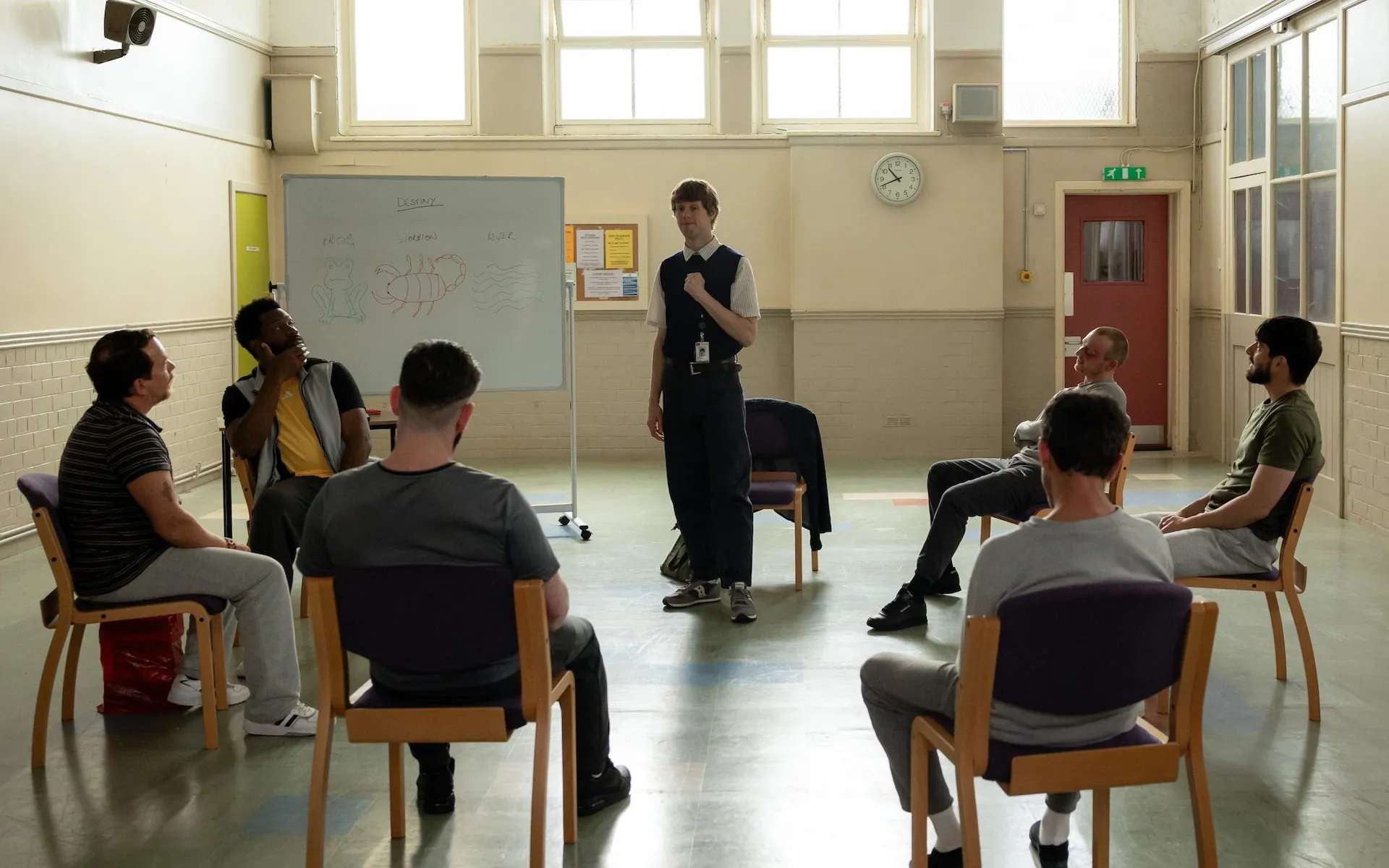
The prison classroom plays like a high-stakes arena, with abstract concepts tested against the blunt facts of life sentences. Dan’s beginner sessions draw an intensity that could embarrass a polite university seminar. For these men, freedom and morality are not conversation starters. They are daily calculations.
One inmate offers a startling definition of liberty that presses against familiar liberal assumptions. He argues that imprisonment has given him a strange total freedom from the demands of the outside world. Bills no longer stalk him. Grocery shopping no longer waits in the queue of chores. Finding a dentist no longer becomes a logistical headache. In his telling, a life with fewer choices can feel like a kind of release, and he presents that claim with the calm certainty of someone who has tested it against his own days.
The class’s temperature rises again during a discussion of the scorpion and the frog. The fable forces a direct confrontation with the possibility of innate badness and the possibility of change. Keith, played by Alex Ferns, emerges as Dan’s intellectual match, armed with a gift for puncturing academic performance.
His description of Slavoj Žižek as the “Billy Connolly of philosophy” lands as a joke with teeth, announcing that celebrity thinkers hold no power here. The room also follows its own social contract. Every man has been judged by the state, branded a failure in official terms, and that shared status turns judgment of one another into a forbidden act. The result is an oddly permissive space where the entry fee is honesty with yourself.
The Internal Prison of the Mind
The inmates face concrete walls. Dan lives inside a psychological structure built from the wreckage of his past. His severe obsessive compulsive disorder functions as a frantic attempt to impose control on a world he experiences as threatening. The series gives this condition a grim, repetitive shape through his gas hob checks. He photographs the appliance again and again, building a digital archive meant to silence the intrusive fear that he has left his home primed for disaster.

That ritual ties to the “executioner” voice inside him, an echo of his father’s influence that keeps issuing verdicts. Gerard Kearns plays the hallucinated father with a predatory force. This figure appears at Dan’s weakest moments, a living warning label stamped onto his bloodline, reminding him that violence sits in his inheritance.
A major strain in the series comes from the gap between Dan’s polished Shoreditch presentation and his private certainty that he belongs on the inside, a criminal whose capture simply has not happened. He dresses and speaks like an academic insider while feeling like an impostor running lines from a script. Prison becomes a brutal reflector for that anxiety, forcing him to see his father’s legacy as a sentence still active, untouched by career success.
His identity becomes another site of performance. Dan lives as a closeted heterosexual, finding it easier to occupy the prisoners’ assumptions than to explain the complexity of who he is. Masculinity becomes the show’s recurring pressure point, presented as something enforced through expectation and fear. Dan’s idea of what it means to be “a man” in this setting keeps circling back to survival, and survival keeps circling back to a violent past he cannot stop rehearsing.
Narrative Structure and Supporting Dynamics
The show’s impact comes through restraint. Its visual approach stays grounded, avoiding the glossy showmanship that often defines expensive streaming drama. The 45-minute structure keeps the pace tight, so the philosophical material holds dramatic weight instead of sliding into lecture. That rhythm also leaves room for Dan’s life beyond the walls, especially his relationship with his brother Lee.
Stephen Wight gives Lee a quiet dignity, shaping him as someone who has already endured addiction and imprisonment. Lee carries an acceptance of the past that Dan cannot access. Their scenes sharpen a bitter irony: the brother who moves through the world freely is the one most immobilized by history.
Humor acts as a pressure release for material this heavy. The guards assume Dan is gay, and the series plays the irony cleanly. Dan finds a strange comfort in their mistaken certainty, since it lets him exist in the prison without the aggressive masculinity he links to his father. The inmates bring their own emotional grounding.
Francis Lovehall is devastating as Dris, and the plotline about an administrative error that keeps Dris imprisoned past his release date lands as a direct accusation at bureaucratic indifference. A life gets derailed by a ledger mistake, and the show treats that reality as terror in plain paperwork. Across these performances, the series keeps the human stakes in view, making sure its big ideas stay attached to the people forced to live with them.
Waiting for the Out premiered on BBC One on January 3, 2026, and is currently available for streaming in its entirety on BBC iPlayer. This six-part drama follows the life of a philosophy teacher working within the British prison system while navigating his own complex family history of incarceration and mental health struggles.
Full Credits
Title: Waiting for the Out
Distributor: BBC One, BBC iPlayer
Release date: January 3, 2026
Rating: 15
Running time: 45 minutes
Director: Jeanette Nordahl, Ben Palmer
Writers: Dennis Kelly, Levi David Addai, Ric Renton
Producers and Executive Producers: Ken Horn, Louise Sutton, Dennis Kelly, Jane Featherstone, Chris Fry, Katie Carpenter, Andy West, Tanya Qureshi
Cast: Josh Finan, Francis Lovehall, Gerard Kearns, Samantha Spiro, Phil Daniels, Stephen Wight, Alex Ferns, Ronkẹ Adékoluẹjo, Neal Barry, Josef Altin, Steven Meo, Ric Renton, Tom Moutchi, Nima Taleghani, Sule Rimi, Charlie Rix, Jude Mack
The Review
Waiting for the Out
Waiting for the Out succeeds as a thoughtful meditation on the limits of autonomy and the enduring power of legacy. By placing philosophical inquiry within the stagnant air of a prison cell, the series forces a confrontation between theory and lived reality. It avoids the easy traps of sensationalism, offering instead a quiet, devastating look at masculinity and mental health. While the pacing demands patience, the performances and intellectual depth provide a rewarding experience. It is a rare drama that trusts its audience to sit with ambiguity and find beauty in the chaos of the human condition.
PROS
- Josh Finan and Alex Ferns provide a masterclass in understated tension and intellectual rivalry.
- The series handles complex philosophical concepts and mental health struggles with genuine insight and sensitivity.
- It subverts carceral stereotypes by focusing on the intellectual life of the incarcerated rather than just their crimes.
- The 45-minute format ensures the narrative remains tight and avoids the bloat common in modern streaming.
CONS
- Some viewers may find the slow, conversational nature of the plot less engaging than traditional thrillers.
- Occasional moments in the childhood sequences lean toward familiar tropes of domestic trauma.