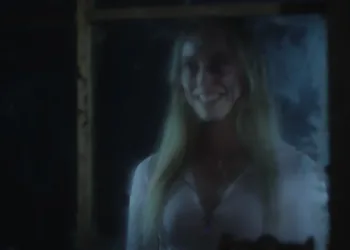


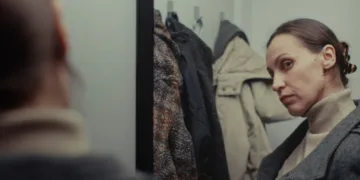
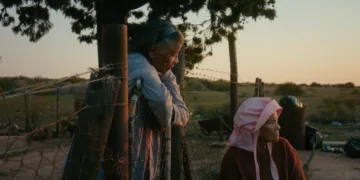























The letters HKN KRZ sit on a black T-shirt before the first formal argument reaches the courtroom in eastern Germany. The code points to the swastika and sets the tone in Faraz Shariat’s Prosecution, released in Germany as Staatsschutz. The film follows Seyo Kim, a state lawyer of Korean descent, played by Chen Emilie Yan with a hard, controlled chill. She works inside a legal order that names itself the most objective system in the world.
Shariat frames that order through cement-grey brutalist architecture, turning public space into an image of a state that prizes procedure and silence. The balance of this clinical routine breaks during a bicycle ride through a public park. A male cyclist forces Seyo into a crash on purpose. While she is on the pavement, Molotov cocktails filled with acid and flammable liquid are thrown from an overpass.
The attack is deliberate and ideological. In the first moments after the assault, Seyo refuses the expected posture of the injured victim. She puts on a hazmat suit and instructs police to secure the scene, placing evidence preservation above the burns on her neck. That discipline opens a rift with her superior, Forch, who insists that she stay a detached observer of her own attempted murder.
The Aesthetic of Defiance
Seyo Kim’s movement from state functionary to defiant investigator appears through a full break with the visual code of the law. Chen Emilie Yan shapes the performance around visible shifts in posture and movement, giving internal fury a sharp physical form. Seyo leaves the prosecutor’s office wardrobe behind and adopts a black leather jacket and a jagged haircut she gives herself.
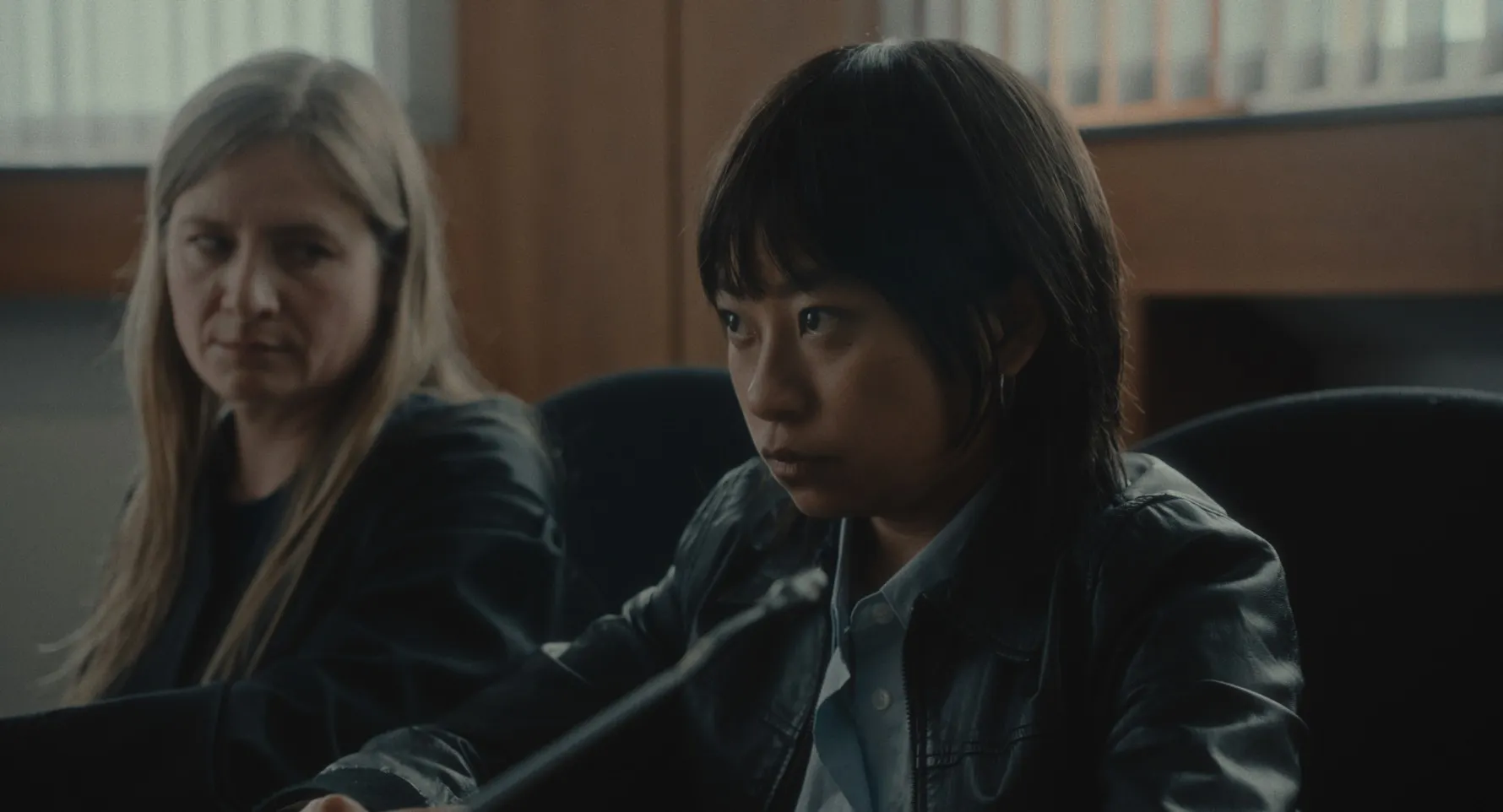
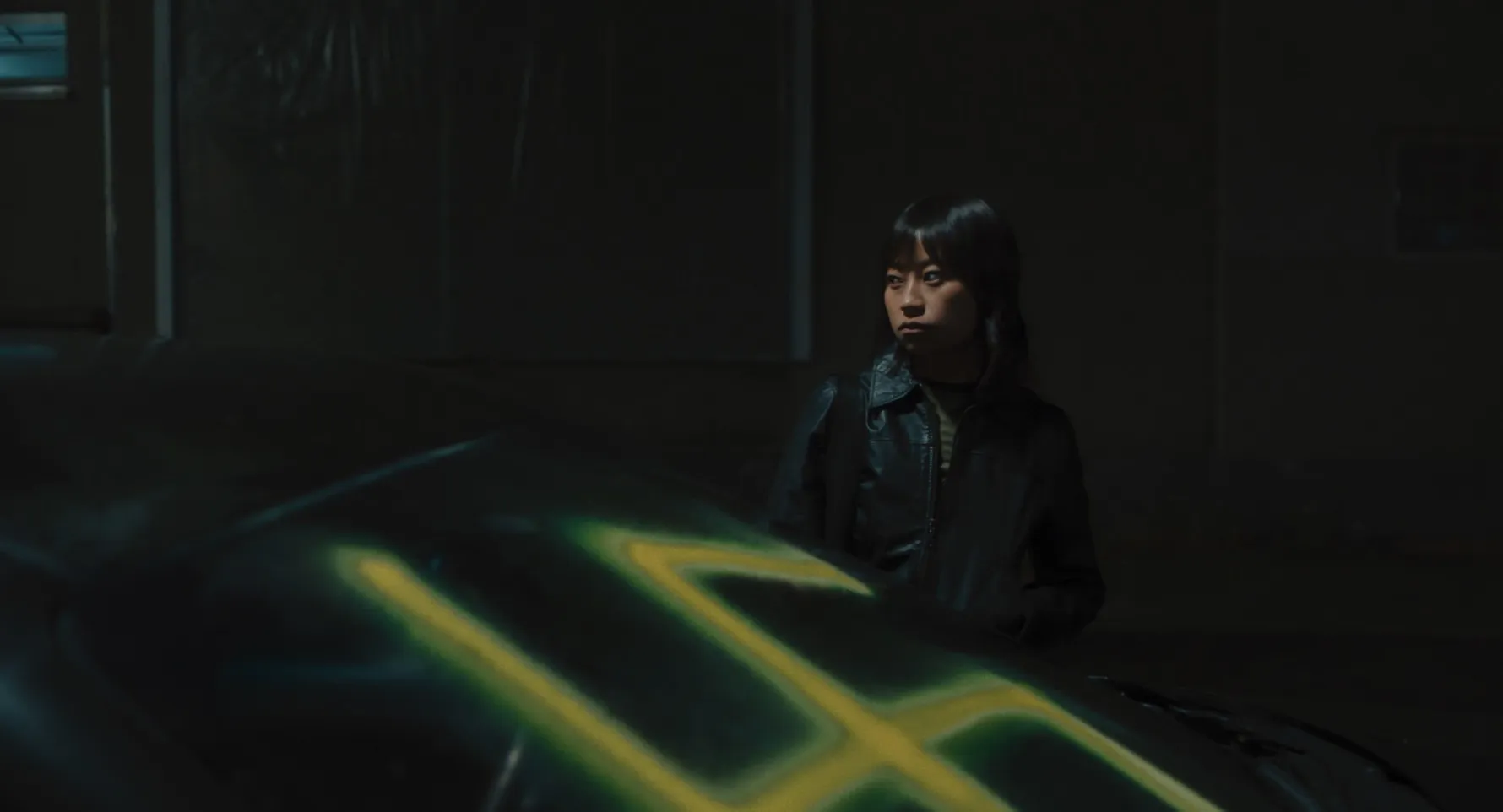
The new look places her in the lineage of the cinematic antihero and invites comparison with the cold resolve associated with figures such as Lisbeth Salander. Her main vehicle becomes a matte-black Dodge Challenger, used as a dense, armored extension of will. It moves through the mild Bavarian landscape with a loud engine that announces presence and refusal. Her investigative tactics become desperate and ethically damaged.
She steals keys from colleagues and enters restricted records rooms. She issues subpoenas that force vulnerable, frightened immigrants to testify in open court. The film uses these choices to show a prosecutor prepared to fracture the system she serves.
Her private life reinforces the same isolation. She speaks German to her father while he answers only in Korean, and her relationship with her girlfriend, Min-su, survives as a chain of missed connections. The portrait that emerges is of a woman working alone inside a society that treats her presence like a bureaucratic irregularity.
Acoustic Pressure and Visual Surveillance
The tension in Prosecution grows from a precise collaboration between Faraz Shariat and the film’s technical team. Cinematographer Lotta Kilian relies on long lenses and wide framing to place Seyo inside cold, impersonal spaces. The effect creates a steady sense of observation, turning the city into a field of surveillance.
Henning Hein’s sound design removes the comfort of a conventional musical score and builds pressure from institutional noise. A photocopier’s rhythmic churn, footsteps echoing through a linoleum corridor, and the hard crack of a slamming door produce an atmosphere thick with administrative dread. These sounds hit with bodily weight and make bureaucracy feel active and hostile.
The investigation’s pacing mirrors that pressure. Sequences of Seyo searching dusty archives carry the nervous pulse of a spy thriller through the editing. The courtroom scenes answer that quiet with disturbance. Spectators hoot and holler at the judge’s rulings, and the proceedings slide toward a tense circus.
The legal process becomes a theater of absurdity where the law’s dignity appears thin and unstable. The stripped-down acoustic design leaves every spoken line exposed, charged, and dangerous, so routine administration plays like a game of cat and mouse.
The Myth of Institutional Objectivity
The title Staatsschutz invokes state protection, and the film keeps asking which state receives that protection. Faraz Shariat draws from extensive research on far-right violence and on failures linked to the NSU investigations, using that material to indict a system with a persistent blind spot toward racialized extremism. The narrative maps the paradox inside objectivity itself.
Neutral procedure can shield ideologies aimed at tearing down democratic order. The judicial machinery reveals a double standard in practice. Neo-Nazi defendants often receive professional courtesy, and that courtesy stands out sharply beside the treatment the state gives left-wing political activists. A character states that the same attack, committed by a different demographic, would trigger a national emergency, while this violence gets framed as an isolated incident.
Seyo is caught in a cycle described as whack-a-mole, where one conviction leaves the wider structure of hate untouched. Her choice to investigate her own case against direct orders marks a recognition about the system’s design and its limits in relation to her life. The film presents a state invested in protecting its reputation for fairness, even while that fairness leaves the victim behind. Justice here arrives through struggle, strategy, and the deliberate crossing of institutional lines.
Prosecution (originally titled Staatsschutz) had its world premiere at the 76th Berlin International Film Festival on February 15, 2026, where it screened in the Panorama section and won the prestigious Panorama Audience Award. Directed by Faraz Shariat, the film follows a German-Korean state prosecutor who, after surviving a racially motivated arson attack, decides to investigate her own case to expose institutional failures and systemic right-wing extremism. Currently, the film is primarily available through festival circuits and is scheduled for a wider theatrical release in Germany via Plaion Pictures later in 2026; streaming availability on global platforms has not yet been announced as of today, February 24, 2026.
Where to Watch Prosecution (2026) Online
Full Credits
Title: Prosecution (Staatsschutz)
Distributor: Plaion Pictures (Germany), New Europe Film Sales (International)
Release date: February 15, 2026
Running time: 113 minutes
Director: Faraz Shariat
Writers: Claudia Schaefer, Jee-Un Kim, Dr. Sun-Ju Choi
Producers and Executive Producers: Paulina Lorenz, Jorgo Narjes, Faraz Shariat
Cast: Chen Emilie Yan, Julia Jentsch, Alev Irmak, Arnd Klawitter, Sebastian Urzendowsky, Kathrin Angerer, Max Krause, Kotbong Yang
Director of Photography (Cinematographer): Lotta Kilian
Editors: Friederike Hohmuth
Composer: Gabríel Ólafs
The Review
Prosecution
Prosecution is a jagged, necessary entry into the legal thriller genre that replaces courtroom sentimentality with structural dread. Faraz Shariat successfully trades the comfort of a "just" system for a gritty, vigilante-adjacent aesthetic that pulses with tension. While the final act occasionally veers into the improbable, Chen Emilie Yan’s frigid, unwavering performance keeps the narrative grounded. It is a film that refuses to offer easy catharsis, instead leaving the viewer with the uncomfortable realization that in a system obsessed with its own neutrality, true justice requires a personal and ethical cost.
PROS
- A masterclass in suppressed rage and professional coldness.
- The use of institutional noises creates a unique, visceral sense of anxiety.
- Effectively deconstructs the myth of judicial objectivity without being preachy.
CONS
- Some courtroom scenes and police interactions strain the limits of credibility.
- The shift into "vigilante" territory can occasionally feel like a populist retreat.
- Some supporting roles feel more like ideological archetypes than lived-in people.