





















White Man Walking captures a volatile stretch of American life with unusual clarity. The year 2020 remains fixed in public memory as a period of social upheaval after the killing of George Floyd. In that climate of grief and anger, filmmaker Rob Bliss shifts away from the large-scale social events that defined much of his earlier work and commits to a solitary protest.
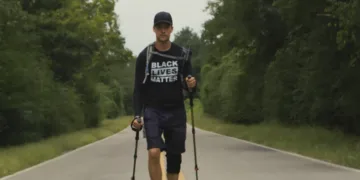
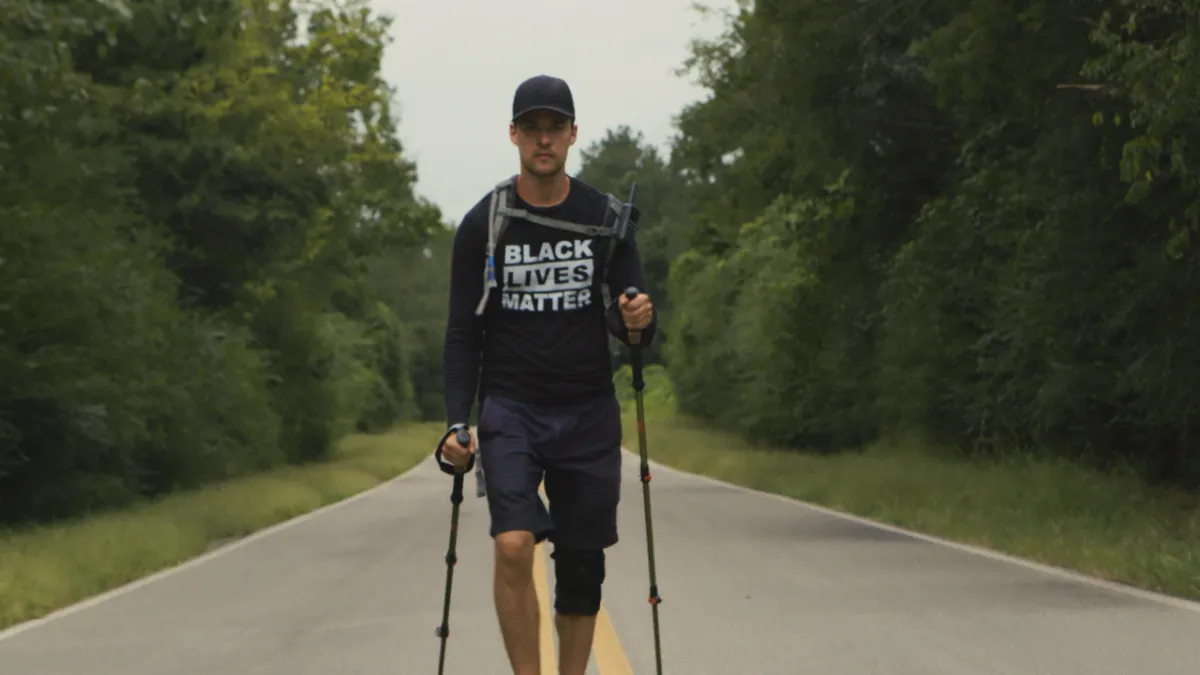
He undertakes a 1,500-mile walk beginning at the Civil Rights Museum in Jackson, Mississippi, with Black Lives Matter Plaza in Washington D.C. as his destination. Bliss wears one t-shirt for the entire trip. The front bears the name Black Lives Matter in bold lettering. The back carries a hand-drawn invitation asking others to walk with him. That visual setup becomes the central image of the film across a sixty-day expedition.
He aims to arrive in the capital shortly before the 2020 presidential election. The documentary leaves aside familiar campaign rhetoric and stays focused on the immediate reality of one man moving through a country that seems increasingly estranged from itself.
The Gritty Reality of the Long Road
The physical strain of the expedition removes the polish often associated with mainstream documentary storytelling. Bliss keeps a punishing routine of 25 miles a day on foot. He is not a trained athlete, and the film makes the cost of that effort plain.
The camera records foot pain, fatigue, and the slow accumulation of exhaustion across two months on the road. Co-director Denise Alder and a small crew track his progress, capturing unscripted encounters that carry a real sense of risk. The project marks a major shift from the viral and playful material Bliss made before. He leaves behind pillow fights and moves into a grounded style built on endurance and uncertainty.
The route itself matters. Those 1,500 miles take him through the American South and through states that voted heavily for Donald Trump, placing him inside a sharply defined cultural terrain. One of the film’s strongest recurring devices comes through audio from Bliss’s mother.
Her voicemails play over the images like a ghostly companion to the walk. They stress the danger he faces and make the stakes feel personal for his family. The messages bring the documentary back to a domestic frame and remind viewers that the activist on screen is also someone’s son.
Faces of a Fractured America
Bliss draws out a broad range of reactions, and those reactions expose the depth of the country’s divide. Hostility arrives early and keeps returning. People shout racial slurs. Drivers flash middle fingers from passing cars. A few encounters become openly frightening, including moments in which people display guns on their own property.
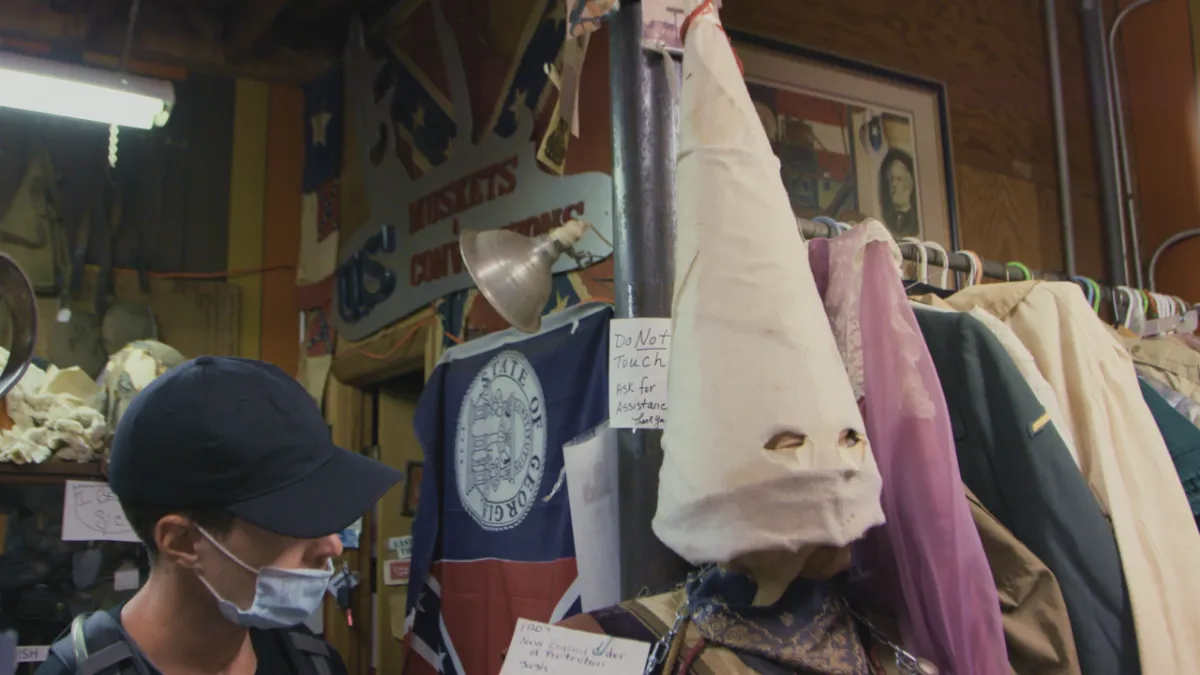
The film places these scenes alongside a key interaction with a Trump supporter named Finley, whose truck is covered in political marketing. Their conversation stays civil, and they walk together for a short stretch. The scene opens space for the idea that contact can still happen across opposing political identities.
Support appears in other forms. Activists such as Kiara Yakita show up, and a Black woman in Georgia offers Bliss her gratitude. These exchanges push the film toward a sharp recognition of privilege. Black citizens advise Bliss about neighborhoods that are too dangerous for his mission.
He faces the irony of relying on his white privilege while entering spaces where Black activists would face far greater danger. The documentary handles these moments with a plainspoken style that avoids lectures and gives the participants room to speak in their own voices.
The Power of Moral Visibility
The film keeps asking a difficult question about the walk itself. Is this a meaningful tool for connection, or does it drift toward performative liberalism? The Black Lives Matter shirt functions as a social trigger. It compels strangers to respond and draws them into engagement instead of silence inside separate bubbles. Bliss works from an idea of good trouble, using public visibility as a path toward some version of national unity. In town after town, the logo ignites arguments about race, belonging, and who gets to claim public space.
The final stretch in Washington D.C. carries one of the film’s few openly hopeful images. A diverse group joins Bliss for the last mile to the plaza. That shared movement stands in sharp relief against the isolated highway stretches seen earlier. From the vantage point of 2026, the fractures in the United States are still easy to see, and the documentary’s central argument still lands with force.
It insists on talking and listening as the only workable way across the distance between citizens. White Man Walking records what happens when personal conviction meets a stubborn and complicated reality, and it offers a quiet, candid view of how much labor real dialogue requires in a divided nation.
White Man Walking is a timely and provocative feature-length documentary that follows filmmaker Rob Bliss as he embarks on a 1,500-mile solo trek across the American South. Premiering in the UK on BBC Four and iPlayer in May 2025 to mark the fifth anniversary of George Floyd’s death, and later released digitally in the US by Watermelon Pictures on February 3, 2026, the film serves as a visceral social experiment. By wearing a Black Lives Matter t-shirt through rural, Trump-leaning states, Bliss captures raw, unscripted encounters that range from extreme hostility to surprising moments of human connection. The documentary is currently available for streaming on major digital platforms and Watermelon+.
Where to Watch White Man Walking (2025) Online









Full Credits
Title: White Man Walking
Distributor: Watermelon Pictures, BBC Storyville
Release date: May 27, 2025 (United Kingdom), February 3, 2026 (United States)
Running time: 1h 10m
Director: Denise Alder, Rob Bliss
Writers: Paula Farmer
Producers and Executive Producers: Georgia Cassidy, Luti Fagbenle, Maxine Watson, Misan Harriman
Cast: Rob Bliss, Finley, Kiara Yakita, Chanelle Helm, Denise Alder, Georgia Cassidy
Director of Photography (Cinematographer): Rob Bliss
Editors: Denise Alder, Rob Bliss
The Review
White Man Walking
White Man Walking is a bracing, unvarnished look at a nation in conflict. While the central concept occasionally feels like a gimmick, the sincerity of the interactions transforms it into a vital piece of social observation. It succeeds by stripping away political jargon and focusing on the friction of face-to-face encounters. It is a quiet, persistent reminder that understanding begins with the willingness to stand in the path of opposition.
PROS
- Raw, unscripted human interactions that reveal genuine societal attitudes.
- Effective use of personal audio, like the mother’s voicemails, to heighten stakes.
- Avoids a "savior" narrative by highlighting the subject's own fatigue and uncertainty.
- Captures a unique historical window with visceral cinematography.
CONS
- The central premise can feel slightly performative or "viral-focused" at times.
- Limited inclusion of sustained Black perspectives regarding the movement's goals.
- The linear structure occasionally feels repetitive during the middle stretches of the walk.