






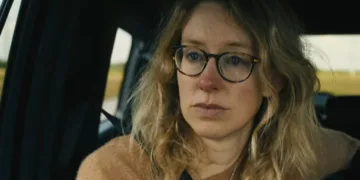













The soil of 17th-century Germany carries the muffled hush left by the Thirty Years War. Through that field of aftershock comes a veteran marked by a jagged scar on the cheek. This figure holds a legal claim to a collapsing farmstead and the drilled discipline of a soldier.
The villagers meet a person of spare speech and hard edges. They do not grasp that their new neighbor is a woman named Rose. She has found refuge in the rough weave of men’s clothing, a way to slip past the sentence of her birth. Safety matters here in plain materials: a coat, a name on papers, a strip of earth that can be defended. Sandra Hüller carries the role with flinty stillness.
She builds a life through coins counted slowly and reconstruction done by hand. Her arrival at a derelict farmstead reads like a first day for someone who already died once in history’s trenches. The village accepts her on the strength of documents and labor. They cannot see the inner scaffolding of survival she has erected. Peasant life feels cramped, severe, and unforgiving. The story moves at a steady pulse, watching a hunger for agency press against the granite weight of religious law.
The Economy of a Stolen Life
Sandra Hüller gives a performance built from physical concentration. She inhabits Rose with a stony lack of vanity, as if the body has learned to speak through restraint. A constant ritual follows her: she sucks on a bullet necklace, keeping close the memory of lead that nearly took her life. Masculinity never becomes pantomime here. The role of provider becomes a practice, a tool for endurance that she wields with care and exhaustion. The villagers label her the soldier, the master, and she carries those titles like masks already warmed by use.
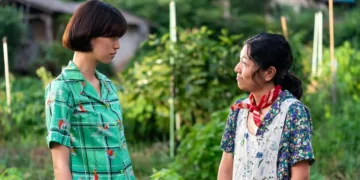
Caro Braun, beside her, plays Suzanna with unexpected depth. Suzanna enters as a quiet bride exchanged for land rights in a deal made by her father. Soon she sharpens into an attentive witness to the domestic life they share, watching the small mechanics of power inside a home.
The film treats the news of Suzanna’s pregnancy with dry irony. Rose meets the surreal logic of fatherhood with a double-take of pure cinematic brilliance, a flicker of disbelief that lands like a confession she cannot speak. In private hours, she relies on makeshift tools to keep the physical illusion intact. The bailiff later names these objects the horn and the spike. The deception becomes labor, repetitive and necessary, another chore among many.
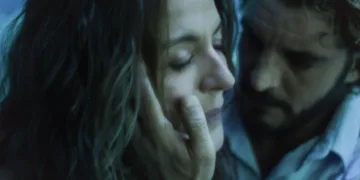
Distance between the two women begins to loosen into tenderness. An injury later tears the disguise away during a moment of bodily crisis. Suzanna does not answer with betrayal. She chooses quiet sorority, an intimacy that feels like a decision made in full awareness of the world outside. Together they fashion a sanctuary inside their home, holding their shared secret as a kind of shelter. Their union reads as fragile resistance to the village’s expectations, a small pact pressed between walls that can never fully keep the law out.
A Monochrome Theology
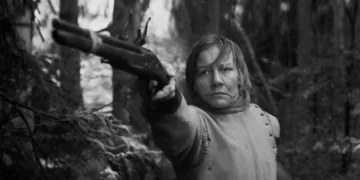
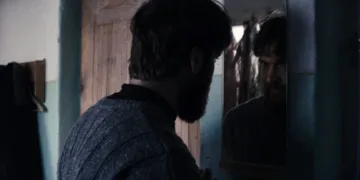
The film’s visual grammar studies shadow and light with severe patience. Gerald Kerkletz shoots in grainy black-and-white, clearing the frame of color so the textures of peasant life can rise to the surface. The production design looks authentically grubby. Mud and timber carry a heaviness that matches the church’s doctrine, thick and inescapable. Scuffed boot heels and weathered beams seem pulled up from the ground, as if the set were an excavation rather than a construction.

Schleinzer leans on wide shots and long takes to create observational gravity. The approach recalls Carl Theodor Dreyer, turning landscape into a brooding fable. Tara Nome Doyle’s a cappella vocal score offers a haunting counterpoint, her high strains echoing the interior suffering Rose cannot release through speech.
The church sits in a sprawling valley, a constant emblem of spiritual surveillance. Marisa Growaldt’s narration holds a clinical distance. Her tone carries the calm of a teacher recounting a folk tale, and that framing sets warmth in the characters against history’s cold record.
The film runs ninety-three minutes, and the lean edit gives each frame the weight of its idea. The camera stays close to faces, searching for the smallest muscle twitch that might betray the truth under a practiced mask. In this monochrome world, the rigid divide between public role and private soul becomes visible as a kind of geometry, drawn in light, sealed in shadow.
The Weight of the Trousers
The film treats freedom as a practical matter of clothing. Rose believes trousers grant the path to self-determined life, a garment that functions like permission. She understands the patriarchy’s hierarchy: land matters, the male form matters, and the village has built its daily rituals around that order.

Rigid religious piety shapes the community, leaving little space for anyone who lives outside the binary. Schleinzer frames the story like a Western. Rose stands as the lone outsider who wins a place through violence and hard work, earning respect after she kills a bear that threatened their livestock. Integration becomes performance, a steady enactment of power that must be repeated to remain credible.
The narration speaks of wicked deeds. The lived truth is simpler: a woman who wants to own a farm, who wants stability with the intensity of a starving person. That hunger becomes her crime in the eyes of a system that confuses obedience with virtue.
The final act brings the collision between identity and local law, the moment the village’s structure protects itself. Rose meets the unfolding tragedy with remarkable resilience. Shame arrives as an instrument the bailiff tries to use, and she refuses its shape.
The film avoids easy political statements and stays close to survival in a world without mercy. Rose’s life reads as defiance of roles assigned at birth, a stubborn insistence on authorship even while walls tighten. The state’s denial of bodily autonomy becomes the last cruelty, faced with a steady gaze that carries both exhaustion and clarity.
She has claimed her humanity through the deception that keeps her alive, and the law moves to punish the very tactic that allowed a self to exist at all. The film leaves questions hanging in the air, like smoke trapped under rafters: how much of the self can be made from necessity, and how much is lost each time survival demands a mask.
Rose is a haunting historical drama that had its world premiere yesterday, February 15, 2026, in the Official Competition of the 76th Berlinale. Set in the desolate landscape of 17th-century Germany following the Thirty Years’ War, the film follows a mysterious soldier who arrives in a remote village to claim a farmstead, hiding the secret that they are a woman living under a male identity. Currently, the film is completing its festival run and is scheduled for a theatrical rollout in Austria and Germany this April. For international audiences, streaming and wider theatrical availability are expected to be announced following its market screenings at the European Film Market.
Full Credits
Title: Rose
Distributor: Filmladen Filmverleih GmbH, The Match Factory
Release date: February 15, 2026 (Berlinale Premiere), April 17, 2026 (Austria), April 30, 2026 (Germany)
Running time: 93 Minutes
Director: Markus Schleinzer
Writers: Markus Schleinzer, Alexander Brom
Producers and Executive Producers: Johannes Schubert, Philipp Worm, Tobias Walker, Karsten Stöter
Cast: Sandra Hüller, Caro Braun, Marisa Growaldt, Godehard Giese, Augustino Renken, Sven-Eric Bechtolf, Robert Gwisdek, Stefan Kurt
Director of Photography (Cinematographer): Gerald Kerkletz
Editors: Hansjörg Weißbrich, Monika Willi
Composer: Tara Nome Doyle
The Review
Rose
The film exists as a skeletal reflection of a soul caught between the anvil of history and the hammer of dogma. It is a work of harsh beauty where identity serves as a desperate shield against a world that demands total submission. Sandra Hüller provides the anchor for this existential drift. She transforms a story of deception into a meditation on the cost of self-ownership. While the rigid aesthetic may distance some, the emotional resonance of this struggle for agency remains undeniable. It is a bleak, necessary vision of survival.
PROS
- Sandra Hüller’s masterfully restrained and physical performance.
- The stark, atmospheric black-and-white cinematography of Gerald Kerkletz.
- A complex, non-cliché exploration of gender as a survival mechanism.
- A haunting, visceral a cappella score that grounds the emotional stakes.
CONS
- The clinical, academic tone of the narration can create a sense of distance.
- The formal rigidity and slow pacing may feel inaccessible to some.
- Certain plot developments rely on a level of village ignorance that strains realism.