

























The vast Namibian desert becomes a sunlit stage for the animated feature Tafiti: Across the Desert. A young meerkat lives inside the protective, subterranean world of his family. The story draws from the literary universe created by Julia Boehme, using the 23rd book in the series as the foundation for this screen expansion.
Tafiti’s days are shaped by the stern wisdom of his grandfather, Opapa, whose isolationist code is framed as a survival method against brutal conditions. That uneasy stability breaks when a venomous snake bites the elderly patriarch. The injury triggers an immediate, life-threatening crisis, and the family lacks a traditional remedy that can meet the urgency of the moment.
Hope narrows to a distant myth: a legendary blue flower with miraculous healing properties, said to grow at the far edge of the burning sands. With the loss of his mentor nearing, Tafiti leaves the safety of the burrow. He rejects ancestral warnings about strangers and pursues the cure, turning a medical emergency into a wide, peril-lined search for salvation.
The Friction of Incompatible Kindred
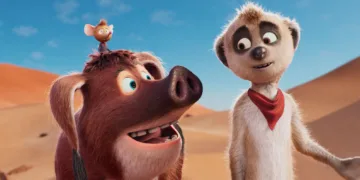
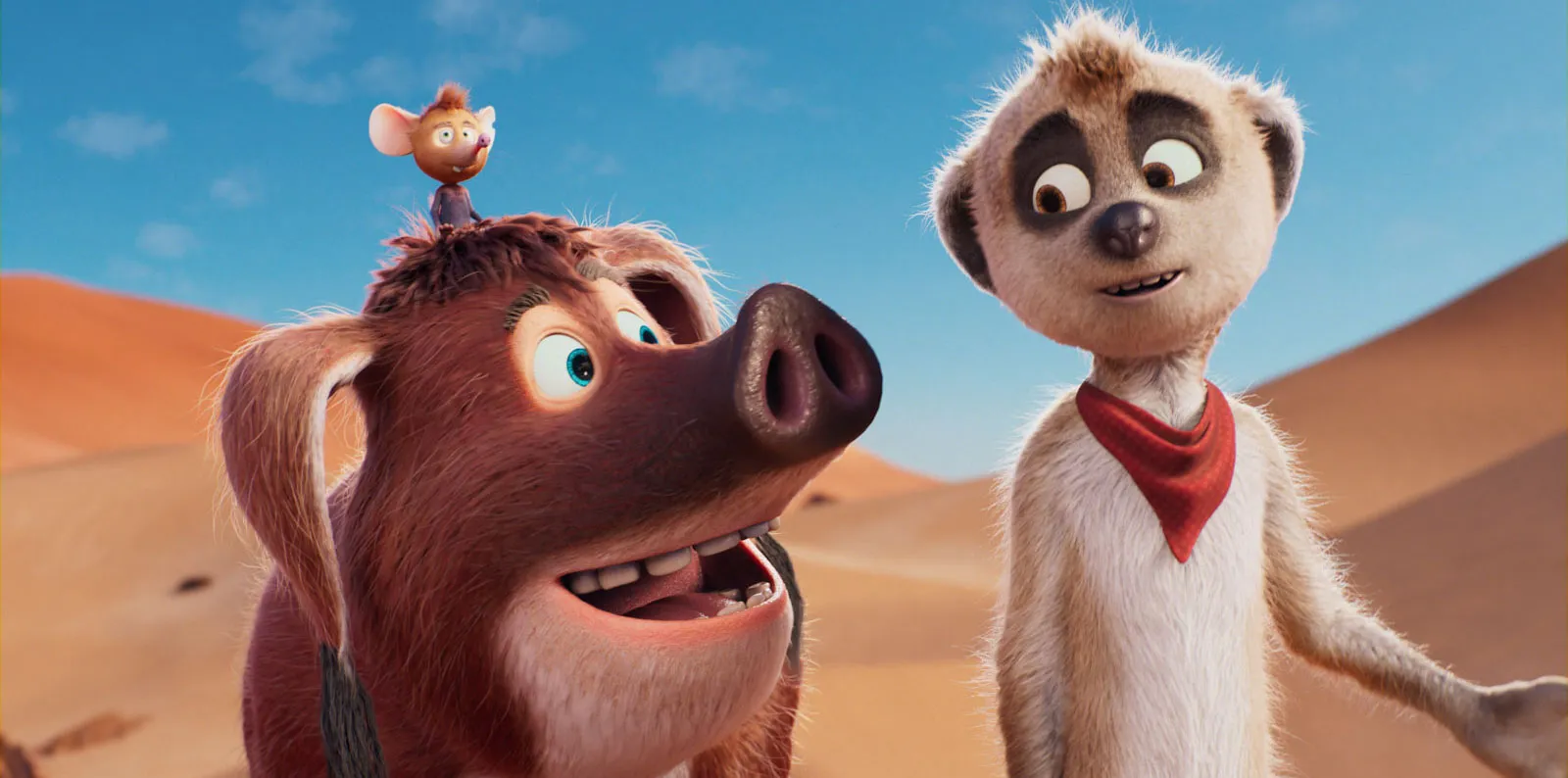
The film’s narrative energy depends on the tension between its two central figures. Tafiti carries an earnest, cautious temperament; Bristles, a clumsy bush pig, brings disorder and noise. Cosima Henman voices the meerkat with urgency and vulnerability that sit close to the surface. Steve Hudson voices Bristles with comic timing that keeps the tone buoyant without dissolving the stakes.
Their first exchanges land as a collision of priorities. Tafiti treats the pig as a liability and a distraction from a mission framed in grave, time-sensitive terms. Movement through danger gradually alters that posture. Repeated exposure to risk creates trust, and the partnership takes shape through action rather than speeches.
Along the way, the pair meets a predatory Eagle voiced by Jeremiah Costello with a hard, menacing authority, and they cross paths with other figures, including a helpful elephant and a rhythmic lizard. These supporting presences fill the desert with varied personalities and keep the world socially textured. Bristles’ antics supply humor that releases pressure, keeping the tension readable for younger viewers.
The vocal work anchors the story’s emotional beats. Tafiti’s irritation registers as credible, and Bristles’ need for acceptance carries weight through persistence and plain feeling. Their dialogue avoids rapid-fire sarcasm and leans toward slower, measured exchanges, giving the relationship room to change in observable steps. That patient rhythm lets Tafiti’s suspicion loosen piece by piece, and the connection between the leads carries the film through its most dangerous passages.
Aesthetic Restraint and Harmonic Depth
Directors Nina Wels and Timo Berg choose a visual approach centered on clarity and emotional communication. The animation appears clean and saturated, turning the African savannah into an inviting, storybook space. The desert is presented as vast, yet the design keeps its surfaces approachable and legible.
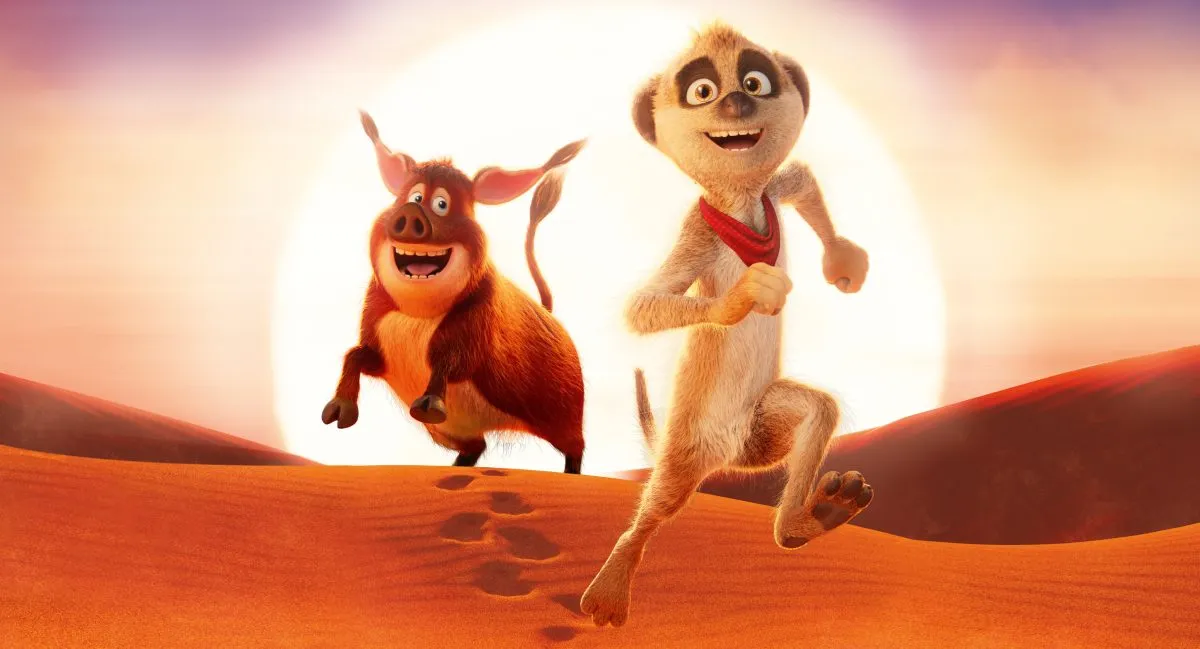
Character models rely on expressive eyes and fluid motion, allowing sentiment to come through without leaning on extra visual ornament. The style keeps attention on faces, gestures, and pacing, with craft serving the characters.
Carsten Rocker’s orchestral score complements that approach. The music favors melodic lines that support the scale of the adventure and the urgency of Tafiti’s purpose. Brass and strings mark shifts in discovery and threat, giving the film a sense of forward motion that stays steady and warm. The experience holds a light, welcoming tone even during encounters with predators and environmental hazards. Light and shadow signal danger in a way that suggests risk while keeping the atmosphere optimistic.
Dry creek beds and shifting dunes read as problems solved through cooperation. The background art helps the setting feel distinct from the familiar greenery of animal-led tales, grounding the story in a desert identity shaped by open space, harsh terrain, and bright air. Sound and image move together with consistent intent, building a cohesive world that feels sincere and inhabited.
Ethical Clarity and the Youthful Gaze
The film plays as a direct study of moral growth for its primary audience. It challenges the elders’ isolationist posture and frames survival as something linked to connection, including help from strangers once labeled as threats. That idea lands through the changing trust between Tafiti and Bristles, with empathy presented as a practical ethic rather than a decorative theme. The story places value on aiding those in need, regardless of origin, and the straightforward structure makes the lesson easy to follow.
Children under ten can take comfort in the plot’s predictable progression, where cause and effect remain clear and emotional stakes stay close to the characters. The film commits to sincerity and a bright moral logic, using a plain distinction between right and wrong to keep the material accessible.
The runtime, set at 80 minutes, fits younger attention spans and supports a brisk pace as the duo moves through a sequence of desert encounters. That efficiency keeps friendship and sacrifice in the foreground. Opapa’s injury brings the fear of loss and mortality into view, and the film treats the subject with gentleness that still respects a child’s capacity to understand.
The stable arc provides a secure framework for approaching those heavier ideas, keeping the focus on emotional growth rather than narrative tricks. The absence of pop-culture references or meta-humor protects the fable’s timeless quality, leaving a work that feels humble, clear-eyed, and necessary for the audience it addresses.
Tafiti: Across the Desert arrived in North American theaters on January 30, 2026, bringing the beloved German children’s book series by Julia Boehme to the big screen. Distributed by Blue Fox Entertainment, the film is an earnest CGI adventure that follows a young meerkat and his unlikely companion, a bush pig, as they brave the Namibian desert to find a mythical cure for a family crisis. Currently enjoying its theatrical run, the movie offers a heartfelt story for families and is expected to reach digital streaming platforms later this year.
Where to Watch Tafiti: Across the Desert (2025) Online










Full Credits
Title: Tafiti: Across the Desert
Distributor: Blue Fox Entertainment, Blue Fox Entertainment 2 LLC
Release date: January 30, 2026
Rating: PG
Running time: 81 minutes
Director: Nina Wels, Timo Berg
Writers: Julia Boehme, Nicholas Hause
Producers and Executive Producers: Talin Oezbalik, Thomas Springer, Helmut Weber, Anja-Karina Richter, Frank Geiger, Mohammad Farokhmanesh, Armin Hofmann, Ali Samadi Ahadi
Cast: Cosima Henman, Steve Hudson, Kathleen Renish, Jeremiah Costello, Dustin Semmelrogge, Mike McAlpine, Mark Rossman, Dela Dabulamanzi, Bürger Lars Dietrich, Thomas Schmuckert, Simon Werner, Simone Cohn-Vossen
Director of Photography (Cinematographer): Not Applicable
Editors: Nina Wels, Niclas Werres
Composer: Carsten Rocker
The Review
Tafiti: Across the Desert
This film offers a sincere, traditional adventure that prioritizes emotional clarity for its youthful audience. It avoids the frantic cynicism of modern studio animation, choosing instead to focus on the dismantling of ingrained prejudice through a shared mission. While the narrative follows a familiar path, the strength of the character dynamics and the warmth of the visual presentation create a comforting experience. It serves as a gentle introduction to themes of trust and sacrifice, making it a reliable choice for families.
PROS
- Earnest vocal performances that ground the animal characters.
- A clean, colorful visual style that remains accessible to children.
- Sincere exploration of empathy and the rejection of isolationist thinking.
- A steady, orchestral score that underscores the sense of adventure.
- Appropriate pacing for younger viewers.
CONS
- Highly predictable plot that offers few surprises for adults.
- Limited innovation in the animal-led quest subgenre.
- Reliance on familiar comedic archetypes for secondary characters.