










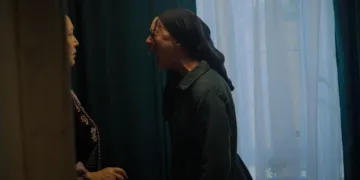
















Ulrike Ottinger returns to cinema with a work that plays like a fevered recollection of European history. In the title role, Isabelle Huppert plays Erzsébet Báthory, the legendary 16th-century Hungarian countess, revived in a version of modern Vienna where time behaves like a trick of folding paper.
The film begins with an image that lands like an omen: the Countess gliding on a blood-red funeral barge through the vaulted subterranean lake of the Seegrotte. The moment sets a regal, theatrical tone that stays intact even as tourists drift nearby, separated by a corner and a century’s worth of indifference. Báthory rises with one urgent purpose.
She wants an ancient grimoire, a magical book that can de-vampirize bloodsuckers and offer either mortality or annihilation. The premise carries the silhouette of grim gothic tragedy, yet Ottinger approaches vampire lore with irreverent, surreal humor. Vienna becomes a collision zone where the U-Bahn shares space with horse-drawn coaches, and the film settles into a campy black comedy that wonders if anyone ever slips free from ancestral shadow.
A Bestiary of the Absurdist Court
The Countess moves through Vienna alongside figures who seem permanently displaced from themselves, like souls set down in the wrong era and told to improvise. Her loyal minion Hermine, played by Birgit Minichmayr, steadies this roaming court with kohl-smudged eyes and a severe Weimar-era bob.

She drives the Countess’s search forward, a stubborn artifact of another century serving a master from somewhere else entirely. The counterpoint arrives in the Countess’s nephew, Rudi Bubi von Strudl. Thomas Schubert plays him as a vegetarian vampire in a lime-green suit, a “black sheep” who fears his own nature and flinches from what he is.
His craving for mortality meets the clinical posture of his psychoanalyst, Theobald Tandem. Lars Eidinger plays the therapist with obstinate skepticism, treating Bubi’s supernatural confessions as delusion dressed up in drama. The dynamic turns into a comic, prickly standoff between mythic fact and modern rationalism.
Bumbling vampirologists trail behind, and the Inspector Doubter follows with his own brand of ineffectiveness. Through all of it, Huppert holds the film’s gravity. She works with poise and restraint, letting small smirks and a cold, deadpan gaze steer her through a sea of ridiculous mortals. She reads as an elite predator who regards the modern world as an absurd spectacle, with occasional hunting folded into her composure like a private habit.
The Candy-Colored Surface of Decay
Ottinger and cinematographer Martin Gschlacht turn Vienna into an artificial maze, shot through saturated, color-flooded images. Red dominates the frame, yet the shade rarely resembles claret. The film prefers candied reds and off-brand ketchup tones, a choice that pushes gore toward theater and announces its own falseness.
In this world, violence registers as performance, staged and insisted upon. Production design leans into operatic surfaces: scarlet ensembles and billowing capes fashioned by Jorge Jara and Katharina Forcher, and Huppert’s supersized sunglasses that make her resemble a chic insect scanning the room for warmth.
Anachronism becomes the local architecture. Nineteenth-century décor sits beside the cold symmetries of contemporary urban life, and the film keeps rubbing the eras together until they spark. Grotesque details stack up like props awaiting their cue: skull-stacked catacombs, a polka-dot Pavillion Cafe, and recurring images of the Mannerist painter Arcimboldo.
The references form an odd collage, and the city reads like a dream-stage where Baroque richness arrives with magnificent artificiality. The eye keeps returning to those luxuriant skins, then listening for what they fail to cover, and the emptiness beneath starts to feel like part of the set.
The Monument of the Unburied Past
“Death must be a Viennese,” says the local lore, and Ottinger’s film treats that macabre saying as a lived condition. The narrative takes aim at the Austrian elite, who look away while the Countess leaves a trail of destruction in hotel toilets.
Their devotion to hierarchy and tradition runs so deep that they protect the standing of a “fine lady” and preserve the ritual of deference, even in the presence of serial killing. The film turns this into a metaphor for the persistence of power. The “undead” stand in for an old guard that keeps its hands on the present and refuses to let go.
The movie embraces a midnight identity during the Vampires’ Ball, where Conchita Wurst appears in a burst of celebratory camp. The flamboyant backdrops carry a different rhythm underneath them, unhurried and shaggy-dog in spirit. The script by Elfriede Jelinek and Ottinger carries biting wit and keeps its distance from tight, classical closure.
It lingers on minor pleasures and an ironic compendium of history, arranged like souvenirs with sharp edges. The vision that remains is a status quo where the past serves as predictable convenience. The old elite arrive wearing new faces, and their bloodsucking grip holds steady in a city built on its own heart crypts.
The Blood Countess celebrated its world premiere on February 16, 2026, as a Berlinale Special Gala at the 76th Berlin International Film Festival. Directed by the legendary Ulrike Ottinger and co-written by Nobel Prize winner Elfriede Jelinek, this baroque horror-comedy marks Ottinger’s return to narrative feature filmmaking. Starring Isabelle Huppert as the titular countess who re-emerges in modern-day Vienna, the film is currently circulating through major international film festivals following its Berlin debut. While a wide theatrical or streaming release for the United States and other territories has yet to be fully finalized, Austrian audiences can expect a theatrical release via Filmladen in late October 2026.
Where to Watch The Blood Countess (2026) Online
Full Credits
Title: The Blood Countess (Die Blutgräfin)
Distributor: Magnify (International), Filmladen Filmverleih GmbH (Austria)
Release date: February 16, 2026 (Berlinale Premiere), October 30, 2026 (Austria)
Running time: 119 minutes
Director: Ulrike Ottinger
Writers: Ulrike Ottinger, Elfriede Jelinek
Producers and Executive Producers: Alexander Dumreicher-Ivanceanu, Bady Minck, Bettina Brokemper
Cast: Isabelle Huppert, Birgit Minichmayr, Thomas Schubert, Lars Eidinger, André Jung, Marco Lorenzini, Karl Markovics, Tom Neuwirth (Conchita Wurst), Burghart Klaußner, Felix Oitzinger
Director of Photography (Cinematographer): Martin Gschlacht
Editors: Pia Dumont
Composer: Wolfgang Mitterer
The Review
The Blood Countess
The Blood Countess is a delirious, candy-colored excavation of European rot, masquerading as a campy midnight romp. While its narrative pulse often sputters under the weight of its own artifice, the film succeeds as a vivid, existential satire of an elite class that refuses to stay buried. Isabelle Huppert’s deadpan brilliance anchors the absurdity, transforming a historical monster into a chic, modern predator. It is a work of minor pleasures and major aesthetics—a shaggy-dog story that finds its soul in the grotesque beauty of the Viennese macabre.
PROS
- Isabelle Huppert’s masterful, poised performance
- Vibrant, operatic costume and production design
- Sharp, satirical wit regarding Austrian hierarchy
- A unique, queer-inflected subversion of vampire lore
CONS
- Sputtering pace and overlong two-hour runtime
- Some subplots feel underdeveloped or trite
- The "shaggy-dog" plot may frustrate those seeking a tight thriller
- Humor and wordplay occasionally get lost in translation