

















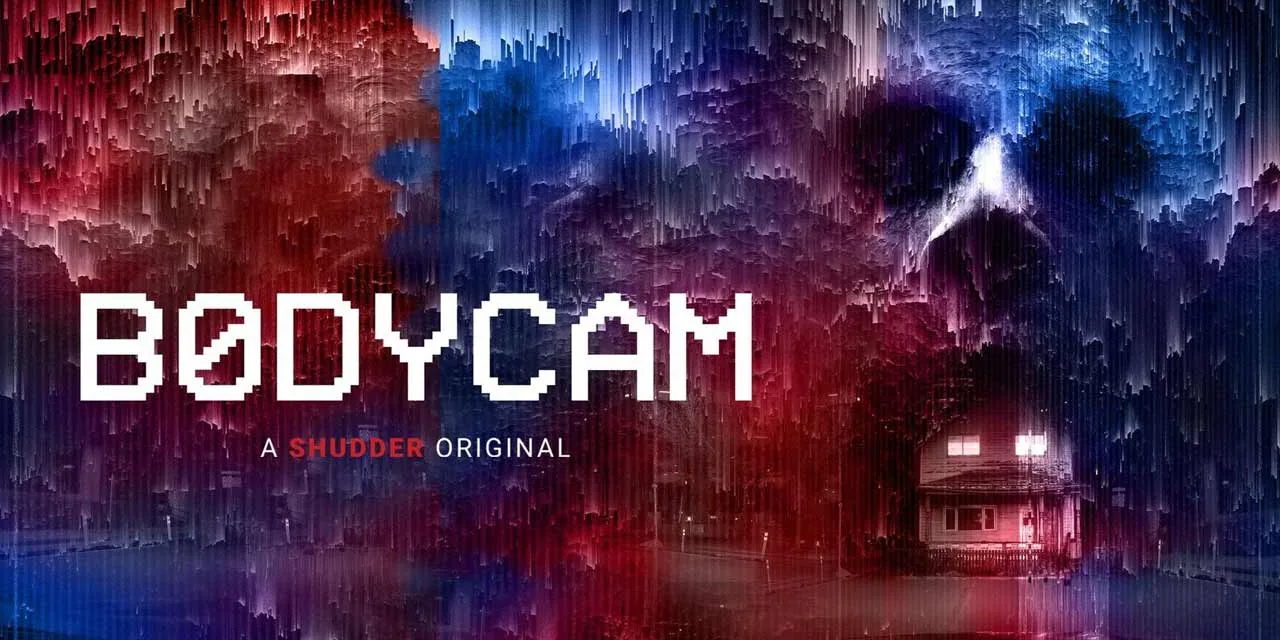
Found-footage horror is one of cinema’s most exhausted sub-genres. Since the late 1990s, the format has been stretched across haunted houses, recovered VHS tapes, and amateur ghost hunters, the vast majority of them indistinguishable from one another. Brandon Christensen’s Bodycam, a Canadian horror film, arrives with a formal idea sharp enough to cut through that noise. Two police officers, Officer Jackson (Jaime M. Callica) and Officer Bryce (Sean Rogerson), respond to a domestic disturbance call in a decaying neighborhood. Their chest-mounted bodycams capture everything. The footage never passes through a traditional cinematographic eye.
What unfolds across a tight 75 minutes is a supernatural horror film that also carries, in varying degrees of coherence, a social critique of policing, community breakdown, and institutional accountability. Streaming on Shudder, Bodycam has enough going for it to hold attention and enough going against it to leave you mildly frustrated when the credits roll. Both truths deserve space.
The Camera That Cannot Be Switched Off
The bodycam conceit is the film’s most intelligently argued idea. Found-footage films have always faced a basic credibility problem: why would anyone keep filming while being chased by something terrifying? Bodycam sidesteps this entirely. The cameras are passive, chest-mounted, and cannot be switched off. There is no character choice involved in the recording. That is a genuine structural improvement over most films of this type, and Christensen earns real credit for identifying and solving the genre’s oldest practical flaw.
The visual grammar the format produces is distinctive. Mounted off-center and angled slightly upward, the fish-eye lens creates a framing that feels invasive and unnatural without being chaotic. The entire film takes place at night, lit exclusively by the flashlights holstered beneath the officers’ guns. Narrow beams of white light cut through genuine darkness, leaving the frame’s edges permanently unresolved. The darkness here earns its keep.
The footage itself behaves as if it has been touched by what it records. Brownish-yellow color tints creep in as the situation deteriorates. Blood flecks the lens. These details do not announce themselves; they accumulate quietly, and the viewer registers them as a mild, priming unease.
The format carries real limitations. Locked into a single continuous night and alternating between only two cameras, the film has no room for respite. There is no cut to the officers at home, no ordinary conversation before the shift. The relentless forward pressure this creates can feel like confinement as much as tension. Building emotional connection to characters who exist only in crisis mode is genuinely difficult, and Bodycam struggles with it throughout. The switching between the two cameras also becomes mechanical after a while, a logistical necessity that the film never quite transforms into a dramatic tool. The bodycam idea is clever enough to differentiate the film within a crowded genre, and clever formal concepts, by themselves, can carry a production only so far.
Policing as Horror, Horror as Policing
Bodycam does not idle. Within minutes, the officers are inside a house that looks as though it has been rotting from within for years. Bryce panics in the basement and shoots a man carrying a bundle. The bundle is a baby. Both are dead. Bryce’s response is immediate and reflexive: damage control. Jackson, caught between conscience and complicity, is pulled along.
This is a strong inciting incident, and the genuine horror in that moment has nothing to do with the supernatural. It is the speed with which an institutional cover-up reflex activates. The tragedy of killing a child registers for neither officer as a moral crisis so much as an evidentiary problem. That is the sharpest thing Bodycam has to say, and it says it almost accidentally, through behavior rather than scripted intention.
The film’s social framework is culturally specific in a way that merits attention. The social coding here draws heavily from American conversations about race and policing, packaged inside a Canadian production. Bryce is a white officer defined by prejudice and self-interest. Jackson is a Black officer who grew up in the very neighborhood they are now patrolling. That positioning is legible, but it is also schematic, and the script never quite decides what to do with the gap between the two men beyond using it as a moral contrast.
Jackson’s backstory carries genuine dramatic potential. A scene at his mother Ally’s home, where the neighborhood’s deterioration presses against his personal history there, could have been the film’s emotional anchor. The script gestures at this and retreats. Ally herself, played with sharp precision by Catherine Lough Haggquist, is the film’s most dramatically effective presence. Her contempt for both officers operates on personal and structural levels simultaneously, and it is one of the few moments where the social commentary and the character writing move in the same direction.
The film’s ideological position on policing is where things become genuinely muddled. The bodycam as metaphor is pointed: evidence that cannot simply be erased. The critique has real weight. Yet the horror imagery draws heavily on homeless people and those suffering from addiction, treating their bodies and behavior as the primary source of fright. This sits uneasily alongside the film’s apparent interrogation of the prejudice the officers carry into the neighborhood. The critique and the execution pull against each other, and the film never resolves that tension. It reads less as intentional ambiguity and more as a script that did not fully interrogate its own assumptions.
Dread Built Well, Then Spent Too Soon
The film’s first 35 to 40 minutes represent its best work. The locations, shot on real derelict sites in Alberta, carry an authentic griminess that CGI environments rarely achieve. Decay here is tactile. The sound design in this early stretch rewards careful attention: distant noises, indeterminate movement, the particular quality of silence in an empty house. Practical-effect scares anchor this section well. Figures in static, wrong-bodied poses. Sudden disappearances from a room the camera just swept. The film’s instinct to withhold rather than show is sound, and the imagination fills incomplete frames with something personal and therefore more frightening.
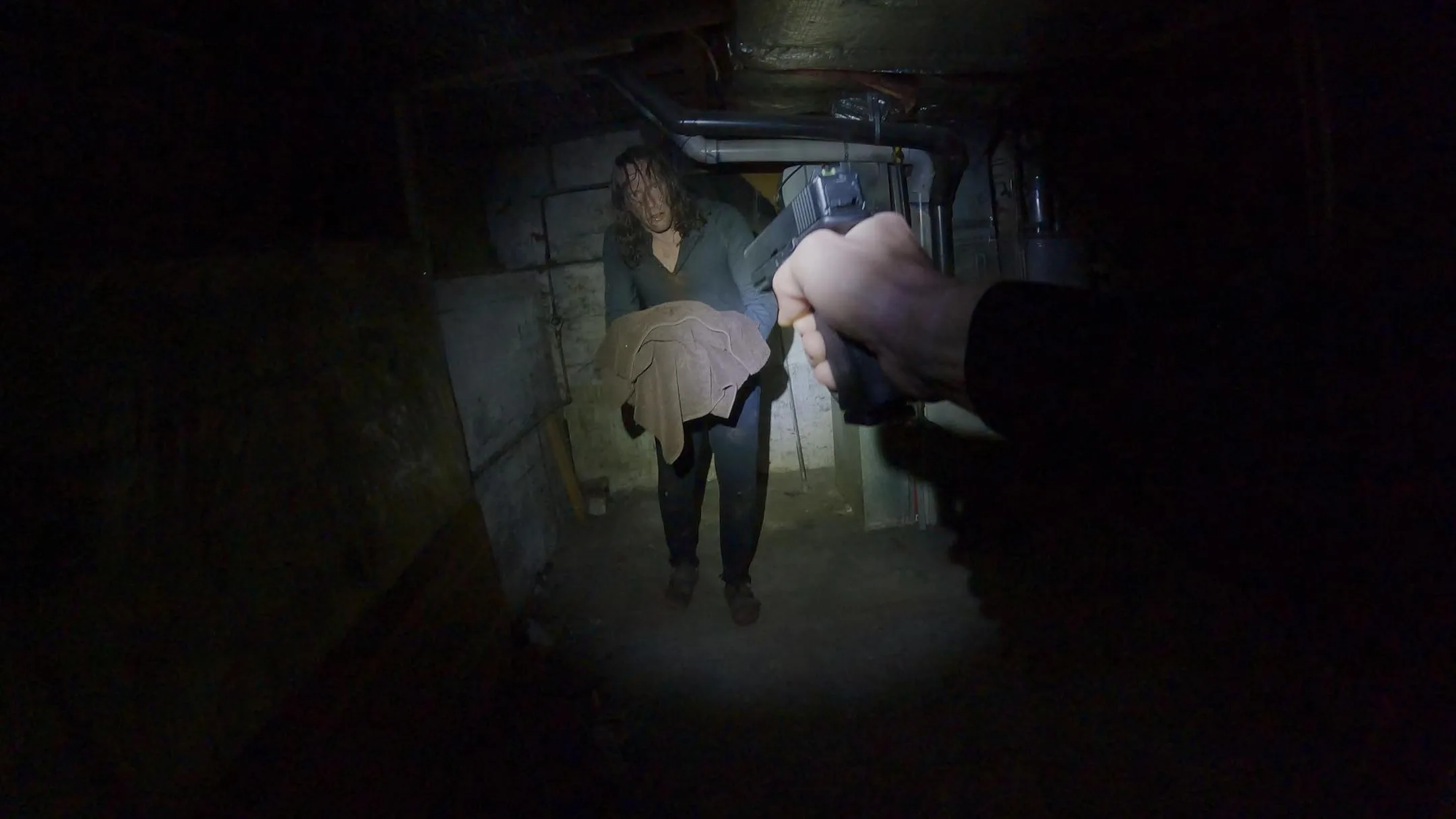
One sequence, set in a house that feels sealed against exit, lands with genuine force. The supernatural logic operating in that scene is internally consistent and communicated through behavior rather than exposition. The sense that something is executing a plan, and doing so with something resembling pleasure, makes it more unsettling than a straightforward chase would be.
The film’s confidence erodes once it commits fully to revealing its supernatural hand. The ambiguity that charged the early scenes burns off quickly, and found-footage horror functions on uncertainty. Once the nature of the threat is named and shown, the accumulation of disturbing imagery has no escalation left to reach for. The jump scares in the second half arrive at predictable intervals. The CGI deployed in the climax is a significant step down from what came before, with a street sequence that tips into video-game visual territory. The creature design, fully revealed in the final moments, would have been far more effective kept to suggestion. The sound mix compounds the problem: demonic voices are frequently unintelligible, and following the film without subtitles becomes a genuine challenge. Seventy-five minutes is a short runtime, but Bodycam manages to feel longer than it is by the time it reaches its end.
Performers Working Against the Current
Jaime M. Callica carries much of the film’s moral weight as Jackson. His performance is largely credible in the first half, where the character’s internal conflict is conveyed through behavior and reaction rather than dialogue. A late confessional scene, shot in close-up directly into the bodycam lens, is constructed to be a moment of raw exposure. Callica brings the sincerity; the dialogue does not return the favor. The words are too plainly written to support what the scene is reaching for, and it falls well short of harrowing.
Sean Rogerson’s Bryce is, for much of the film, the more dynamically written character. His self-serving reasoning is legible, his fear as consequences close in reads as genuine, and Rogerson finds the desperation in the role without overplaying it. In the final third, as the script runs thin, his performance follows it down. When both leads lose their footing simultaneously, the structural cause becomes visible: the direction is not giving them enough to hold onto.
Haggquist’s Ally is the film’s supporting standout, her scenes the most dramatically charged in the picture. Elizabeth Longshaw as Bryce’s pregnant wife appears briefly and serves her function with economy.
Christensen shows real craft in the film’s first half. His command of atmosphere, patience with shadow and silence, and trust in practical effects all speak to a filmmaker who understands the mechanics of dread. The screenplay, written with his brother Ryan Christensen, is where ambition outpaces execution. The social critique is real but unresolved. The characters are positioned well but written thin. Bodycam suggests a director with a clear visual intelligence and a genuine feel for genre, working from material that did not give him the foundation he needed to follow through on what he started.
Bodycam is a supernatural horror-thriller that premiered on March 13, 2026. The story follows two police officers who investigate a domestic dispute that leads to an accidental shooting. In a desperate attempt to avoid public outcry, the officers try to cover up the incident, only to discover that they are being hunted by a malevolent entity that is always watching through their cameras. As of today, April 20, 2026, the film is available for streaming on Shudder and AMC+, offering a chilling perspective on accountability and the unseen.
Where to Watch Bodycam (2025) Online










Full Credits
Title: Bodycam
Distributor: Shudder, AMC+, IFC Films
Release date: March 13, 2026
Rating: TV-MA (or Unrated)
Running time: 1 hour 15 minutes
Director: Brandon Christensen
Writers: Brandon Christensen, Ryan Christensen
Producers and Executive Producers: Chris Ball, Kurtis David Harder, Brandon Christensen, James Norrie, Nina Kolokouri
Cast: Jaime M. Callica, Sean Rogerson, Catherine Lough Haggquist, Elizabeth Longshaw, Colette Nwachi, John J. Gulayets
Director of Photography (Cinematographer): Bradley Stuckel
Editors: Brandon Christensen
Composer: Samuel Joseph Smythe
The Review
Bodycam
Bodycam is a horror film that earns genuine respect for its formal ingenuity and squanders much of it through a script that loses its nerve. The first half is disciplined, atmospheric, and quietly unsettling. The second half reveals a film uncertain of what it wants to say and unwilling to commit to the harder version of its own story. Christensen is a director worth watching. This particular film is worth seeing once, with tempered expectations.
PROS
- The bodycam format credibly solves found footage's passive filming problem
- Strong atmosphere and location work in the first half
- Catherine Lough Haggquist delivers the film's sharpest performance
- Practical effects are restrained and effective
- Pacing is brisk for the most part
CONS
- The supernatural element is revealed too early, dissolving tension
- Social commentary is muddied by its own horror imagery choices
- CGI in the final act is noticeably weak
- Both lead characters are written too thinly to carry emotional weight
- The sound mix in the second half is frequently difficult to follow