



















Jorma Taccone’s Over Your Dead Body opens on Dan and Lisa, a married couple whose relationship has reached a breaking point. Dan directs commercials, and Lisa chases theater work that rarely materializes. A weekend trip to a remote cabin begins as a private setting for mutual murder plans.
Each of them intends to kill the other. That poisonous setup changes fast once three violent fugitives crash into the picture. The film builds its identity through a nasty view of marriage, slapstick physicality, and bursts of gore. Jason Segel and Samara Weaving play the couple, while Timothy Olyphant heads the group of intruders who push them into a frantic survival scenario.
The Spite of the Creative Professional
My own home renovation disasters have usually stopped at muttered swearing and bad measurements, so watching Dan and Lisa turn domestic frustration into homicide has a certain awful comic charge. Their seven-year malaise has curdled into open hostility.
Dan hovers over every detail with a controlling streak, and Lisa answers with steady criticism. The film lays out the betrayals in plain view. Dan burned through their money on projects that went nowhere. Lisa cheated with a classmate from acting school. Those wounds shape every interaction.
Their work lives sharpen that bitterness. Dan has the air of someone who once imagined a richer artistic life and now spends his days directing pop-up ads for wireless companies. Lisa clings to the image of herself as a serious stage actor while her career keeps stalling. Over Your Dead Body understands the special resentment that grows when creative ambition turns stale. It treats failed artistic dreams as a pressure cooker for this marriage. That idea gives the opening stretch a mean, focused energy.
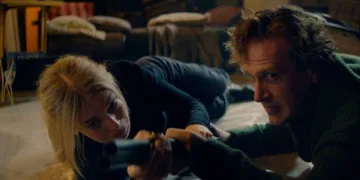
The murder plans spring out of that resentment with grim logic. Dan gathers tape and chloroform and starts constructing a fake hiking accident, even speaking loudly about Lisa’s solo hike to help build an alibi. Then the script flips the angle. Lisa has her own preparations ready, including a taser, and the cabin starts to feel like a battlefield before any outside threat arrives.
The screenplay uses those details well. It roots the film in mutual contempt and gives every object in the room a possible second use. The story favors a hard, sour view of long-term commitment, and it keeps the characters pinned to their flaws. Dan and Lisa spend so much energy blaming each other that they have almost nothing left for self-examination.
A Violent Shift in Perspective
The arrival of the fugitives resets the movie in one sharp gesture. Pete, Todd, and Allegra come crashing through the ceiling and into the bedroom, which is the kind of entrance that tells you the film is about to change its rhythm. Up to that point, the story works as a caustic two-person dark comedy. After that rupture, it leans into survival-thriller territory. Dan and Lisa’s clumsy murder plotting suddenly looks minor next to the practiced brutality of escaped convicts.

The script leans on flashbacks to fill in background and reframe what we are seeing. That fractured structure changes the audience’s relationship to the chaos and explains how this cluster of people ended up at a cabin in Finland.
I have a soft spot for movies that gamble on structural shifts like this, especially when they treat genre as something flexible instead of fixed. Taccone’s film reaches for that kind of shape. The reach is visible. So are the seams. The energy holds for long stretches after the intruders appear, though the repeated time jumps can interrupt momentum.
Dan and Lisa are pushed into an uneasy alliance. Survival takes priority, and their verbal warfare gives way to physical action. That movement from domestic nastiness to siege thriller is one of the film’s clearest storytelling choices. It reframes the marriage through action beats rather than dialogue.
The couple stops circling each other and starts responding to a shared danger. That structural pivot gives the film a playful relationship with audience expectation. It keeps changing the terms of the conflict, which helps sustain interest even when the pacing turns uneven.
A Performance of Mutual Disdain
The acting sells much of that tension, even if the two leads operate on different frequencies. Jason Segel plays Dan with a weary, almost detached quality. Samara Weaving gives Lisa a harder, more alert presence that still registers expressively. Their styles do not lock together smoothly, and that disconnect becomes part of the film’s design. For a story about a marriage full of corrosion, the friction between their performances feels useful. I read that mismatch as an extension of the relationship itself.
Timothy Olyphant makes the strongest impression as Pete. He moves through the film with a smug, sociopathic grin and a thickheaded swagger that takes over the room. His scenes gain an immediate charge from that confidence. Juliette Lewis plays Allegra as a delusional guard wrapped up in her own romantic fantasy, while Keith Jardine gives Todd the looming force of an enforcer built to intimidate. Together, they work as cruel reflections of the couple at the center. Their presence turns the cabin into a space where every interaction feels unstable.
The cast handles the film’s chaos with commitment. Weaving continues to look at home in modern genre material, and Segel gets room to show a harsher register than audiences may expect from him. The supporting performances inject volatility into nearly every scene. That unpredictability helps the atmosphere stay tense. At the same time, the script keeps the characters fairly thin on the inside, which makes emotional investment harder to sustain. You watch the mess with interest, though attachment remains limited.
The Mechanics of Bloody Comedy
The violence has a cartoon logic that brought Looney Tunes to mind for me, mixed with the clean physical setup-and-payoff you get in a Buster Keaton silent. Household objects become instruments of damage. Lawnmowers, billiard balls, and hammers all enter the action with a grisly sense of purpose. That choice gives the film a playful visual language, and the 87North team supports it with polished prosthetic makeup and stunt work. The technical craft is easy to see. The action beats land cleanly, the physical jokes register, and the gore has texture.
Taccone shows real command in those sequences. The editing keeps things moving at a brisk clip, and the sound design gives the impacts extra force. Those elements matter in a film like this because timing is everything. A violent gag lives or dies through rhythm, cut placement, and sonic punch. Over Your Dead Body often gets those mechanics right.
The trouble comes from tone. One sexual assault sequence is framed as a punchline, and that decision throws the comic rhythm badly off balance. The scene lingers in the mind for the wrong reasons, and the aftertaste carries forward. The film keeps trying to fuse silly mayhem with sadism, and that fusion never settles into a stable register. Taccone’s move from broad parody into this remake produces a film that feels jagged and messy. The ending lands without much force. Even so, the craft in the action, editing, and sound remains visible throughout.
I admire the impulse behind the film. It reaches for genre-mixing that sidesteps cleaner mainstream formulas, and that instinct feels closely tied to a strain of independent filmmaking that is willing to get messy in pursuit of a sharp effect. The movie taps into a current appetite for stories that treat relationships as arenas for cruelty, performance, and violence. Its view of intimacy is ugly, exaggerated, and very deliberate. The tonal control slips. The technical skill does not.
Over Your Dead Body is a 2026 action-comedy thriller that serves as an English-language remake of the Norwegian film The Trip. After making its high-profile world premiere at the South by Southwest (SXSW) Film & TV Festival on March 14, 2026, the film is scheduled for its wide theatrical release across the United States on April 24, 2026. Domestic audiences can catch the film in theaters via the Independent Film Company (IFC Films), while international viewers will be able to stream it on Amazon Prime Video.
Where to Watch Over Your Dead Body (2026) Online










Full Credits
Title: Over Your Dead Body
Distributor: Independent Film Company (IFC Films), Amazon Prime Video
Release date: March 14, 2026 (SXSW), April 24, 2026 (United States)
Rating: R
Running time: 105 minutes
Director: Jorma Taccone
Writers: Nick Kocher, Brian McElhaney, Tommy Wirkola, Nick Ball, John Niven
Producers and Executive Producers: Kelly McCormick, David Leitch, Lee Kim, Guy Danella, Nick Spicer, Aram Tertzakian, Timo Argillander, Nate Bolotin, Maxime Cottray, Kjetil Omberg, Jørgen Storm Rosenberg, Andrea Scarso, Jorma Taccone, Tommy Wirkola
Cast: Jason Segel, Samara Weaving, Timothy Olyphant, Juliette Lewis, Paul Guilfoyle, Keith Jardine
Director of Photography (Cinematographer): Matthew Weston
Editors: Jeremy Cohen
Composer: Matthew Compton
The Review
Over Your Dead Body
Over Your Dead Body works as a visceral experiment in marital destruction. It excels during moments of chaotic physical comedy and impressive stunt choreography. However, the film stumbles when trying to balance its mean-spirited humor with genuine character growth. The inclusion of an off-putting tonal misstep mid-film further disrupts the momentum. It remains a technical achievement for the 87North team. I find it to be a flawed but energetic addition to the cabin-in-the-woods subgenre.
PROS
- High quality stunt work and fight choreography.
- Timothy Olyphant’s menacing and charismatic presence.
- Professional prosthetic makeup and practical effects.
CONS
- Jarring shifts between slapstick and disturbing violence.
- Minimal chemistry between the two lead actors.
- Poorly timed jokes regarding sensitive subjects.