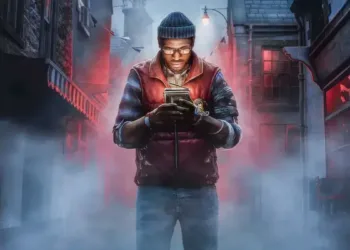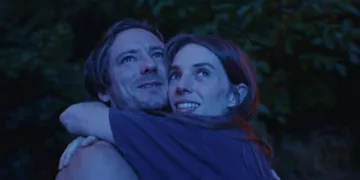


















There’s something almost delusional about being in love. Early on, your relationship feels like the most important thing in existence, a private universe with its own gravity. Most of us quietly outgrow that feeling. Graham Parkes’ feature debut, Wishful Thinking, asks what happens to a couple who never do.
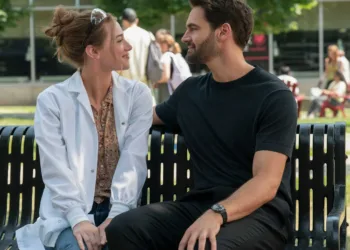
Premiered at SXSW, the film stars Lewis Pullman and Maya Hawke as Charlie and Julia, a Portland couple whose passionate, turbulent bond turns out to have a very literal effect on the world around them. When they’re happy, reality bends in their favor. When they fight, things fall apart in ways that start small and escalate to the genuinely catastrophic.
This is a magical realism romantic comedy-drama that wears its ambition openly. It’s funny, anxious, tender and chaotic, sometimes all within the same scene. Parkes is not interested in making a safe, comfortable love story. He’s after something rawer: an honest look at what happens when two people who clearly belong together struggle to figure out how to actually be together. The result is one of the more surprising and inventive films to come out of the American indie scene in recent memory.
When Love Becomes a Force of Nature
Charlie is a musician and audio engineer with a temper that arrives without warning. Julia is an indie video game designer whose ambition and anxiety compete constantly. They met in Portland on a night that felt charged and unexpected, the kind of connection that makes you rearrange your life. Julia moved to the city for him. That was then.
Now they cycle through fights and reconciliations at a pace that exhausts everyone around them. A friend pushes them toward a couples seminar run by the Tilly twins, two identically named TikTok gurus played with deadpan precision by Kate Berlant, who preach manifestation, twin flames, and the healing power of being very online. During the session, seated back to back, Charlie and Julia are prompted to speak freely. What comes out is word-for-word identical.
That shared unison is the crack through which the film’s magical premise enters. Their emotional state has physical consequences. A houseplant browns during a screaming match; it blooms overnight when they reconcile. Charlie’s songs chart when things are good. Sea levels rise when things go badly. They begin testing this deliberately, manufacturing conflict and intimacy like scientists experimenting on their own relationship.
The film’s real subject is codependence and the way passion can become an excuse to stop growing. Charlie and Julia are drawn to each other’s intensity, and the magical conceit makes that visible in ways that straight drama rarely manages. Their desires, left unchecked, cause harm to people around them: coworkers lose jobs, careers are derailed, the damage keeps expanding. Parkes handles this with a light touch, but the implication is clear: solipsism has a cost, and the belief that your love is the center of everything only holds until it starts breaking things.
Two People Who Can’t Help Themselves
Lewis Pullman carries Charlie with an almost alarming physical openness. Every mood shift registers in his body: a tightening jaw, a shift in posture, a voice that drops or rises without warning. He moves from warm and disarming to explosively difficult within the same scene, and the performance never lets you feel safe predicting which version is coming. A quieter subplot involving Charlie’s mother, played with restraint by Kerri Kenney-Silver, reveals the emotional architecture beneath the volatility: a man who never learned to hold his fear, so it comes out sideways. It’s subtle work inside a film that otherwise runs at high volume.
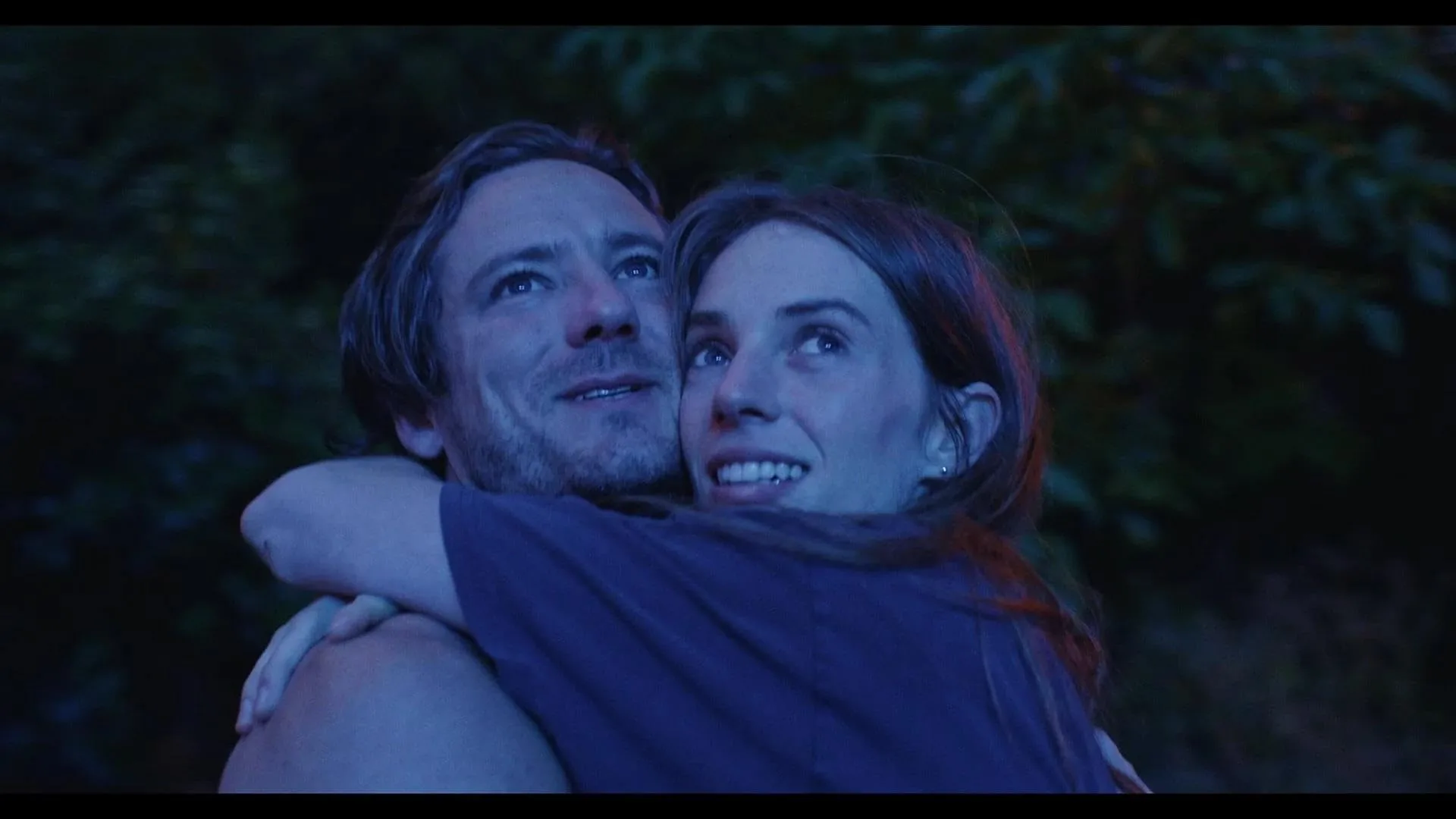
Maya Hawke’s Julia is a different kind of difficult. She’s high-strung from the first frame, a wound spring of professional anxiety and personal insecurity who can be simultaneously the most self-aware person in the room and completely blind to how she comes across. Hawke plays this without softening it, which takes genuine confidence. The result is a character who is hard to be around and impossible to stop watching.
Together, they generate a chemistry that feels genuinely unscripted. Their arguments carry the specific cadence of two people who have had this exact fight before, and their tender moments hold the relief of a couple rediscovering why they started.
The supporting cast fills in the world with real personality. Kate Berlant’s Tilly twins are a precisely calibrated comedy performance; she commits completely to the bit. Jake Shane brings warmth and understatement to Jeff, Julia’s devoted coworker. Randall Park is a perfectly timed comic foil as Bobby. Jon Hamm, playing himself, anchors a recurring gag that builds steadily and keeps landing.
A Director Who Trusts His Material
Graham Parkes makes a confident first feature. The hardest thing about a film like this is tonal: comedy and genuine emotional pain are difficult to keep in the same frame without one swallowing the other. Parkes manages it by trusting his actors and staying close. The magical elements are handled with deliberate lightness. A sink unclogs, a shelf breaks, the weather turns. These things happen and the film moves on, which is exactly right.
Cinematographer Christopher Ripley shoots on the Sony Venice 2, with results that carry a textured, almost film-like quality. The handheld approach gives longer takes an unpredictable, lived-in energy during the couple’s more volcanic exchanges. Ripley and Parkes also make expressive use of split-screen, dividing the frame to reflect Charlie and Julia’s emotional divergence. It works as structure and as visual wit: two slightly misaligned skylines communicate the state of the relationship with an efficiency that dialogue can’t match.
Oliver Lewin’s score is one of the film’s quiet pleasures. It drifts between whimsical and melancholic, tracking the couple’s emotional weather without underlining it too heavily. The music feels present rather than explanatory.
The film loses some footing in its final act. The trajectory becomes readable earlier than it should, and the resolution, emotionally grounded as it is, lands with less surprise than the setup promises. These are the seams of a debut, and they show. Still, as a first feature, it announces a filmmaker with genuine confidence in his material and a real gift for working with actors.
Wishful Thinking is a surrealist science fiction romantic comedy film that had its world premiere at the South by Southwest (SXSW) Film & TV Festival on March 12, 2026, where it won the Grand Jury Award for Best Narrative Feature. The story follows Julia and Charlie, a Portland-based couple who attend a unique “energy work” therapy session to save their relationship. However, the session triggers a karmic system that causes the world around them to physically reflect the state of their emotional connection. As of today, April 20, 2026, the film is continuing its festival run following its successful debut in Austin, Texas.
Where to Watch Wishful Thinking (2026) Online
Full Credits
Title: Wishful Thinking
Distributor: Highway 10, Buckwild, Pinky Promise
Release date: March 12, 2026
Rating: Not Rated
Running time: 105 minutes
Director: Graham Parkes
Writers: Graham Parkes
Producers and Executive Producers: Matt Smith, Dan Gedman, Kara Durrett, Lewis Pullman, Sarah Mather, Graham Patrick Martin, Cameron Fuller
Cast: Maya Hawke, Lewis Pullman, Randall Park, Jake Shane, Amita Rao, Eric Rahill, Kate Berlant, Kerri Kenney-Silver
Director of Photography (Cinematographer): Christopher Ripley
Editors: Lilly Wild
Composer: Oliver Lewin
The Review
Wishful Thinking
Wishful Thinking is a sharp, emotionally honest debut that earns its magical premise through grounded performances and confident filmmaking. Pullman and Hawke are exceptional, and Parkes shows a natural instinct for balancing comedy with genuine feeling. The final act loses some momentum, and the resolution is more familiar than the setup deserves. Those are real limitations. They don't undo what works, and a great deal works here.
PROS
- Lewis Pullman's career-best performance
- Sharp, genuinely funny writing
- Inventive magical realism premise handled with restraint
- Strong supporting cast across the board
- Confident tonal balance from a first-time director
- Ripley's cinematography is visually distinctive
CONS
- Final act becomes predictable
- Resolution lacks the surprise the setup earns
- Rules of the magical conceit occasionally strain credibility