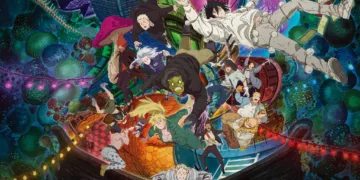





















Returning to the dual worlds of the Hole and the Sorcerer’s realm feels like wandering back into a beloved industrial nightmare, the kind of place where every surface looks damp and every hallway seems to have lost a fight with rust. After a hiatus long enough to make fans suspect amnesia-inducing smoke had entered the chat, Dorohedoro Season 2 returns with its grimy personality intact.
The visual language remains devoted to urban decay. Pipes leak, walls stain, and every room appears to have hosted at least three terrible decisions. That filth gives the central mystery a perfect home. Caiman keeps searching for his original face and the identity of the person inside his mouth. The Cross-Eyes boss still hangs over the story like unpaid rent with a knife.
The series holds onto its unstable signature rhythm. It mixes visceral violence with strange domestic warmth, shifting from decapitation to gyoza talk with the confidence of a show that knows exactly how weird it is. This season gives the chaos a clearer shape by pairing the present hunt with trips into the histories of its main players. The pacing gains force from that structure. Forward motion keeps the mystery alive, then the flashbacks slow the pulse just enough to expose the old wounds feeding the madness.
Scavengers and Shadows: The Cross-Eyes Crisis
The story turns much of its attention toward the damaged remains of the Cross-Eyes organization. Risu reaches Berith and tries to settle among the current members, where hospitality has apparently gone to die in a corner. These people are far from the imposing villains one might expect.
They live in dark, dingy houses, struggle with poverty, and use old newspapers for toilet paper. Their boss is gone. Their black powder supply is running low. The result gives the supernatural conflict a grubby social bite. The Cross-Eyes come across as a desperate cult waiting for a miracle that keeps missing the train.
Caiman and Nikaido move through the Zagan City subway system, a fitting artery for a world that always seems clogged. Their arrival in Mastema introduces Natsuki, a rookie dealer whose point of view grounds the life of a low-level sorcerer. She stands for the many magic users who lack the godlike status of En’s elite circle. Her presence sharpens the economic divide built into the sorcerer world. Magic functions as currency, power, status, and survival tool. Those without enough of it scrape by in the dark.
En remains eccentric, lethal, and hilariously unsuited for any human resources department. His obsession with the Cross-Eyes boss pushes him toward strange methods, including Dream Machine Mushrooms. These fungi let him manipulate and test his subordinates inside a shared hallucinogenic state. Corporate management by mushroom trip feels ridiculous, yet it fits his flamboyant menace perfectly.
As En toys with dreams, he sends Shin and Noi into the forest to investigate a black powder production site. Their clash with the Cross-Eyes there proves that desperate scavengers can still draw blood when trapped. En’s luxury and the Cross-Eyes’ squalor keep pressing against each other, giving the world-building a nasty economic charge.
Echoes of the Past: Origin Stories and Trauma
This season strengthens its monsters by looking backward. The magic school flashbacks give Risu’s early life a harsh clarity. He struggled to produce smoke and stood in Aikawa’s shadow, with Aikawa’s mannerisms landing uncomfortably close to Caiman’s. Their bond grew through shared failure and a mutual hatred of predatory teachers. Seeing Risu as a frustrated student gives his current quest for vengeance a heavier pulse. He was harmed long before he became a head in a box, which is quite a résumé line, even by this show’s standards.

Nikaido’s past gets a similarly revealing treatment through the discovery of her secret diary. Her childhood unfolds in a surprisingly lush rural setting, a beautiful farmland far from the industrial grime of the Hole. That contrast makes her later fall into the world of sorcerers feel sharper and sadder.
Her early connection to Asu, before he became a devil, reframes their current relationship. It explains why a powerful devil would risk Chidaruma’s wrath to protect her. The threat of hunters searching the woods for young sorcerers cuts through the softness of the setting. Even paradise in Dorohedoro needs a warning label.
Kasukabe’s medical history offers the season’s most disturbing look into the past. His connection to the neighborhood association in the Hole reveals the cruelty aimed at anyone suspected of being a sorcerer. The group moved from self-defense into sadistic pleasure, and the shift is ugly in a way the series refuses to soften.
Ai’s tragic history and the psychological weight of Kasukabe’s research explain his fixation on the macabre. He has seen the worst of both worlds. His scientific curiosity becomes armor against what he has witnessed. These origin stories fill gaps, then twist the knife by turning the characters into tragic figures trapped inside violence they never chose.
Grotesque Beauty: Technical Execution and Tone
MAPPA continues to give the series a visual style that embraces the grotesque with open arms and probably bloody gloves. The fight scenes hit hard, with violence that feels physical and unapologetically messy. The battle with the giant freak in the house and the bloody aftermath at Haru’s home stand out among the season’s action beats. The animation also handles the surreal comedy with impressive precision, especially during the Cross-Eyes’ attempt to stage their landlord’s body. Their plan to make the death look like a suicide or a quiet demise in the tub collapses into dark comic failure. The timing is nasty, absurd, and sharply edited.
The show keeps finding beauty in disgust. Detailed textures make blood sprays, meat, grime, and decay feel tactile. The cinematography leans into cramped interiors and grim spaces, letting the setting press down on the characters. Editing drives the tonal pivots, cutting from violence to absurdity with the snap of a trap shutting. It is classic genre whiplash filtered through a mutant kitchen sink. Horror, comedy, crime story, body nightmare, hangout show: somehow the pieces keep moving in the same diseased direction.
Sound plays a major role in that effect. The opening and ending themes give each episode a frantic industrial pulse, locking the series into its rusty tempo. Magic sequences and violent encounters arrive with crunch, sizzle, and wet impact, making every strike and transformation feel unpleasantly close. The voice acting grounds the absurdity. Tender moments such as Caiman’s breakdown and Kasukabe’s reunion with his wife land because the performances treat the feelings seriously. Without that emotional anchor, the series could become a parade of weirdness marching in circles.
The balance between horror and humor remains its sharpest weapon. The shift from Asu’s brutal torture to the Cross-Eyes’ comic bumbling is jarring in the best possible way. It mirrors daily life in the Hole, where survival and farce keep sharing the same filthy room. One moment brings panic. The next brings a ridiculous misunderstanding. That tonal whiplash feels intentional, keeping viewers alert and slightly bruised. In a world this broken, laughter starts to look like the last sane reflex.
Fragile Bonds in a Broken World
For all the gore and magic, the season’s emotional pull comes from its character dynamics. Kasukabe and Haru’s reunion is a standout. Haru has transformed into a devil, and Kasukabe meets her with quiet, sincere devotion. He reacts with human unease, then reaches an embrace that feels earned. The scene highlights the strange durability of love in a world where your partner can become a literal demon and the relationship still has better communication than half the couples on television.
Caiman’s psychological struggle brings fresh vulnerability to him. The moment where he sees a reflection of his true face and loses control is genuinely unsettling. His fear of hurting Nikaido reveals the depth of their bond. He chooses isolation in pain because he cannot bear the risk of harming the person who has anchored him. Nikaido’s gentle reassurance gives the scene a rare warmth. Their partnership rests on trust, and the show gives that trust room to breathe amid the muck.
Fujita and Ebisu keep supplying a stranger, more eccentric emotional payoff. Fujita’s frantic attempt to reach Ebisu before she leaves for her family home shows how their friendship has grown. Ebisu’s return to her parents’ house lands with a cruel twist. The discovery of a violent copy of herself in her home feels like empty cruelty at first glance, then settles into the series’ bleak logic. Nobody gets a clean break here. Trauma follows characters home, sits on the couch, and ruins the reunion.
That may be the season’s sharpest punchline, grim as it is. Dorohedoro can make a corpse-disposal gag sing, then turn around and ask why its most damaged people keep getting punished. The joke lands. The bruise stays.
Dorohedoro Season 2 premiered globally on April 1, 2026, marking a long-awaited return to the chaotic, industrial landscapes of the Hole and the Sorcerer’s world. Produced by the renowned studio MAPPA, the series continues to blend high-octane visceral violence with its signature dark, surreal humor. Fans can stream the latest episodes on platforms such as Netflix and Crunchyroll, where the show is being released with both subtitled and dubbed versions to accommodate its international audience.
Where to Watch Dorohedoro Season 2 Online






Full Credits
Title: Dorohedoro Season 2
Distributor: Netflix, Crunchyroll, Animation Digital Network
Release date: April 1, 2026
Rating: TV-MA
Running time: 24 minutes
Director: Yuichiro Hayashi
Writers: Hiroshi Seko
Producers and Executive Producers: Akito Takahashi, Nobumasa Sawabe, Yusuke Tannawa
Cast: Wataru Takagi, Reina Kondo, Yoshimasa Hosoya, Yu Kobayashi, Kenyu Horiuchi, Mitsuhiro Ichiki, Koki Uchiyama, Daiki Hamano
Director of Photography (Cinematographer): Hyo-Gyu Park
Editors: Masato Yoshitake
Composer: (K)NoW_NAME
The Review
Dorohedoro Season 2
Dorohedoro Season 2 is a masterful return to form, successfully deepening its lore without losing its chaotic soul. By weaving poignant backstories into its industrial-grime aesthetic, it elevates from a mere gore-fest to a compelling character study. The balance of surreal comedy and visceral horror remains unmatched, proving that the series’ long hiatus only sharpened its edge. It is a dense, rewarding descent into madness that rewards patience with profound narrative payoffs.
PROS
- Detailed expansion of Mastema and the internal politics of the Cross-Eyes.
- Seamless shifts between slapstick comedy and harrowing psychological trauma.
- Meaningful origin stories for Risu, Nikaido, and Kasukabe provide high emotional stakes.
- A standout soundtrack that perfectly captures the show's manic energy.
CONS
- Occasional moments where the lack of lasting damage for main characters undercuts battle tension.
- The intensity of the violence may occasionally overshadow the intricate narrative for some viewers.
- Certain traumatic moments feel unceremoniously piled onto already tragic characters.







