













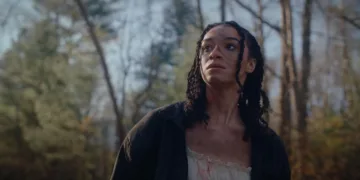











Tuscany in the mid-14th century appears as a burial ground for broken institutions. The Black Death has torn apart the social order of Medieval Italy, leaving a land where the divine feels distant and law survives as a fading memory.
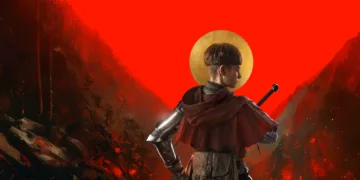
Aeta crosses this ruin as a noble knight errant whose presence challenges the strict gender codes of her era. After the plague takes her entire family line, her remaining sense of purpose rests in her bond with Bianca. Their relationship carries a quiet resistance to the society around them, and that resistance faces destruction once Bianca is marked for confinement inside a convent.
A private sorrow soon becomes a regional catastrophe when bandits raid their home and take Bianca, sending Aeta through a brutal chase across a world shaped by rot, sickness, and the panic of people near death. The story builds a harsh vision of apocalypse as a present condition, a suffocating pressure that governs every decision.
Cinematic Grandeur Against Technical Decay
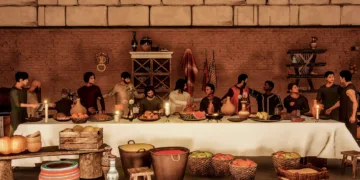
The visual identity of 1348 Ex Voto tries to connect interactive media with the measured style of contemporary prestige European cinema. Its landscapes often stun the eye, with emerald forests thick with moisture and white mountain slopes lit by a cold, severe glow. The developers use angled compositions and tight framing to create dread, drawing on techniques common to historical horror cinema.
This artistic reach keeps running into weak technical execution. Character models suffer most clearly from that divide, especially through facial animation that sends the experience straight into the uncanny valley. During scenes built for emotional force, mouths and eyes warp in ways that recall 90s CGI tests, a comparison no tragic revelation wants in the room. These twisting faces turn dramatic moments into accidental comedy, breaking the mournful tone the writing clearly wants to sustain.
The world reveals similar problems once the player moves through it. From a distance, the vistas carry real force. Up close, they expose blobby textures and jagged edges that suggest a hurried production. Texture pop-in appears often, with environmental details forming just a few feet ahead of Aeta as she walks. The frame rate also struggles, dropping during shifts from lush outdoor spaces to dark, narrow chapel interiors.
This technical resistance reaches the act of movement itself. The game uses a linear corridor layout that limits exploration, while the absence of a map or strong landmarks creates steady confusion. Players can wander through forest areas that resemble the last three clearings, searching for a ledge or interaction prompt that the game fails to mark with clarity.
The Friction of Combat and Mechanical Stagnation
The main gameplay system rests on dual-stance swordplay, letting Aeta shift between one-handed and two-handed techniques. In concept, this aims for the tactical weight of modern action games where stagger management defines victory. In play, the system feels slow and stubborn.

Aeta carries a heavy movement style that makes each swing feel risky, especially since enemies often attack faster and can trap the player in repeated hits. This imbalance pushes players into a rigid defensive rhythm where success comes through long cycles of blocking and dodging. Most encounters become waiting games, with the player standing back until an opponent finishes a preset combo, then landing one safe hit during the recovery window. Aggressive play receives swift punishment from the mechanics.
Combat frustration grows through technical problems inside the fighting engine. A strange vacuum effect lets enemies slide across the ground to strike Aeta, even at a visual distance that appears safe. Parry timing feels unreliable, turning a timed block into a wager. The targeting system creates its own chaos, often pulling the camera toward a passive enemy in the background while an active threat is already swinging.
The game includes a skill tree and weapon parts such as pommels and guards, yet these upgrades provide passive numerical gains. They never change the fighting style or create fresh ways to interact with the world. By the final stretch, high-level gear makes the awkward fights easy, but the lack of mechanical variety keeps combat feeling like labor from beginning to end.
Narrative Dissolution and the Weight of Performance
The story’s emotional force depends almost fully on the excellent voice work from Alby Baldwin and Jennifer English. Their chemistry as Aeta and Bianca gives the game a rare trace of warmth inside an experience shaped by technical failure. They convey the desperation of a forbidden love with enough sincerity to rise above stiff character models and warped facial motion.

Their work keeps the bond between the leads alive and gives the player a reason to reach the ending. The writing around them cannot hold that energy. The game gestures toward complex ideas, including the morality of survival during plague and the disruption of medieval gender roles, then leaves those ideas underdeveloped. Narrative threads tied to Aeta’s identity or Bianca’s hardships appear briefly, then vanish or return as passing remarks during loading screens.
The second half has a fractured structure, with abrupt scene transitions that imply missing story material. Aeta often appears in a new place without any clear account of how she arrived, or she escapes the effects of a life-threatening capture within a single cut. This missing connective tissue shrinks the world and makes the stakes feel manufactured.
Mission design adds to the problem through a repeated pattern of walking along beautiful, empty paths until a small arena fight begins. The occasional puzzles offer little relief, usually asking the player to move a wooden box to reach a higher ledge. These sections feel like padding for the five-to-ten-hour runtime. The central performances carry real strength, yet the game lacks the structure needed to support its ambitions, leaving behind strong fragments that never fully cohere.
The Review
1348 Ex Voto
1348 Ex Voto is a work of striking artistic ambition crippled by technical failure. While the central performances and atmospheric setting offer a haunting glimpse into a plague-stricken Italy, the core experience is hollowed out by unresponsive combat and a disjointed narrative structure. It mimics the skin of a prestige blockbuster without possessing the mechanical bones to support it. The result is a beautiful but frustrating trek where the emotional weight of a forbidden love is frequently lost in a sea of glitches and repetitive design.
PROS
- Exceptional voice acting from Alby Baldwin and Jennifer English.
- Picturesque environmental design and cinematic framing.
- Atmospheric historical setting during the Black Death.
CONS
- Unresponsive and repetitive defensive combat.
- Severe facial animation glitches and technical instability.
- Linear, empty level design with frustrating navigation.
- Jarring narrative jumps and abandoned story threads.