






















The silence of a fossilized bone carries a strange pressure, a muted force that museum glass can rarely hold. Calcified remains invite the mind to restore heat, breath, appetite, fear, and motion to creatures left behind as mineral evidence. Netflix’s The Dinosaurs takes that imaginative act and turns it into a four-part reconstruction shaped like a sensory encounter with a vanished world.
Produced by Steven Spielberg and directed by Nick Shoolingin Jordan, the series adopts the visual grammar of a modern wildlife documentary to stage a history that spans 140 million years. It trades the dry cadence of traditional paleontology for an intimate study of biological struggle. Morgan Freeman supplies the vocal architecture, lending ancient gravity to a story that begins in the dust of Pangea and closes in the fire of an asteroid strike.
The series is most alive when it attends to physical reality. It follows dinosaur evolution from the Triassic period through the end of the Cretaceous era, treating the animals as bodies under pressure. Industrial Light & Magic’s digital imagery gives the production its sense of presence, moving the material beyond diagram and illustration. Feathers emerge as tools of survival. Bipedal movement becomes a decisive adaptation.
Hunger, shelter, speed, nesting, and fear define the day-to-day existence of these creatures. The usual distance of historical narration gives way to heat, humidity, volcanic instability, and a planet remaking itself under every clawed foot. That choice gives the series its strongest critical value: extinct life is treated as lived experience, full of sensation and danger.
From Pangea’s Dust to the Cretaceous End
The four chapters, Rise, Conquest, Empire, and Fall, give the series a clean evolutionary spine. The opening chapter begins 235 million years ago on the supercontinent of Pangea. The land has the hostile grandeur of Mars, shaped by vast deserts and a total absence of rain.
Ancient reptiles dominate this dry, punishing world. Against those giants, the Marasuchus appears small and bird sized, a fragile ancestor whose survival depends on one pivotal physical change. It learns to run on two legs. That increase in speed helps it evade predators, turning a modest anatomical advantage into the seed of a dominance that will stretch across millions of years.
Environmental change drives the story with the force of an unseen author. The Carnian Pluvial Event, a million-year period of rain and volcanic activity, transforms desert into forest. The changed world demands new bodies. High vegetation rewards height and reach, leading to the rise of long-necked giants able to feed where others cannot. As the timeline moves through the Jurassic and Cretaceous periods, dinosaurs reach their greatest physical scale. The series pays attention to social structure too.
Hadrosaur mothers guard nests in creche-like spaces. Pterosaurs extend dinosaur-adjacent life into the air, while Pliosaurs command the oceans. The planet becomes a field of adaptation, every terrain asking a different question of the body. Scale matters here, yet behavior matters with equal force, since the series keeps returning to care, competition, movement, and hunger as the true machinery of survival.
Earth remains a merciless host throughout. The series stresses extreme weather, including freezing winters that catch many species unprepared. The Yutyrannus, called the Snow King, thrives in such cold because feathers have given it protection. This early cousin of the T-Rex carries one of the production’s clearest ideas: survival belongs to creatures capable of alteration. Landmasses shift.
Volcanic gases poison the air. Food chains collapse under pressure. The final movement carries the story toward the end of the Cretaceous era, where Tyrannosaurus Rex and Triceratops stand as the last rulers of the prehistoric world. The asteroid impact arrives as a rapid, total catastrophe, ending a reign that lasted over 100 million years.
The irony of evolution gives the narrative its melancholy intelligence. A species may spend eons refining its form and still vanish under the violence of a single planetary event. Traits that preserve life in one era may become burdens in the next. The movement from the small, scavenging Marasuchus to the massive, specialized predators of the Cretaceous reveals life’s astonishing flexibility. It also clarifies the show’s sternest lesson. Climate has always acted as the planet’s judge, deciding which species flourish and which retreat into stone.
The Digital Breath of Industrial Light and Magic
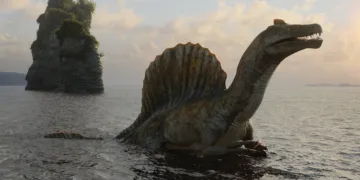
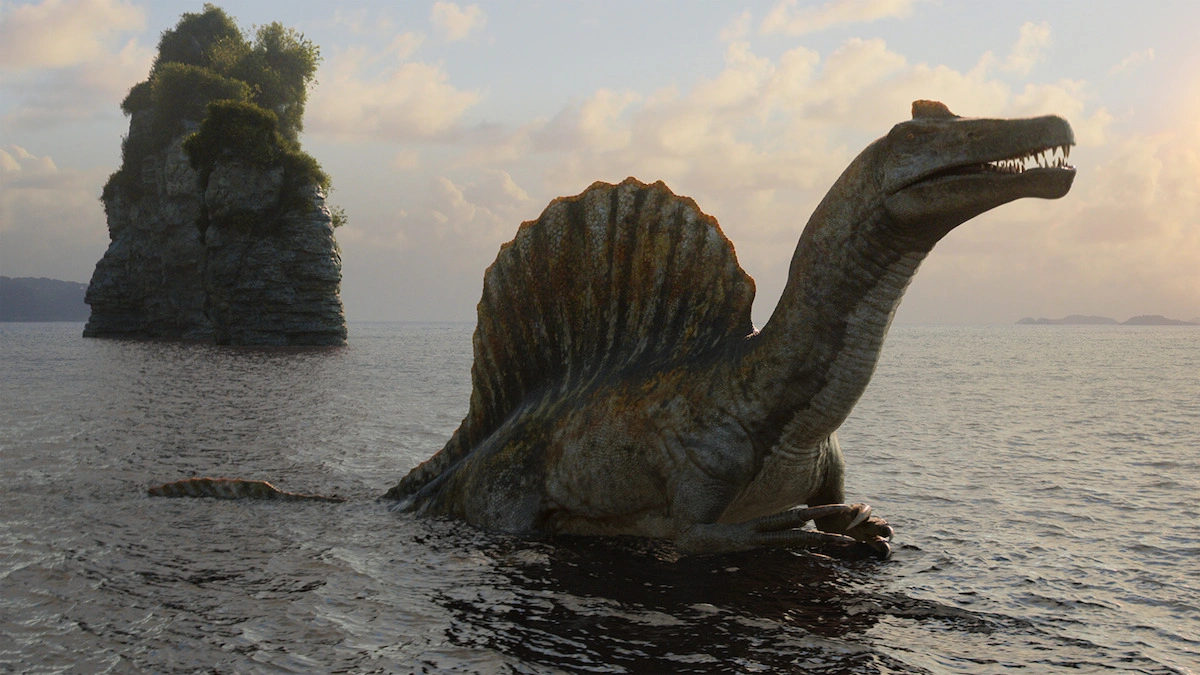
The series depends on the technical authority of Industrial Light & Magic, whose digital work gives the impossible a tactile charge. The creatures have skin with translucency, muscles that tighten during pursuit, and eyes that catch light with predatory intelligence.
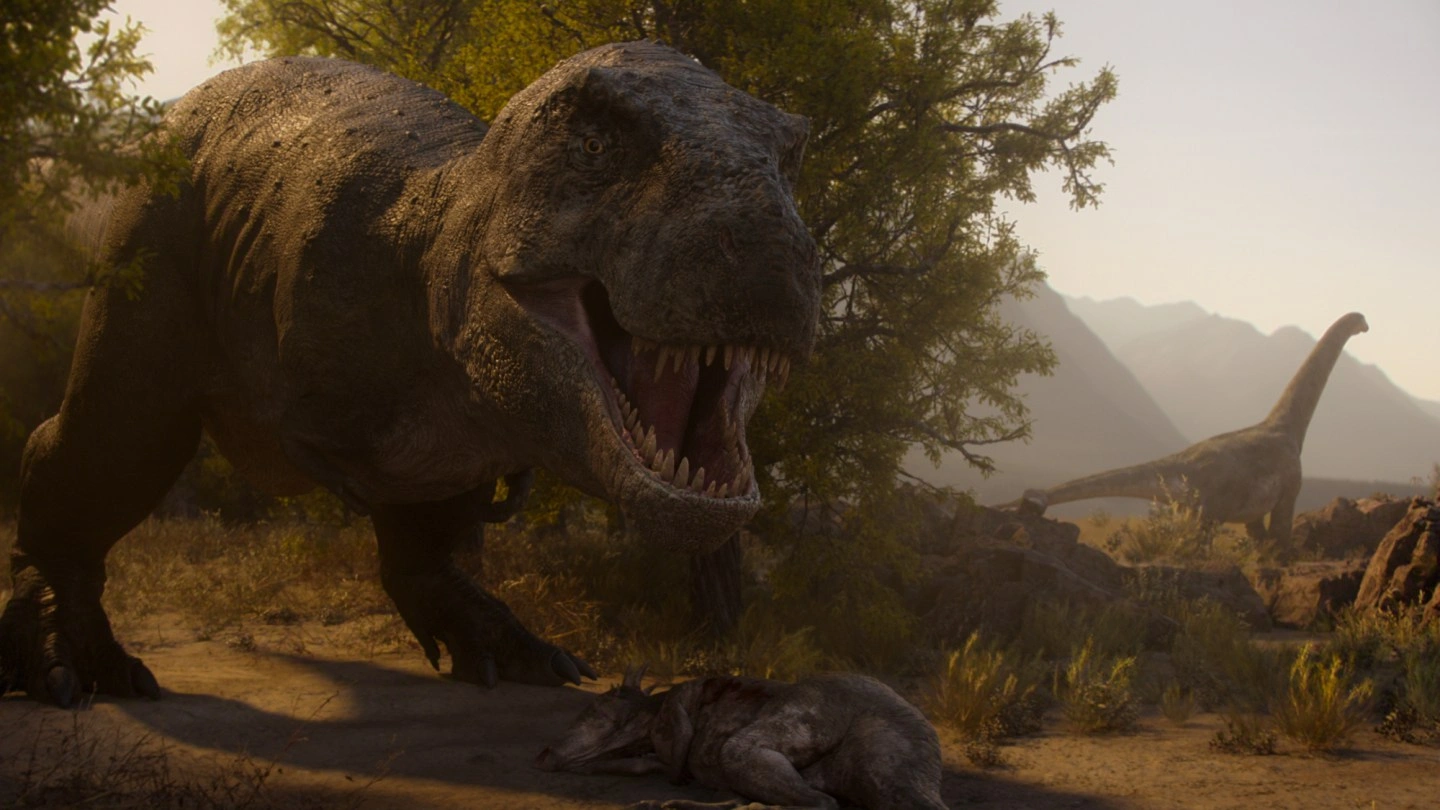
Placed inside real-world settings, they occupy the frame with credible weight. Detail becomes persuasion. A foot displaces sand. Water gathers on scales. Flesh reacts to weather and motion. The image argues for the animal before the narration needs to explain it.
The environments receive the same care. Ancient landscapes are rendered with painterly precision, from the arid red sands of early Pangea to the oxygen-rich jungles of later periods. Lighting and weather secure the illusion. Triassic sandstorms feel heavy and abrasive. Jurassic rainfall lands with thick physical force.
The landscapes operate as living systems, shaped by heat, moisture, wind, and geological violence. The result is a world that feels touchable, hazardous, and indifferent. This precision keeps wonder from turning decorative, since beauty in the series is usually tied to risk.
The cinematography borrows heavily from contemporary wildlife filmmaking. Close-ups, sudden reframings, and movements that suggest handheld camerawork give the images immediacy. The illusion is clear: these events seem captured by a crew standing dangerously near the action. Sound design deepens that effect. The animal calls include chirps, growls, and low-frequency vibrations.
A T-Rex boom signals size and threat. Smaller scavengers register through sharper squeaks. The narration’s stretched pronunciation of “Saaaandstorms” finds its echo in the audio track, fusing voice, image, and atmosphere into a single sensory argument.
That technical achievement changes the moral posture of looking. The series presents dinosaurs in open light, asking the viewer to receive them as biological realities. The fusion of CGI and live-action backgrounds reduces the artificial sheen that often clings to prehistoric recreation.
Digital effects become the chief language of the work, the means through which time is translated into flesh. The spectacle gains force because it is anchored in anatomy, motion, and habitat. The technical team turns these prehistoric figures into three-dimensional beings with heft, texture, and presence.
The Voice of God and the Reality of the Kill
Morgan Freeman’s narration gives the series much of its emotional mass. His calm, authoritative delivery steadies even the most violent sequences. The performance links scientific observation with dramatic storytelling, guiding the viewer through a world that is brutal, magnificent, and unforgiving. He calls the prehistoric landscape a “vision of hell,” and the images honor the phrase. The Dinosaurs faces the violence of nature directly. Predation is shown in detail, including the deaths of young animals and the relentless search for food.
The series treats individual animals as protagonists, a choice that makes extinction legible at the level of the body. A mother Hadrosaur races to save her babies from an aerial predator. A lone Pachycephalosaurus defends his family from an interloper. These figures are granted temperaments, fears, and impulses, creating a bond across millions of years. Their behavior draws attention to the shared drive to survive and protect offspring, a drive that cuts across time and species without sentimentality.
Time presses against every scene. The sight of a species spending millions of years evolving before sudden erasure creates a scale that resists easy comprehension. The series emphasizes the labor of surviving a single day in this environment. Its “eat or be eaten” reality has no softness. An animal appears, fights to remain alive, then may be killed by a predator or altered environment. Repetition turns the cycle into a meditation on existence, stripped of comfort and rich in awe.
This emotional strategy makes deep history feel close. The death of one creature becomes a miniature version of a planetary fate. The final asteroid sequence is staged with solemnity for animals that ruled for so long. Voice and image combine to make their end feel like a tragedy written across the entire Earth. By grounding immense time in individual experience, the series gives prehistory a startling modern pulse.
Modern Fossil Science and the Fragility of Existence
The Dinosaurs reflects a fertile era in paleontology. Recent discoveries and technological gains have allowed scientists to understand these animals with sharper accuracy. The series draws on that data to shape its depictions of bone structures, mating habits, and diets. It leaves behind older, flatter images of prehistoric life, presenting a world marked by variety, social behavior, and adaptation. Feathered species and social hierarchies appear as part of the current scientific picture.
The writing remains accessible while keeping its intellectual texture. Dense jargon is kept away, leaving room for families to follow the information clearly. The visuals invite younger viewers, while the realistic violence and extinction theme give the work a sterner charge. The series functions as an educational piece and a polished entertainment object. It offers a clear grounding in evolution, climate pressure, and the conditions that shape biological success.
The deeper message concerns fragility. Biological success depends on environmental stability, and the series returns to that idea with quiet insistence. Dinosaurs became the most successful land animals in the planet’s history, then vanished through climate upheaval and sudden geological disaster.
Their story reveals the scale of natural systems and the frailty of any life form living inside them. Adaptation is treated as a constant demand placed on every species. The series closes with respect for these ancient rulers, whose vanished dominion is now reconstructed through the evolutionary aftermath that produced humanity.
The Dinosaurs premiered on Netflix on March 6, 2026. This four part documentary series provides a detailed look at the Mesozoic era. It tracks the evolution of ancient life from its origins to its final days. Steven Spielberg served as the executive producer, while Morgan Freeman delivered the narration. The episodes use advanced digital imagery to place these animals in realistic environments. The production focuses on biological shifts that allowed these creatures to rule the planet for millions of years.
Where to Watch The Dinosaurs Online


Full Credits
Title: The Dinosaurs
Distributor: Netflix
Release date: March 6, 2026
Rating: TV-PG
Running time: 43-48 minutes per episode
Director: Nick Shoolingin-Jordan, Jolyon Sutcliffe, Amber Cherry Eames, Darren Williams
Writers: David Fowler
Producers and Executive Producers: Steven Spielberg, Darryl Frank, Justin Falvey, Keith Scholey, Alastair Fothergill, Dan Tapster, Jolyon Sutcliffe, Amber Cherry Eames, Darren Williams
Cast: Morgan Freeman
Director of Photography (Cinematographer): Jamie McPherson
Editors: Ben Lavington Martin, Rob Davies, Andrew Chastney, Charles Dyer
Composer: Lorne Balfe
The Review
The Dinosaurs
The series provides a visceral encounter with prehistory by treating ancient life with the same dignity as a modern nature documentary. Its success lies in the balance between scientific accuracy and emotional storytelling. The high fidelity digital work makes these creatures feel physical and present. This production offers a sobering look at the fragility of life and the power of planetary change. It stands as a masterful recreation of an era defined by survival and sudden silence.
PROS
- Exceptional digital imagery from Industrial Light & Magic provides physical weight to the creatures.
- Authoritative and calming narration helps ground the more violent sequences.
- The focus on individual survival stories makes the vast timeline feel personal.
- Accurate representation of recent paleontological discoveries regarding feathers and social behavior.
- Detailed sound design creates a sensory experience that emphasizes the scale of the animals.
CONS
- The repetitive structure of introducing an animal followed by its death can feel predictable.
- High levels of nature based violence might prove too intense for the youngest viewers.
- The focus on family friendly accessibility limits the depth of the academic discussion.