































Hozy is built around a simple pleasure: taking a neglected room and making it feel lived in again. You clear out trash, sweep and mop the floor, wash the windows, repaint tired walls, then unpack furniture and decor until the space starts to feel like someone’s home. The premise is familiar, close to the design-first comfort of Unpacking and the tidy repetition of a cleaning sim, yet Hozy gives that formula a softer, more tactile shape.
Each level arrives as its own little world, from apartments and studios to a treehouse and stranger, dreamlike spaces. The pace is unhurried, there is no timer pushing you forward, and the game trusts you to place things wherever they feel right. That freedom gives Hozy its strongest identity. It is happiest when it lets you settle into the rhythm of restoration and watch a room turn from debris-strewn ruin into a space that feels personal.
Cleaning the Room, Building the Mood
Each level follows a clear structure that makes the work easy to understand and satisfying to finish. The first stage is clean-up. You gather rubbish, sweep away grime, mop floors, wash windows, strip out damaged flooring in some rooms, and paint over tired surfaces or replace old wallpaper where needed. The game is careful about clarity here. Tasks are tracked in a simple checklist, so you always know what is left and what still needs one last pass. That makes the manual labor feel precise rather than fussy.
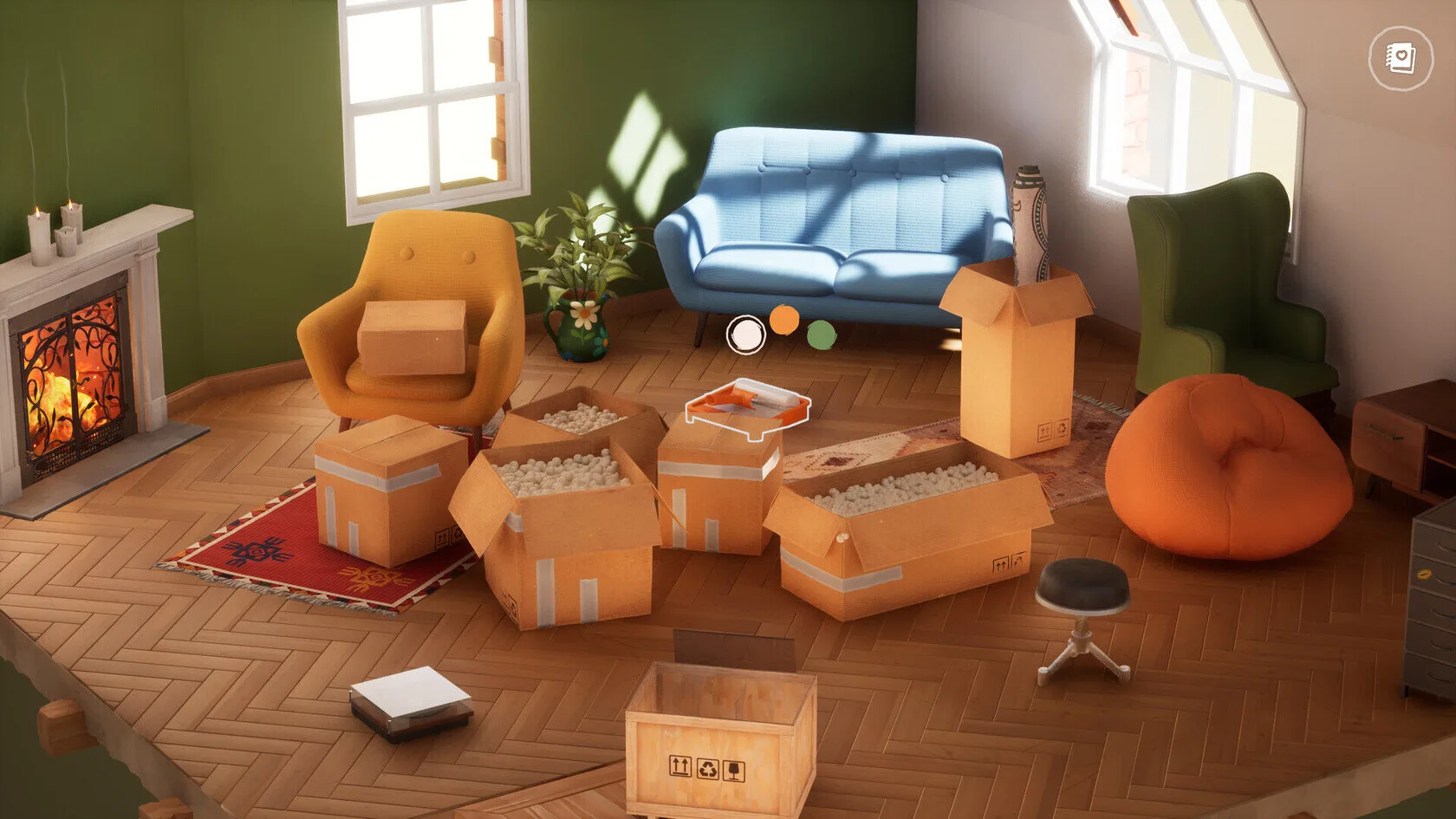
Once the room is ready, the decorating begins. Hozy opens up into a freeform arrangement game, handing over boxes of furniture, plants, lights, wall pieces, and small decorative objects that can be rotated and flipped into place. The absence of strict rules is part of the appeal. You can build a neat, balanced room or cram everything together in a way that feels messy and playful.
The game allows that kind of improvisation without judgment, which gives even a small collection of items a surprising amount of expressive power. There are also light interactive touches scattered through the spaces. You can open windows, switch on lamps, turn on radios, and see small reactions tied to individual items. Those details help each room feel occupied rather than staged.
The one part that feels less graceful is the inventory flow. Items come out of boxes in order, one at a time, which can make comparison awkward and force you to crowd the room with objects before you know what you actually want to keep. That system can interrupt the calm pace just enough to remind you that Hozy is still working through some rough edges.
Light, Sound, and the Feel of a Space
Hozy’s strongest advantage is presentation. The game leans into stylized realism, and the result is a room that feels physical in a way many decorative games never quite manage. Light falls across surfaces with real warmth. Dust hangs in the air. Wet paint clings to walls before drying. Mopped floors leave visible marks that fade over time. Even small interactions have weight to them, from plants shifting with a breeze to pillows sagging when you grab them. That sense of materiality makes the act of cleaning and decorating more satisfying, because every gesture seems to change the room in a visible way.
The sound design carries the same care. The soundtrack adjusts as progress is made, so the music feels like it is growing with the room rather than sitting on top of it. Environmental audio fills the gaps with wind through open windows, birds in the distance, city noises, fans humming, drawers sliding open, and the click of a light switch. Those layers are modest, yet they do a great job of building atmosphere. Hozy understands that a cozy game lives or dies by texture, and the combination of sight and sound gives each room a sense of place.
The spaces themselves help keep that feeling fresh. A treehouse has a different emotional shape from a moody studio or a cluttered apartment, and the item selection shifts to suit each location. Some rooms feel warm and inviting, while others lean into a more stylish or brooding mood. Hozy also includes accessibility options, including color blindness settings, which is a practical touch that fits the game’s careful design.
Small Scope, Strong Appeal
Hozy is compact, and that compactness shapes nearly every part of the experience. With nine levels, it is easy to finish in a single sitting or stretch across a couple of short sessions. That short length suits the game’s mellow tone, since Hozy works best as a focused break from something louder and more demanding. It never asks for mastery in the way a simulation game might, and it never tries to become a full building sandbox.
That restraint also limits its range. Paint choices are narrow, customization stays tied to each room’s preset set of objects, and the most ambitious decorative freedom is still bound by the structure of the level in front of you. A stronger sandbox mode, or a deeper set of room-wide tools, could have given the game a longer life.
The story hints, made through room descriptions and small item notes, suggest personal histories and lived-in spaces, yet Hozy keeps those threads light and understated. That choice fits the game’s quiet tone, though it also means the emotional ideas rarely build into something richer. There is charm in the suggestion, but the game leaves a lot of that material hanging in the air.
Even so, Hozy makes a convincing case for its own scale. It knows exactly what it is, and it delivers that experience with polish. The result is a small, calm game that values atmosphere, precision, and the simple pleasure of turning disorder into something welcoming.
Hozy is a relaxing, physics-based simulation game that invites players to restore forgotten neighborhoods by cleaning and decorating abandoned homes. Released on March 30, 2026, the game emphasizes a stress-free experience without timers or penalties, focusing instead on the satisfying mechanical flow of painting, wiping windows, and arranging curated furniture across nine unique locations. It is currently available for purchase on PC via the Steam store and is also playable on macOS.
The Review
Hozy
Hozy is a polished, relaxing room-restoration game with gorgeous lighting, tactile cleaning, and satisfying decorating. Its short length, light story, and limited customization keep it from reaching a higher tier, but the core loop is charming and easy to enjoy.
PROS
- Beautiful visuals and lighting
- Relaxing, tactile gameplay
- Strong sound design
- Freeform decorating
CONS
- Very short
- Limited customization
- Inventory can feel clumsy
- Camera could be better