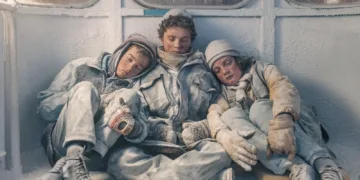











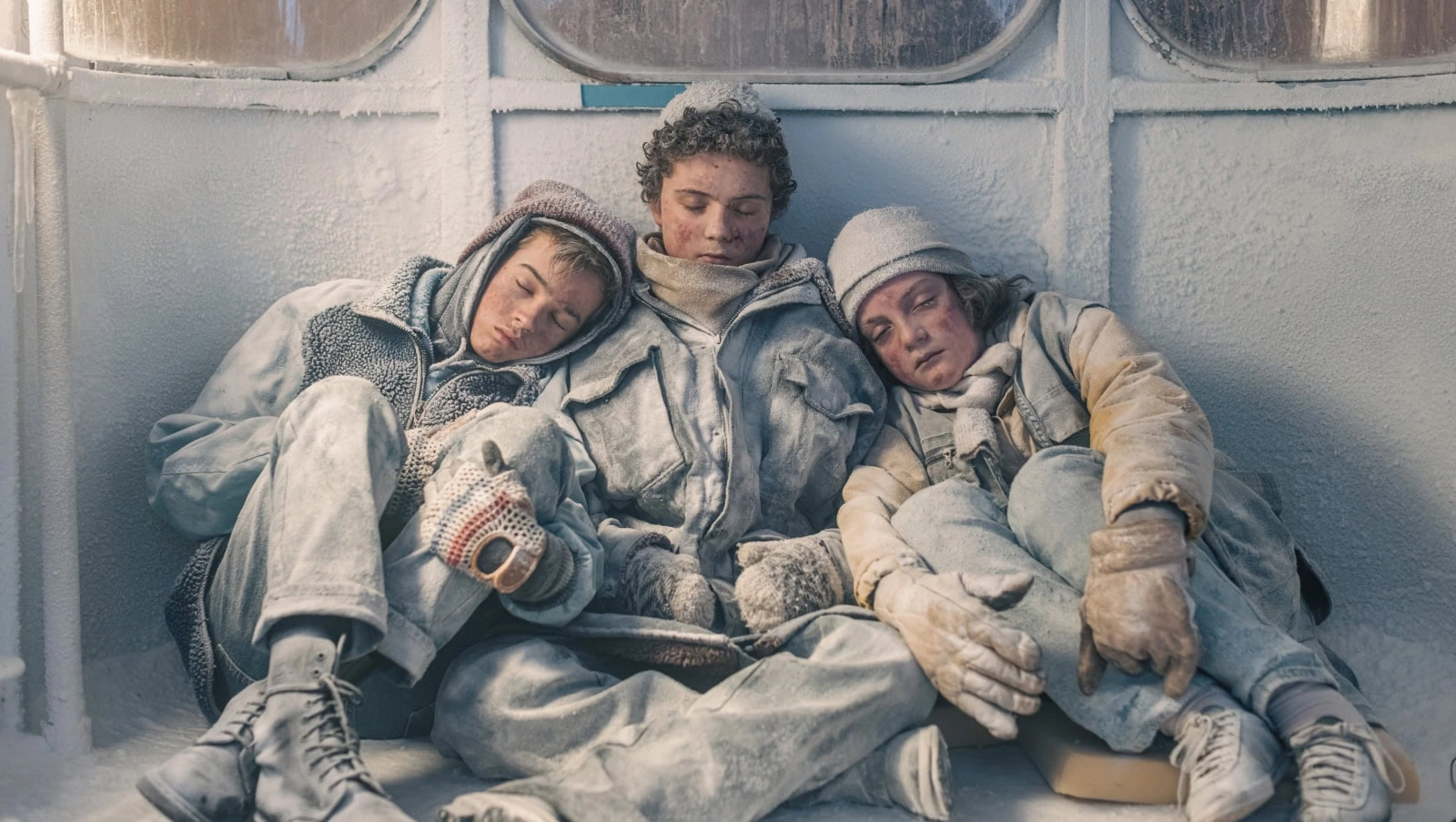

“Last Ride” opens on March 10, 1982, amid the frost-bitten spread of Vargøy, Norway. Three teenagers, Devin, Syd, and Jamie, carry a recognizable form of American adolescent curiosity as they persuade a hungover guide named Øyvind to take them on an after-hours cable car ride.
Their disaster is triggered by an astronomical event inspired by the 1974 text “The Jupiter Effect.” A massive power surge tied to the rare planetary alignment destroys Øyvind’s pacemaker and leaves the boys suspended in a steel box above the winter void.
The survival story sits inside a present-day frame involving an intoxicated survivor played by Gustaf Skarsgård. He returns to the site with his son, played by Samuel Paul Small, and a dealer, played by Jasper Pääkkönen, to face the trauma that has followed him for decades.
The immediate danger is blunt and almost ancient. The boys have no heat. They have no communication. Their isolation feels complete. Cinqué Lee uses the premise to peel civilization down to its frailest skin. The landscape becomes a silent, white witness, watching panic bloom inside metal. The power outage produces literal darkness and symbolic darkness, cutting Vargøy away from the world with cruel efficiency.
The Accents of Adversity
Roman Griffin Davis, Felix Jamieson, and Charlie Price carry the film’s emotional load. Their rapport has the scuffed ease of boys who know how to needle each other, forgive each other, and pretend none of it matters. Davis brings curly-haired innocence, a sharp shift from his role in “Jojo Rabbit.” Price gives Jamie a brash, libertine quality that rubs against the group’s fear like sandpaper. Jamieson plays Syd as the moral center and eventual leader, the boy who starts measuring danger with unusual clarity.
The casting choice has a strange charge. These British actors play American teenagers, and their accents occasionally sink into a muffled register, perhaps meant to imitate the half-swallowed diction of natural teen speech. The result creates a faint linguistic displacement, a tiny artifice that sits beside the realism like a loose screw. It bothered me. Then, a few scenes later, I found it oddly appropriate. These boys are geographically stranded, emotionally stranded, and, in a minor vocal sense, culturally adrift.
Kristofer Hivju gives Øyvind a brief burst of rough energy. His shared affection for The Clash with the boys creates a small pocket of joy before the machinery of doom gets serious (and it gets very serious, because cable cars rarely do casual menace). In the modern scenes, Gustaf Skarsgård plays a man drowning in memory. He holds Øyvind’s old canteen like a sacred object. Pääkkönen feels somewhat wasted as the drug dealer, with the role providing less texture than the actor suggests he could handle.
The teenagers cling to childish fantasies of zombies and space-born catastrophes while facing a colder reality. Syd’s insistence that they will handle the crisis together signals a hard turn toward maturity. His readiness to sacrifice for the others shapes the performance’s emotional core. The crisis becomes a crucible for friendship, forcing the boys across the narrow, painful bridge between childhood and survival.
Chromodynamic Isolation
The film works as a bottle movie in the sky. Lee makes strong use of the gondola’s cramped interior and builds a visual scheme I will call chromodynamic isolation. The shifting glow of the Northern Lights plays against the grey, rusted steel of the car. That celestial light gives the survival dread a surreal cast, as if the universe has decided to stage a private light show for three freezing boys. Very considerate. Very useless.
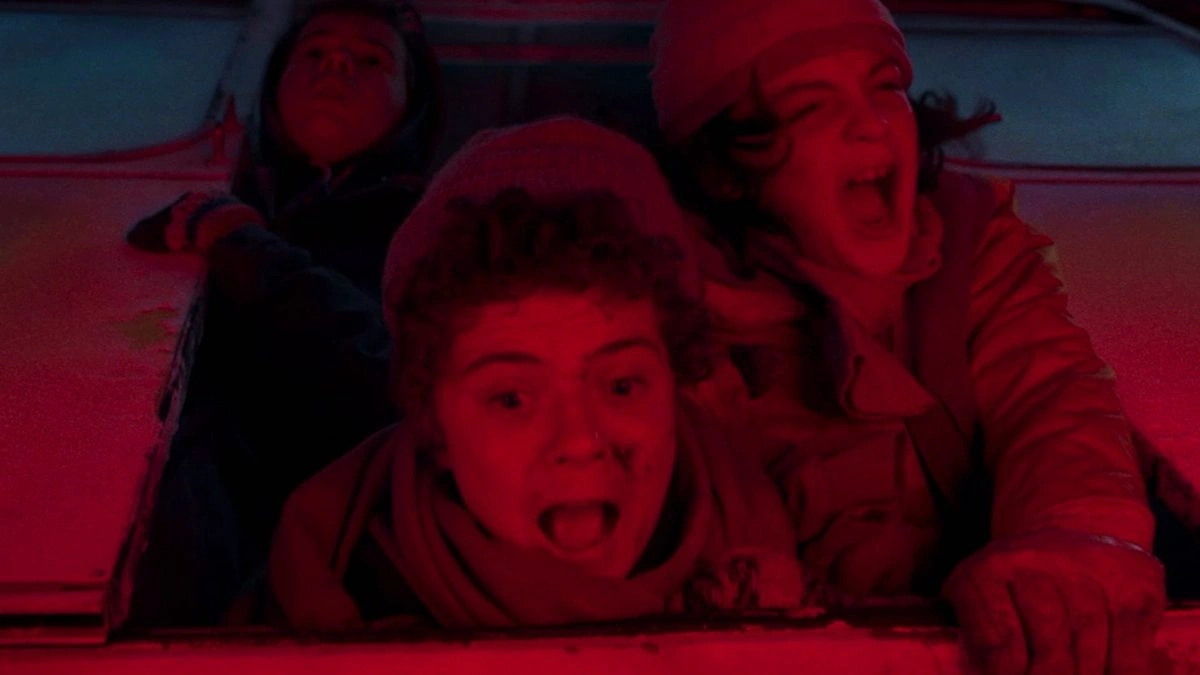
The cinematography renders the Norwegian winter with harsh physical clarity. Wind and snow look heavy, hostile, and alive. The sound design has similar precision. The wheeze of the cable car and the steady clinking of metal against metal keep reminding us that safety is a rumor.
The film’s environmental storytelling thrives through these small mechanical threats. The production design marks the 1980s through Brooklyn-inspired gear and survival items, grounding the boys’ personalities in objects before fear reduces those objects to tools, tokens, or dead weight.
Lee keeps the single location visually active through varied camera work. Angles shift. Weather patterns shift. The gondola’s metal box becomes a pressure chamber for adolescent dread. The isolation operates as a physical trap and a psychological irritant.
The mountain’s silence is broken by the atmospheric groans of machinery, a soundscape that seems to come from some industrial afterlife. This technical care makes hunger and cold feel tactile. Every visible breath becomes an hourglass. The visual language suggests a world whose systems have failed. The gondola becomes a cold, mechanical tomb.
Survivancy and the Pre-Digital Void
The script studies survivancy, a term I’ll use for surviving while keeping one’s humanity intact. The boys avoid the familiar “Lord of the Flies” pattern in which isolation corrodes decency. They move toward empathy. They speak about family pain, absent parents, and secret flings with a sensitivity that feels aspirational for 1982, perhaps suspiciously so, and still emotionally persuasive. The period setting matters. With no mobile phones, the mountain becomes a pre-digital void. Intelligence, patience, and trust become their operating system.
Cinqué Lee, supported by executive producer Spike Lee, turns attention toward character internalities. The “Jupiter Effect” functions as a pseudo-scientific anchor, giving the disaster a strange historical texture without turning the film into a full cosmic puzzle box. The pacing follows a slow-burning psychological design. The film gives priority to the boys’ emotional passage from childhood toward adolescence, treating survival as a moral condition as much as a physical one.
The trio’s loyalty stands against the bitterness of the modern frame. Their ordeal becomes a meditation on mortality, youth, and the fragile civic contract between scared people in a confined space. The friendship feels earned through shared terror and small acts of care. That matters culturally, too. In an era often drawn to spectacle, “Last Ride” treats solidarity as the real special effect. The boys leave the crisis changed. Their loyalty remains the most meaningful artifact of what happened in that suspended steel room.
Last Ride is a survival thriller directed by Cinqué Lee that premiered on February 20, 2026. Set during the winter of 1982 in the snowy mountains of Norway, the film follows three American teenagers whose mountaintop excursion turns into a nightmare when a rare celestial event causes a massive power surge, leaving them stranded in a stalled cable car. As of May 2026, the movie is available to watch on major digital and on-demand platforms, including Prime Video, Apple TV, and Fandango at Home.
Where to Watch Last Ride (2023) Online








Full Credits
Title: Last Ride
Distributor: Quiver Distribution
Release date: February 20, 2026
Running time: 98 minutes
Director: Cinqué Lee
Writers: Cinqué Lee
Producers and Executive Producers: Ann Carli, John Einar Hagen, Cinqué Lee, Spike Lee
Cast: Roman Griffin Davis, Felix Jamieson, Charlie Price, Kristofer Hivju, Gustaf Skarsgård, Jasper Pääkkönen, Samuel Paul Small
Director of Photography (Cinematographer): John Christian Rosenlund
Editors: Iikka Hesse
Composer: Juri Seppä, Tuomas Wäinölä
The Review
Last Ride
"Last Ride" is a meditative survival piece that prioritizes the fragile architecture of friendship over the typical machinery of thrillers. Cinqué Lee crafts a claustrophobic study of adolescent loyalty within a frozen Scandinavian crucible. The framing device occasionally dampens the tension, yet the technical precision and the chemistry of the young leads remain effective. It is a slow-burning exploration of mortality that replaces generic gore with a haunting, celestial atmosphere.
PROS
- Evocative sound design and atmospheric cinematography.
- Organic chemistry between the three young leads.
- Empathetic approach to the survival genre.
CONS
- Inconsistent and unnecessary American accents.
- Predictable structure caused by the framing device.
- Narrative pacing feels stretched for a feature length.