























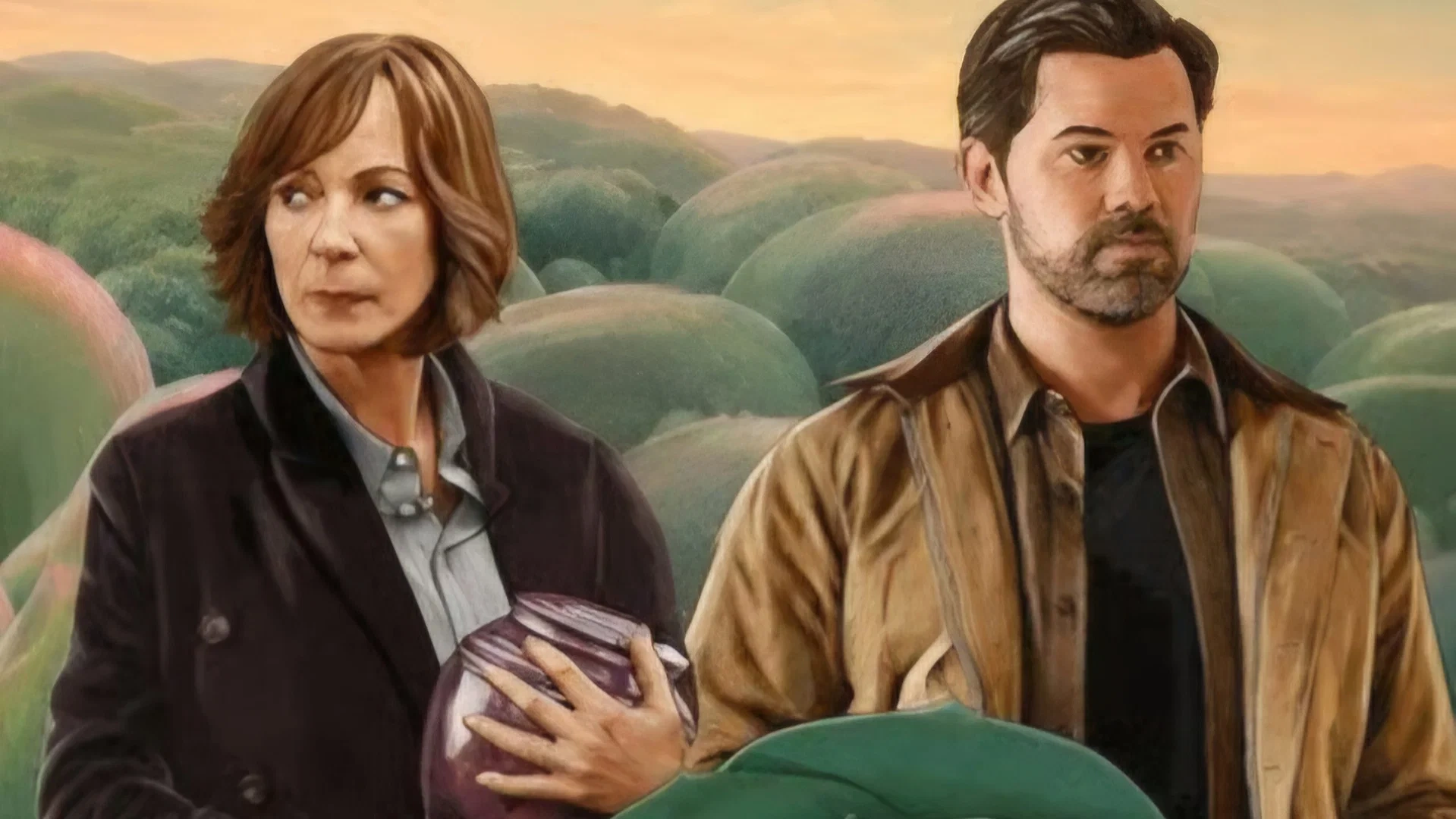

Jim Rash makes his solo feature directorial debut with Miss You, Love You, an HBO production that pares cinema down to nerve endings, bad rooms, and worse timing. The film lands in a sunlit, stripped-down corner of New Mexico, where Diane Patterson, played by Allison Janney with magnificent, coiled hostility, has endured three miserable years after leaving New York City. Now she is suddenly a widow.
Her estranged son, Tyler, does not arrive to help bury his father. He is trapped overseas on a work assignment and sends Jamie Simms, his personal assistant, played by Andrew Rannells, to manage the grim machinery of funeral arrangements.
This creates a brutal week-long collision between strangers tied together by an absent man. Rash turns the premise into a study of emotional outsourcing, a phrase ugly enough to fit the subject. A quiet home becomes a pressure chamber where grief is sharpened, categorized, and redistributed across seven days.
The Economy of Proxy Grief
Diane lives inside hyper-resentment, a form of psychological rigor mortis formed during her husband Henry’s decline from Parkinson’s disease. She transfers her sense of abandonment onto Jamie, using him as the son-shaped target standing in the room. The arrangement feels painfully current. Family obligation now gets passed down a chain of assistants, workers, handlers, and professional intermediaries. Intimacy has a payroll department. Grim, yes. Efficient, too, which may be worse.
Jamie enters as the perfect long-suffering corporate stooge, almost pathologically polite, carrying deep private damage beneath the customer-service glaze. Tyler’s text messages keep arriving with the title phrase attached, a tiny digital ritual that reveals the enormous emotional distance between mother and child.
As Diane and Jamie clash, their confessions surface in jagged bursts. Jamie says he came out at thirty-five, after his parents had died, and he gestures toward a painful, unreturned history with Tyler that began in a West Hollywood bar. Diane shares her own shame: Henry’s illness had taken his volume, and she missed his final cries for help.
The film gives caregiving fatigue a cruel physical weight. It understands a social truth usually discussed in embarrassed half-sentences: families can become transaction systems, while strangers hired to perform tasks become the people who hear the truth.
The Proscenium of the Two-Bed, One-Bath
Rash builds the film around architectural pressure. Diane’s tasteful, restrictive house has the emotional airflow of a sealed jar. The characters remain locked inside it, with awkward trips to a diner, a grocery store, and a church offering brief exposure to the outside world. Daniel Moder’s cinematography refuses desert postcard beauty. The camera stays close to walls, rooms, faces, and surfaces, turning the home into a claustrophobic map of injury.
The physical objects carry Henry’s ghost with theatrical bluntness. An unfinished painting waits in a corner. Empty pet bowls mark the absence of a cat taken by an owl. A dying succulent plant becomes a rather emphatic symbol of Diane’s failing domestic care. Subtle? Hardly. Effective? Annoyingly, sometimes.
The dialogue has cyclical rhythm, circling anger until the characters seem trapped inside their own repeated accusations. It swings from cruel wit to heavy disclosure, then back again, like people using language as both shield and blunt instrument.
The townspeople, played in minor roles by Bonnie Hunt, Oscar Nuñez, and Suzy Nakamura, drift through the frame as comic interruptions. Their appearances act like speed bumps, small jolts of social normalcy that make Diane and Jamie seem even further cut off from ordinary human weather.
Scripted Tantrums and Grounded Triumphs
Janney is spectacular. She leans into Diane’s unlikable sharpness with such commitment that the character’s cruelty becomes almost architectural, part of the house, part of the air. She grounds a role that could have hardened into monstrous caricature, shaping Diane into a portrait of bone-deep exhaustion.
Rannells meets her with admirable control. His eager-to-please corporate smile begins as armor, then slips away during a staggering third-act monologue. In that moment, Jamie’s professionalism cracks, and the film briefly escapes its own neat construction.
The screenplay often stumbles over its theatrical instincts. Too many exchanges feel manufactured, as if the characters have been waiting offstage for their turn to deliver a polished wound. Their speeches become structural lectures, closer to acting workshop material than spontaneous human speech.
The story follows a familiar independent-drama path, with mismatched lonely people placed together until pain begins to sound like medicine. The neighbor comedy falls flat, landing with the energy of someone knocking politely during an emotional exorcism.
Rash’s final confrontation works because he refuses clean comfort. The catharsis is messy, loud, and humanly inconsistent. Barry White’s “You’re the First, the Last, My Everything” then arrives and somehow becomes oddly transcendent. The film remains strange and imperfect, a cultural artifact built from resentment, care work, delayed confession, and family failure. Its willingness to sit inside that mess gives it a ghostly relevance.
The American drama film Miss You, Love You is scheduled to premiere on May 29, 2026, on HBO and will be available to stream simultaneously on HBO Max. The project features an intimate look at grief as an estranged son sends his assistant to manage his stepfather’s funeral arrangements, forcing a prickly widow into an unexpected alliance with a total stranger.
Where to Watch Miss You, Love You (2026) Online


Full Credits
Title: Miss You, Love You
Distributor: HBO Films
Release date: May 29, 2026
Rating: TV-MA
Running time: 97 minutes
Director: Jim Rash
Writers: Jim Rash
Producers and Executive Producers: Kevin Walsh, Nat Faxon, Gigi Pritzker, Rachel Shane
Cast: Allison Janney, Andrew Rannells, Bonnie Hunt, Suzy Nakamura, Oscar Nuñez, Lisa Schurga
Director of Photography (Cinematographer): Daniel Moder
Editors: Doc Crotzer
Composer: Mark Orton
The Review
Miss You, Love You
Miss You, Love You functions as a jagged, hyper-theatrical chamber piece that succeeds on the sheer velocity of its performances rather than the originality of its script. Jim Rash constructs an authentic, often painful dissection of outsourced family devotion, though his dialogue occasionally feels too rehearsed for the screen. Allison Janney and Andrew Rannells elevate the predictable indie-drama framework into something genuinely arresting, avoiding easy sentimentality. It is an imperfect but affecting look at modern grief.
PROS
- A powerhouse, uncompromised performance by Allison Janney that grounds bitter resentment into deep exhaustion.
- Andrew Rannells provides excellent dramatic support, culminating in a raw, showstopping third-act monologue.
- Astute thematic exploration of caregiving fatigue and the modern outsourcing of family intimacy.
CONS
- Theatrical, overly calculated dialogue that occasionally mimics acting exercises rather than natural human conversation.
- Predictable narrative arc that follows familiar independent drama tropes.
- The comedic subplots involving the local townspeople fall flat.