

























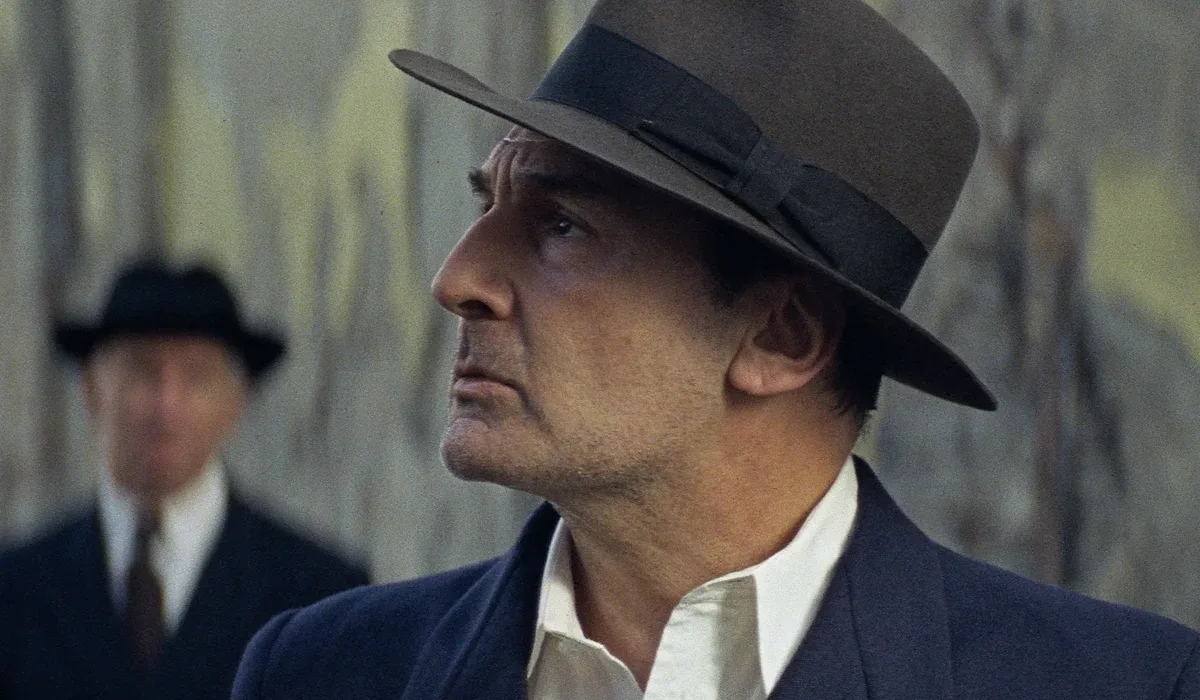

László Nemes removes the historical biopic’s polished armor and leaves behind a skeletal, trembling study of human fragility. His film fixes its gaze on the final, agonizing months of Jean Moulin, the legendary figure assigned by Charles de Gaulle to unite the fractured, quarrelsome factions of the French Resistance. The story opens inside occupied Lyon in March 1943, a city already breathing fear.
Moulin enters like a phantom, descending from a black sky under the fragile alias Jacques Martel. His mission to build an emergency underground network collapses after a brutal Gestapo raid at a local medical office. That disaster places him in the grip of Klaus Barbie, an SS officer marked by a calm, almost ceremonial sadism.
Nemes refuses the sweeping grandeur of wartime epics. He creates a linear, merciless study of dread. The film becomes a severe inquiry into psychological and physical captivity, where the familiar machinery of the historical thriller slowly drains away into a cold existential void.
The Stripping of the Mythic Icon
The screenplay by Olivier Demangel and Nemes narrows its field with deliberate severity, following a tightly localized path that leaves much of the larger political situation outside its frame. This decision can make the secondary characters feel fixed in rigid historical types, with their inner lives left partially sealed. The restriction still carries a philosophical charge, since it strips national heroism of its ceremonial glow.
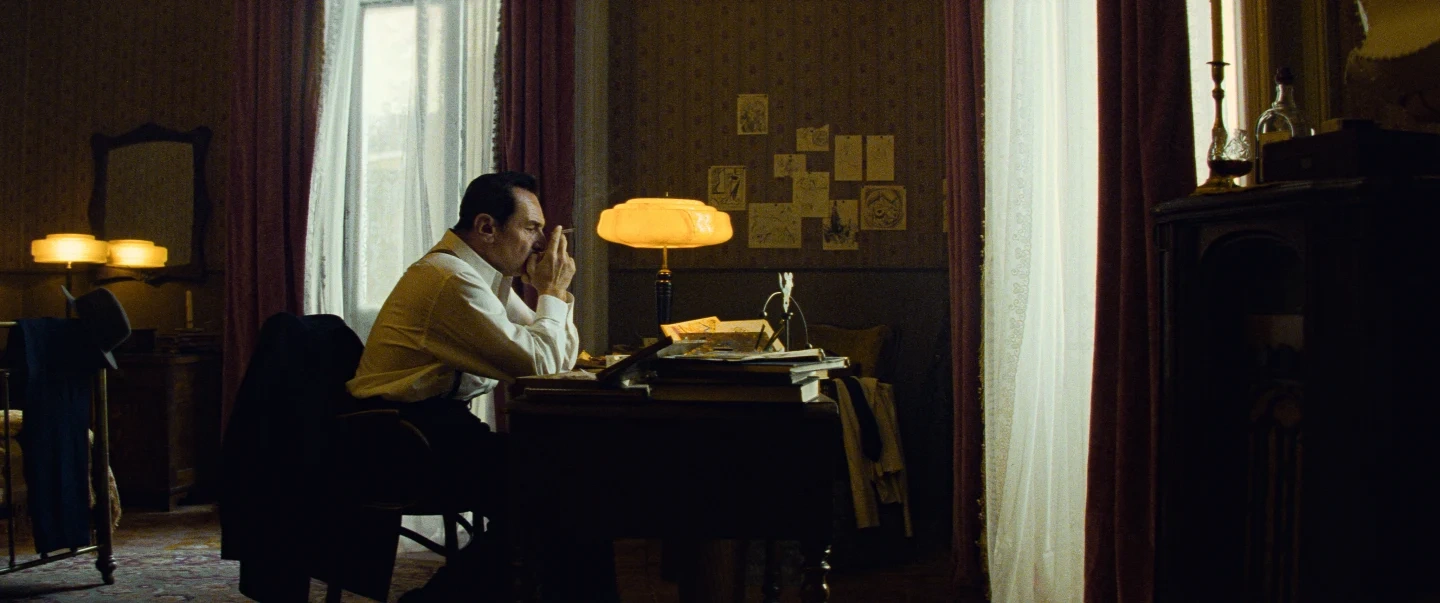
Many wartime dramas move from human flaw toward sanctified legend. This film reverses that motion. Moulin first appears as a sleek, cinematic espionage figure, then gets dismantled piece by piece until a frightened, self-aware man remains. He knows his own limits. He fears the coming torture. He fears the possibility that pain may reach the place where conviction fails.
Gilles Lellouche gives this descent a grave restraint. Early scenes show him with controlled, icy poise during clandestine meetings. As imprisonment tightens around him, that composure thickens into morose resignation. Lellouche defines heroism through silence, turning resistance into a bodily refusal to speak. The grand speech gives way to breath, bruised flesh, and withheld names.
That quiet severity meets Lars Eidinger’s Klaus Barbie, a performance alive with volatile, sociopathic force. Eidinger brings the bleak prison blocks a terrifying unpredictability, moving between chilling calm and erratic theatrical fury. The peripheral characters offer brief glimpses into Moulin’s hidden, fragmented existence.
His exchanges with his aristocratic cover decoy, Comtesse de Forez, played with elegant vulnerability by Louise Bourgoin, suggest suppressed personal truths without forcing them into confession. His quiet solidarity with a young cellmate named Martin gives the film a small flare of human warmth inside the surrounding darkness.
A Suffocating Geometry of Yellow and Green
The film’s technical design turns history into a physical state of entrapment. Director of photography Mátyás Erdély shoots on 35mm film in true anamorphic CinemaScope, a format often associated with grand horizons. Here, the width becomes oppressive. Characters appear pinned against heavy, unyielding backgrounds, as if the frame itself has learned the logic of confinement.
The visual language carries a harsh noir sensibility. Daylight arrives in jaundiced yellow, sickly green, and pallid tones, suggesting a world decaying from within. Night brings hard lighting, deep shadow, and thick winter mist that swallow faces and make Lyon feel like a city infected by paranoia.
Stéphane Rozenbaum’s precise period production design keeps this stylized dread rooted in rough physical detail. The dark, uneven cobblestones, cramped apartments, and damp, repetitive architecture of Montluc prison create a tangible sense of doom.
The soundscape is just as punishing. Tamás Zányi’s immersive sound design traps the viewer inside stone, iron, and breath, catching every footstep and every strained inhalation. Laetitia Pansanel-Garric’s sparse score rejects melodramatic swelling, allowing the raw, aggressive sounds of captivity to set the rhythm of Moulin’s isolation.
The Exhaustion of the Flesh
After the midpoint, the remaining spy-thriller shape evaporates, and the film hardens into a slow, grueling procedural of human agony. Nemes studies the body under siege, while avoiding the cheap shock of graphic gore. The most explicit violence stays outside the frame. Horror arrives through sound, including the distant, sickening presence of a prison guard’s dogs.
This formal coldness forces the audience to sit with cruelty as an administrative system, a process with rooms, schedules, orders, and echoes. The approach can also become heavy in its own right. The linear structure and two-hour runtime establish steadfastness and brutality early, then repeat those ideas until the experience nears narrative exhaustion.
This relentless focus raises a troubling philosophical question about historical memory. By devoting such exact attention to the clinical mechanics of a slow, painful death, the film risks defining a man by his destruction. A viewer may leave uncertain about the ethics of remembrance here. Is a resistance leader honored through the meticulous reconstruction of suffering, or through a fuller engagement with the ideals he died trying to protect?
Moulin had its highly anticipated world premiere in the main competition of the Cannes Film Festival on May 17, 2026, where it competed for the prestigious Palme d’Or. The historical war biopic is scheduled for its wide theatrical release in France by Studio TF1 on October 28, 2026. Audiences looking to stream the project can watch it globally on Disney+ and HBO Max, both of which secured the distribution rights for their respective streaming platforms ahead of its festival rollout.
Full Credits
Title: Moulin
Distributor: Studio TF1, Disney+, HBO Max
Release date: May 17, 2026 (Cannes Film Festival world premiere), October 28, 2026 (Theatrical release in France)
Running time: 128 minutes
Director: László Nemes
Writers: Olivier Demangel, László Nemes
Producers and Executive Producers: Alain Goldman
Cast: Gilles Lellouche, Lars Eidinger, Louise Bourgoin, Félix Lefebvre, Marcin Czarnik, Max Warburton, Hortense Quentin de Gromard, Théo Costa-Marini, Izabella Caussanel, Pierre Nisse, Christian Harting, Cser Kinga
Director of Photography (Cinematographer): Mátyás Erdély
Editors: Péter Politzer
Composer: Laetitia Pansanel-Garric
The Review
Moulin
Moulin is less of a historical tribute and more of a severe, existential descent into the limits of human endurance. While its rigorous rejection of biographical cliché and its suffocating visual atmosphere are technically masterful, the film ultimately traps itself in a repetitive loop of suffering. By prioritizing the clinical mechanics of agony over a deeper exploration of its hero's ideals, it leaves behind an impressive but emotionally hollow monument to pain.
PROS
- A masterfully claustrophobic, 35mm anamorphic noir aesthetic that perfectly captures wartime paranoia.
- Gilles Lellouche’s deeply internal, restrained performance that effectively demythologizes the traditional war hero.
- A chilling, unpredictable turn by Lars Eidinger that brings a volatile energy to the prison sequences.
CONS
- The narrative trajectory becomes an exhausting, slow-moving procedural in its second half.
- Secondary characters and the broader political context are flattened into rigid, unexamined archetypes.
- The film risks defining a great historical figure by the mechanics of his death rather than the ideals of his life.