
























Yerba Buena begins with a simple kind of chaos. Barb, a jobless newcomer trying to make a life in 1970s San Francisco, is riding through a city that already feels slightly broken before the plot fully explains why. Her friend Russell gets kidnapped by a biker gang member, a suspicious briefcase falls into her hands, and suddenly her ordinary bad day turns into a physics puzzle adventure with a cassette-powered device at its center.
That device, the Oscillator, defines the whole game. It lets Barb copy physical properties from selected objects and paste them onto glitched objects scattered through the world. A moving object can lend its momentum to a car, platform, block, or even part of a building. The idea gives Yerba Buena the spirit of a first-person puzzle game like Portal, yet its personality is messier, stranger, and rooted in a retro city fantasy filled with biker gangs, tech paranoia, and self-aware video game logic.
The game also carries a playful contradiction. It looks bright and funny, yet its world is trapped by corporate ambition, artificial intelligence, and characters who may have far less control over their lives than they think.
Barb, The Glitch, and the Limits of Agency
The story starts as a rescue mission. Barb wants to save Russell from Bear, the biker who steals his cab and pulls him into a larger mess. From there, Yerba Buena grows into a meta-narrative about NPCs, programming errors, player characters, and a city caught in artificial loops. Barb is treated like a background figure who suddenly gains the tools to interfere with the system around her, which gives the game its strongest thematic hook.
This is where the game’s design and story connect best. Barb’s lack of control is built into the world, then challenged through the Oscillator. She cannot fight enemies, level up, or shape dialogue like an RPG protagonist. Her version of choice comes through physical manipulation. She changes routes, moves barriers, bends object behavior, and breaks the rules of spaces that were never meant to give her power.
That said, Yerba Buena is still a linear game. Player choice rarely creates lasting narrative consequence. You solve the puzzle and move forward. In that sense, it resembles indie narrative puzzlers rather than choice-heavy RPGs like Disco Elysium or Citizen Sleeper, where decisions reshape relationships and outcomes. Yerba Buena uses interactivity to express agency at the mechanical level, not through branching story paths.
The supporting cast gives the world warmth. Russell, Wanda, Jorge, and Tee help build the sense that Barb has a small chosen family worth saving. Tee, stuck in a T-pose, is the clearest joke in a game full of glitch humor. Barb herself is likable and practical, though she can feel underwritten compared with the ideas around her. The city, too, sometimes feels underused. The 1970s mood is visible in the fashion, cars, biker imagery, and cop-show flavor, yet many chapters move indoors or into surreal amusement park spaces that pull the game away from San Francisco’s texture.
The Oscillator Turns Physics Into Storytelling
The Oscillator is one of those puzzle tools that sounds complex until you see it in motion. The scanner highlights usable objects. Orange or yellow objects provide traits, while blue glitched objects can receive them. That color language gives the player a clear first step: find what can be copied, then figure out where it belongs.
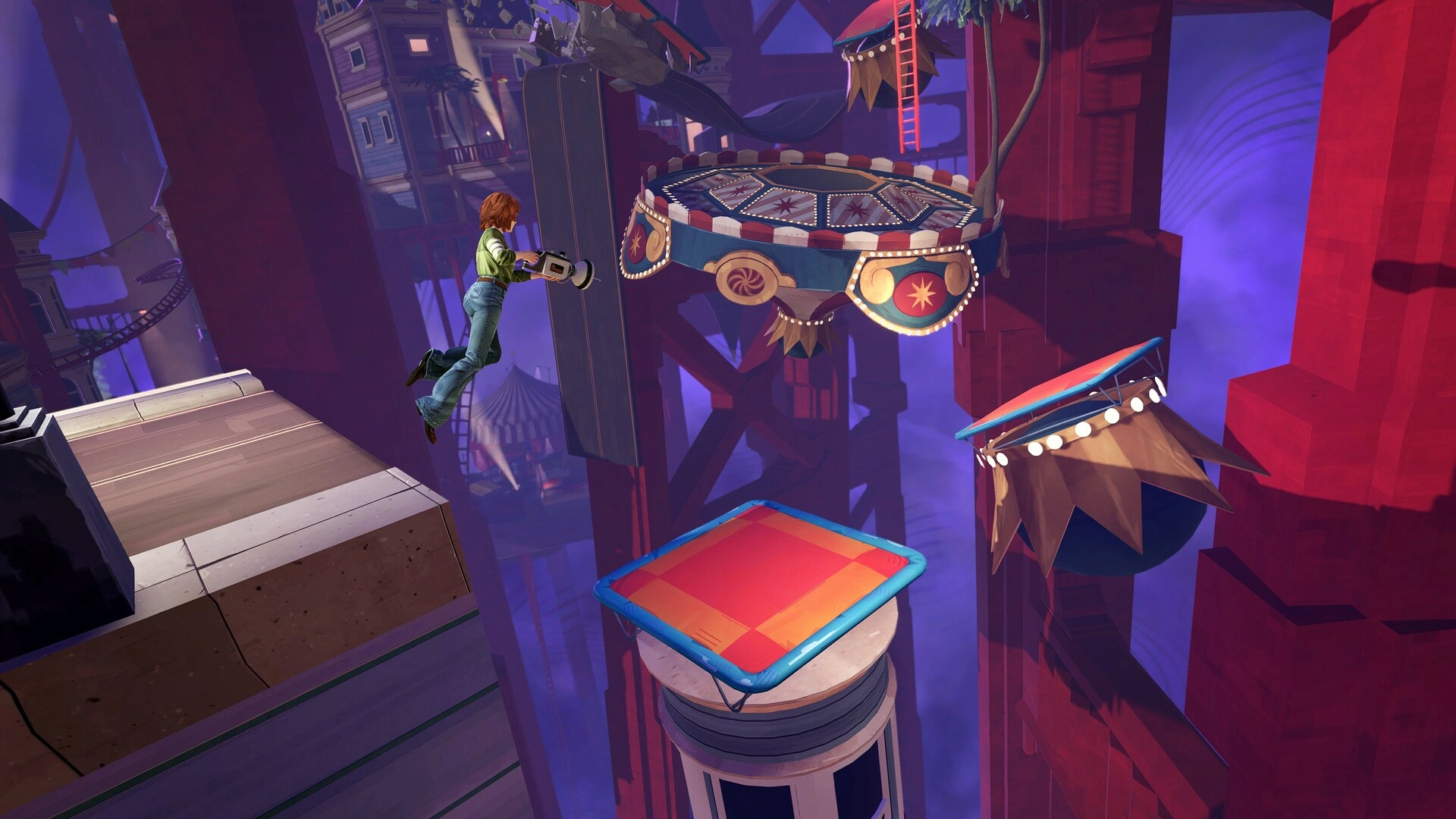
Movement is the foundation. If an object moves upward, Barb can copy that upward force and apply it to a platform. If something spins, she can make another object rotate. The best puzzles ask players to stop thinking of the environment as scenery and start treating it as a toolbox. Cars become stepping stones. Building sections become bridges. Surfaces become launch pads. A city street can turn into a puzzle board.
Later powers widen that logic. Barb can make objects gaseous so they lose solidity. She can apply bounce properties to surfaces. Sticky or honey-like traits change how objects and movement interact. The game slowly shifts from simple copying to layered sequencing, where the player needs to combine motion, phasing, bounce, and timing in the correct order.
This is where Yerba Buena shines. Its strongest puzzles create a clean mental click, the kind that makes a player feel clever without needing a stat sheet, combat build, or dialogue tree. The systems are readable enough for casual players to understand, while the combinations give puzzle fans something to chew on. It has some of the same brain-itch appeal as Portal, The Talos Principle, or Superliminal, where the core mechanic becomes a language.
The problem is that Yerba Buena does not always teach that language cleanly. Some solutions depend on details that are easy to miss, such as a small target, a poorly signposted object, or a mechanic that has not been explained with enough confidence. Later puzzles become longer and stricter, with pits, lasers, grinders, and sequences that can punish one misplaced action. A failed setup can sometimes force a full restart rather than a quick correction.
The Oscillator itself can also fight the player. Aiming may feel unreliable when objects have small active zones or when a puzzle asks for quick property swaps. Platforming remains basic, with no ledge-grab safety net, and bounce sections can become more awkward than satisfying. The reset system is another weak point. Since objects often return fully to their default state, the player cannot easily undo one mistake while keeping the rest of a solution intact.
These issues matter because Yerba Buena is a game about precision and consequence. Each copied trait is a choice, but the consequences feel meaningful only when the rules are clear. When the systems behave well, the game turns problem-solving into playful rebellion. When the targeting or clueing falters, the same systems become trial and error.
Style, Sound, and the Uneven Rhythm of a Smart Idea
Yerba Buena has a vivid painted look that suits its artificial world. The comic-book flourishes, bright colors, and chunky character designs give the game an immediate identity. Its visual style also helps support the meta-fiction. Stiff animations or odd character transitions can read like part of the game-within-a-game conceit, though lip movement and scene transitions still look rough at times.

The sound design is solid without leaning too hard on expected 1970s cues. That may disappoint anyone hoping for a heavier period soundtrack, yet it keeps the game from feeling like a simple nostalgia exercise. The voice acting carries the humor well enough, with some stilted moments that rarely sink a scene.
Pacing is less consistent. The game runs about ten hours, depending on how often a player gets stuck. Early chapters feel brisk and funny, with puzzle spaces that encourage experimentation. The back half grows heavier, longer, and stricter. That shift fits the story’s darker ideas about control, artificial intelligence, and corporate takeover, yet it can drain some of the breezy energy that makes the opening hours so inviting.
The amusement park training zones are useful because they teach new Oscillator powers in focused spaces. They also risk feeling stretched when the main rescue plot is waiting elsewhere. Technical rough edges add friction too, including mid-cutscene loading screens, possible bugs, limited graphics options, and frame-rate dips on Steam Deck.
Yerba Buena works best as an indie puzzle game about agency in a world that was never built to offer it. It does not provide the branching consequence of a choice-driven RPG, and its story can feel scattered, but its central mechanic gives Barb a tactile way to push back against a broken system. That idea has real emotional force. Every copied movement, shifted platform, and glitched object becomes a small act of resistance, even when the execution stumbles.
The Review
Yerba Buena
Yerba Buena is a smart, colorful puzzle adventure with a terrific central mechanic and a playful meta-fiction hook. The Oscillator gives its best puzzles real spark, turning glitched objects into tools for movement, traversal, and problem-solving. Its story has charm, its world has personality, and Barb’s fight for agency gives the game emotional weight. Still, uneven clueing, awkward platforming, unreliable aiming, and a harsher back half hold it back from greatness.
PROS
- Inventive Oscillator mechanics
- Clever physics-based puzzles
- Strong visual style
- Fun meta-narrative premise
- Charming retro atmosphere
CONS
- Imprecise aiming
- Some frustrating puzzle logic
- Basic platforming
- Uneven pacing
- Story can feel messy