





















The most unsettling thing Jannis Lenz does with violence is keep it slightly out of reach. A threat circulates through a school on a phone screen. A bruise appears after paintball in the woods. A boy bites another until the skin gives way. None of these images arrives with the visual grammar that usually tells an audience exactly how frightened, sympathetic, or disgusted it should feel. Alexander Dirninger’s camera observes with a cool, fixed patience, and that distance turns interpretation into the film’s central ethical problem. We keep seeing evidence. We are less certain what it proves.
That question settles most heavily around Andi, played by Anton Petzold as a boy whose vulnerability and volatility seem permanently fused. One video shows him raging at classmates and threatening them. Another shows the humiliation sitting behind that anger: Andi naked in a gymnasium, unable to reach clothes his tormentors have taken from him.
The school responds to the first image because institutions are built to process visible danger. The second image is messier. It reveals the social cruelty that produced the danger, yet cruelty dispersed across a group is harder to discipline than one furious boy caught on camera.
Lenz understands the psychological power of that imbalance. Andi can look frightening without ceasing to look frightened. Petzold plays him with a physical awkwardness that makes his anger feel defensive until it suddenly does not. The film repeatedly invites the audience to perform the same judgment as the adults around him. Is this an injured teenager being mistaken for a threat, or a genuine threat whose injuries tempt us into excusing him? The film keeps the light low on that moral answer.
Lukas, played by Florian Geißelmann, is safer socially and therefore compromised in a quieter way. He sees what happens to Andi, dislikes it, and rarely intervenes. When Andi finally asks why Lukas never does anything, the accusation exposes the cowardice built into spectatorship. Silence protects Lukas. It also helps preserve the conditions hurting his friend. Geißelmann’s withdrawn performance fits Lenz’s preference for unreadable surfaces: small changes in his face carry conflicts the screenplay seldom verbalizes.
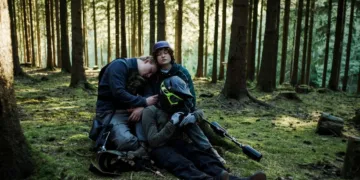
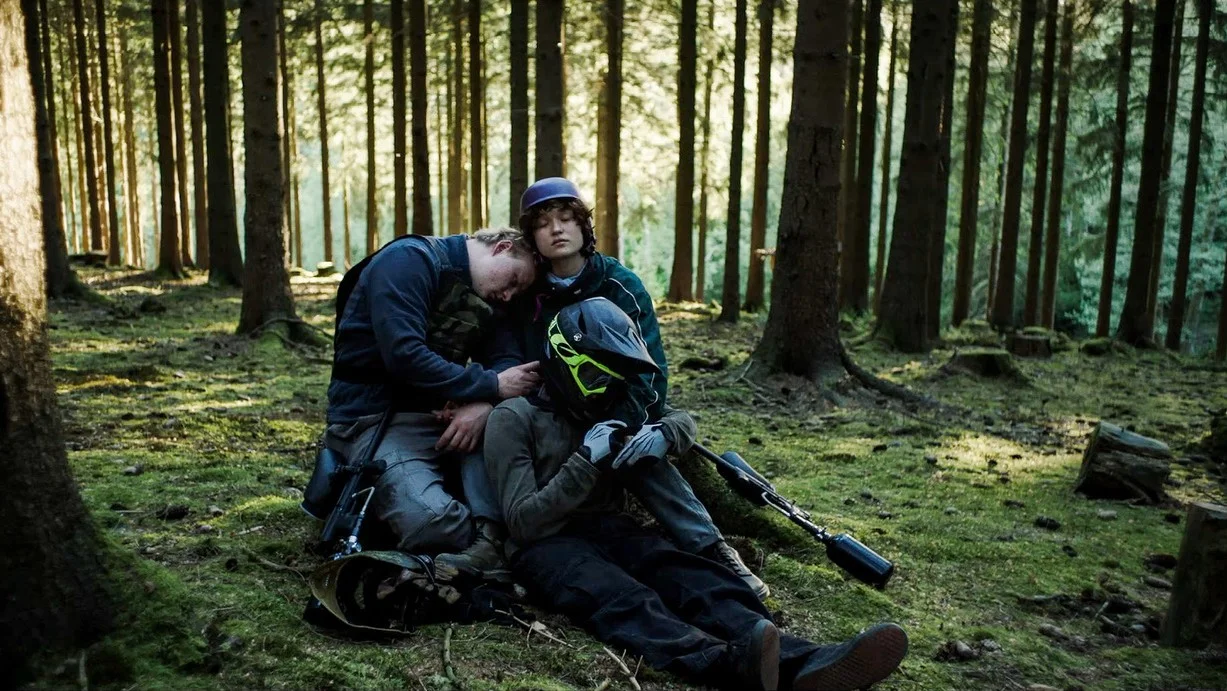
Outside school, Lukas and Andi retreat with Maja, played by Mathilda Smidt, into the nearby forest. Static compositions, long takes, and an austere visual distance follow the trio into the trees, refusing the warmer grammar that might mark this place as safe.
Their games make that instability physical. Paintball leaves bruises. Touch becomes biting. The three film each other as intimacy moves toward pain and then back toward tenderness. Maja often acts as the connective tissue, encouraging contact between the boys and helping create a private code of behavior whose rules belong only to them.
The acts are consensual, which distinguishes them sharply from Andi’s humiliation at school. Pain chosen among friends becomes a means of reclaiming control over bodies that have been mocked, watched, disciplined, or ignored. That reading is persuasive, though Lenz pushes the rituals so deliberately that their symbolic purpose sometimes becomes visible before their emotional logic does. A bruise can signify trust, aggression, shame, intimacy, and resistance, and the film asks it to carry nearly all of them.
The visual severity compounds the problem. If the forest is meant to offer a different emotional order from school, its images often possess the same chill. A meeting among parents, a counseling session, a paintball chase, and an intimate woodland ritual can arrive with nearly identical weight. The camera refuses hierarchy so insistently that the film occasionally loses texture.
Sound provides distinctions the images sometimes deny. After one paintball excursion, Lukas and Andi sit together while nearby wind turbines pulse through the silence. Their mechanical rhythm fills the conversational space without relieving it.
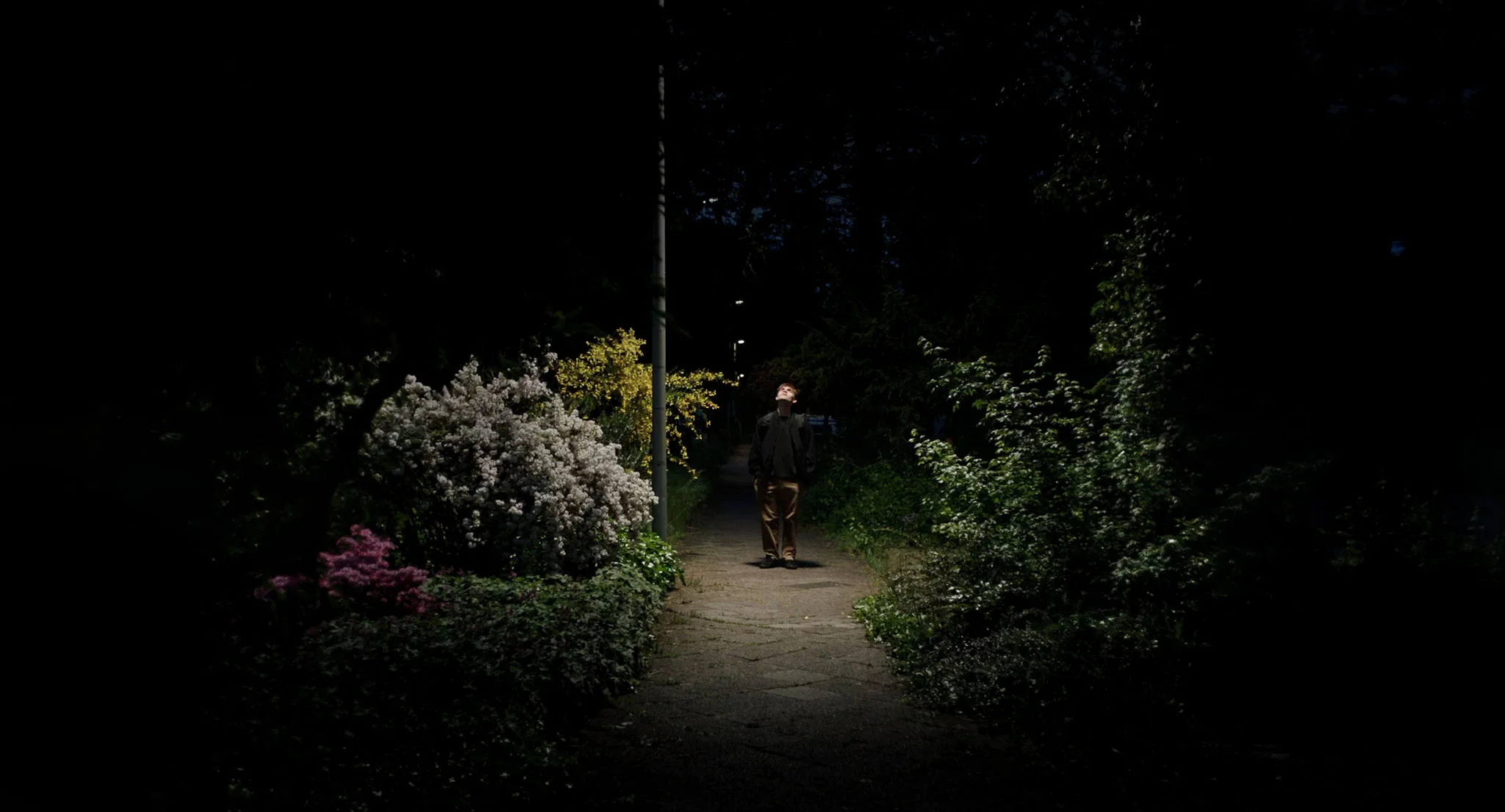
Nora Czamler and Benedikt Palier’s sound work, alongside Palier’s echoing score, repeatedly makes ordinary environments feel contaminated by expectation. Lenz borrows the audience psychology of the thriller here. We anticipate escalation because the film has trained us to hear menace even when nobody is moving.
That tactic becomes especially effective when Lukas cuts padding from his dead mother’s clothes and tapes it around his torso. Lenz withholds the practical explanation long enough for the action to resemble some obscure expression of grief. Then Lukas enters the woods and the object reveals itself as makeshift paintball armor. The scene is a miniature version of the film’s method: observation first, judgment second, correction later. Context changes the image.
The adults never quite learn that lesson. Lukas’s father Martin, who also teaches Andi, is sincerely concerned about his son and increasingly wary of the friendship. School officials hold meetings, introduce interventions, and discuss disciplinary responses. Nobody is presented as cartoonishly indifferent. Their failure is subtler and nastier: they understand procedures better than they understand the children those procedures are supposed to protect.
The counselor’s suggestion that occupying the victim role can be a personal choice crystallizes the problem. It converts a social hierarchy into an individual attitude and gives institutional misunderstanding the calm voice of expertise. Lenz quietly mirrors the students and their guardians here. The teenagers torment Andi because he is vulnerable. The adults begin treating Andi himself as the disorder that must be contained. One method uses ridicule, the other paperwork.
At 118 minutes, the rigor begins to wear thin. The middle stretch repeats emotional temperatures the film has already established, and some school discussions add procedural detail without significantly altering the moral geometry. Lenz’s restraint is initially a source of menace. Later, it risks becoming an affectation, especially when nearly every scene is granted the same grave duration.
The ending inherits that tension. Lenz refuses a clean explanation of Andi, the trio, or the violence gathering around them. Such refusal suits a film built around partial evidence, yet ambiguity cannot substitute indefinitely for dramatic consequence. Maja suffers most from the withdrawal. She is essential to the physical and emotional architecture of the trio, then becomes less fully resolved once that structure begins to fracture.
Still, the image that remains is not Andi threatening classmates or an adult committee deciding what to do with him. It is three teenagers trying to invent rules for touching one another because the existing rules have failed them. Lenz films that invention with such suspicion that sanctuary and danger occupy the same frame. The forest protects them for a while. The camera never pretends protection is the same thing as safety.
Oasis had its world premiere at the 83rd Venice International Film Festival on September 6, 2026, competing in the Orizzonti section. The German-Austrian drama follows three teenage outsiders who seek refuge in a nearby forest after school conflicts, forming their own alternative community away from societal pressures.
Full Credits
Title: Oasis
Distributor: Mindjazz Pictures
Release date: September 6, 2026 (Venice International Film Festival) / February 4, 2027 (Germany)
Running time: 1 hour 58 minutes (118 minutes)
Director: Jannis Lenz
Writers: Alexander Dirninger, Jannis Lenz
Producers and Executive Producers: Markus Kaatsch, Nina Poschwatta
Cast: Florian Geißelmann, Anton Petzold, Mathilda Smidt, Godehard Giese, Melisa Krasniqi
The Review
Oasis
Oasis is strongest when its visual restraint turns uncertainty into moral pressure. Jannis Lenz observes bullying, intimacy, and institutional failure without granting the viewer an easy position of innocence. That severity sometimes becomes monotony, especially across the middle stretch, and Maja is left with less dramatic resolution than the trio’s design promises. Still, the film’s best images linger because they refuse to tell us where refuge ends and danger begins.
PROS
- Precise visual control
- Excellent sound design
- Anton Petzold’s volatile performance
- Strong moral ambiguity
- Disturbing use of physical intimacy
CONS
- Austere style grows repetitive
- Middle section runs long
- Some symbolism feels overworked
- Maja is under-resolved