
























Twenty years on, the name Katrina still conjures images of submerged houses and desperate faces on rooftops. With Katrina: Come Hell and High Water, Netflix offers a commemorative look at the 2005 hurricane that became one of America’s most defining modern calamities.
The three-part documentary series aims to dissect the disaster, charting a course from the meteorological threat to the man-made failures that followed. Its structure is deliberate: two episodes reconstruct the event with harrowing detail, while a final installment, directed by Spike Lee, meditates on the two decades of recovery and remembrance that have passed.
Blending raw archival footage with present-day interviews from survivors, officials, and cultural figures, the series presents itself not as a simple historical record. It is an inquest into a national tragedy whose floodwaters revealed deep faults in the country’s foundation.
Anatomy of a Calamity
The series’ initial two hours function as a meticulous reconstruction of civic collapse, moving with the inexorable pace of the storm itself. The narrative builds a quiet dread, detailing the days leading up to landfall with a focus on a city psychologically conditioned to dismiss such threats.
We are reminded of the culture of “hurricane parties,” a local coping mechanism that underscores a deeper, more dangerous normalization of risk. This casual attitude was mirrored by a lethargic official response, with delayed evacuation orders that failed to account for the city’s most vulnerable residents.
The filmmakers, Geeta Gandbhir and Samantha Knowles, masterfully juxtapose the detached language of meteorologists tracking the storm’s path with grainy home video footage from residents capturing an eerie, humid calm before the deluge. This contrast makes the subsequent chaos feel both inevitable and shockingly violent.
The documentary provides a clear-eyed explanation of the engineering malpractice at the disaster’s center. It looks back to Hurricane Betsy in 1965, a prior catastrophe that prompted the Army Corps of Engineers to build a new levee system. The series explains how this system, plagued by design flaws and shoddy construction, was a failure waiting to happen.
The infamous “Hurricane Pam” drill, conducted just a year before Katrina, predicted a nearly identical scenario of levee breaches and catastrophic flooding, yet its dire warnings were largely ignored. The documentary presents the breaking of the levees not as an unforeseeable accident, but as the direct outcome of decades of federal neglect.
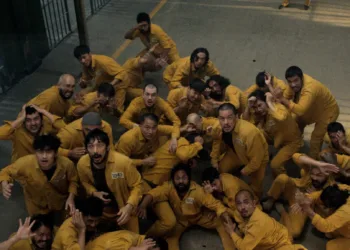
When the floodwalls fall, the camera work shifts from wide, impersonal news helicopter shots to claustrophobic, water-level perspectives from personal camcorders, immersing the viewer in the rising tide. The focus then shifts to the human nightmare that unfolded at the Superdome. Designated a “shelter of last resort,” it is depicted as a scene of squalor and desperation, a symbol of governmental abandonment where thousands were left without food, water, or sanitation.
Through this collage of news reports and survivor accounts, these episodes chronicle the physical destruction of New Orleans, laying bare the mechanics of how a predictable storm spiraled into an unthinkable catastrophe.
A Deluge of Neglect
The series transitions from documenting the storm to diagnosing the sickness that made its impact so lethal. The tragedy, it argues, was not simply an act of nature but a product of profound institutional negligence and ingrained prejudice. This argument is grounded in searingly personal testimonies that make abstract failure feel painfully concrete.

The account of Robert Lynn Green Sr., who describes being on his roof as his entire house floated away before his granddaughter and mother were swept into the flood, gives the immense loss an unbearable intimacy.
His story, along with those of others like Shelton “Shakespear” Alexander, who filmed his experience inside the Superdome, becomes a microcosm of a city abandoned by every level of its government. These narratives form the emotional foundation upon which the series builds its sharp critique.
The documentary dissects the complete breakdown of the chain of command, portraying a chilling paralysis among officials from Mayor Ray Nagin to Governor Kathleen Blanco and the Bush administration’s FEMA. Figures like Lt. General Russel L. Honoré, who was tasked with commanding the military relief effort, provide frank assessments of the slow and inadequate response, highlighting the bureaucratic inertia that cost lives.
The series directly confronts the racial dynamics of the disaster by deconstructing the media’s pernicious “looting” narrative. It contrasts news reports that described Black survivors taking essential supplies as “looting” while white residents in similar situations were “finding” food. This analysis reveals how language shaped a punitive response instead of a humanitarian one, recasting victims as criminals and justifying the militarization of the relief effort.
Key cultural moments are presented as ruptures in the national consciousness. President Bush’s detached flyover in Air Force One is framed as the ultimate symbol of political insulation, a leader looking down from 30,000 feet on a crisis he failed to manage.
In this context, Kanye West’s unscripted declaration that “George Bush doesn’t care about Black people” during a live telethon is not just a celebrity outburst. It is portrayed as a lightning strike of unfiltered truth, shattering the carefully managed media spectacle and injecting an uncomfortable reality about race and class into the national conversation.
The Soul’s High Ground
The final episode, under Spike Lee’s direction, pivots from the event to its long echo, transforming the series from a historical document into a living requiem. This installment is less a chronicle and more an elegy, examining the systemic injustices that followed the floodwaters’ recession. Lee’s authorial voice is immediately apparent.

He employs his signature stylistic flourishes, like plastering the words “SYSTEMIC RACISM” on screen when a subject speaks them, a choice that refuses to let the viewer treat the concept as an academic abstraction. His off-camera questions are audible, positioning him as an active participant in the conversation, not a detached observer.
He revisits individuals he has documented for twenty years, creating a unique longitudinal study of trauma, memory, and endurance. This approach offers a powerful look at the “second flood” that hit New Orleans: the wave of policy decisions and predatory capitalism that reshaped the city.
The episode methodically exposes the inequities of the recovery. It explores the discriminatory “Road Home Program,” a federal grant system that allocated rebuilding funds based on pre-storm property values, a practice that systematically undervalued homes in Black neighborhoods and locked residents out of returning.
It details the post-Katrina dismantling of the city’s public school system, which resulted in the mass firing of thousands of Black teachers and the acceleration of privatization. This section shows how gentrification became a tool of displacement, turning once-vibrant Black communities into sanitized spaces for new, wealthier, and whiter residents.
Yet the episode is not solely a catalogue of injustices. It is a profound meditation on culture as resistance. Through interviews with figures like musician Branford Marsalis and actor Wendell Pierce, Lee frames the fight for New Orleans as a fight to preserve its irreplaceable soul. The city’s music, food, and traditions are shown as acts of defiant survival.
The film closes with a stylistic shift, giving the final word to the residents themselves in the form of poetic performances. Shelton “Shakespear” Alexander and Phyllis Montana-Leblanc deliver powerful monologues that function as both prayer and proclamation, expressions of grief and declarations of existence. Their words affirm that the spirit of New Orleans will not be erased.
Katrina: Come Hell and High Water is a three-part Netflix documentary series that premiered on August 27, 2025, commemorating the 20th anniversary of Hurricane Katrina. The series, which is now available to stream on Netflix, explores the hurricane’s devastating impact on New Orleans and the systemic inequities it exposed.
Full Credits
Director: Geeta Gandbhir, Samantha Knowles, Spike Lee
Producers and Executive Producers: Alisa Payne, Spike Lee, Geeta Gandbhir, Sam Pollard
Cast: Soledad O’Brien, Marc H. Morial, Mitch Landrieu, Kimberly Rivers Roberts, Shelton Alexander, Gralen Banks, Russel L. Honoré
Director of Photography: Rafael Leyva, Eric Averdung (Note: This is based on previous movie searches, specific cinematographer info for this title was not easily retrievable)
Editors: Arielle Amsalem, Anna Auster, Barry Alexander Brown (specific episode details and roles vary)
Composer: Terence Blanchard
The Review
Katrina: Come Hell and High Water
Katrina: Come Hell and High Water is an essential and searing documentary. The series moves beyond simple remembrance to deliver a formidable inquest into one of America's deepest shames. Its three-part structure expertly balances a harrowing chronicle of the storm with a sharp critique of the institutional failures that magnified the tragedy. The final, poetic act by Spike Lee solidifies its status as a vital piece of television, a tribute to the resilience of a city and a grave reminder of the consequences of neglect.
PROS
- A comprehensive three-part structure that examines the disaster from multiple angles: historical, analytical, and long-term.
- Features powerful and deeply moving personal testimonies that ground the large-scale tragedy in human experience.
- Offers an incisive critique of the institutional failures and racial bias that defined the catastrophe.
- Spike Lee's artful direction in the final episode provides a unique and reflective look at the city's two-decade aftermath.
- Meticulous use of archival footage blended with contemporary interviews creates a full and immersive account.
CONS
- The subject matter is emotionally intense and the footage can be difficult to watch.
- Its initial episodes cover events that may be familiar to viewers acquainted with previous documentaries on the subject.
- The stylistic shift in the final episode could feel abrupt to some viewers expecting a uniform tone.