





























The Woolhaven expansion plays as a sizable post-game chapter built around proving you truly understand the original campaign. Access is locked until you have defeated the four Bishops and the final boss. Once those threats are dealt with, a strange icy totem appears in the base camp.
Feeding it resources activates a route to Woolhaven, a ruined mountain village that doubles as the ancestral graveyard of the lamb species. The art direction pivots into stark snowfields and exposed peaks, replacing the base game’s softer greens with harsh white slopes.
Woolhaven also introduces Yngya, the skeletal Goddess of Winter. She shares a history with the protagonist as another casualty of the Bishops, and her return hinges on your ability to recover the lost souls of her disciples. Where the main campaign frames progress through conquest and growth, this chapter leans into mourning and restitution. That shift gives the story a heavier emotional pull that matches the setting, and it puts real weight behind every step into the blizzard-thick village and the fights waiting beyond it.
The Survival Tax of Eternal Frost
Winter adds an aggressive layer of cult management that rewires your daily priorities. The weather behaves like an enemy with its own move set. Blizzards roll in often, shutting down work cycles and placing followers in immediate danger, and lightning strikes stack extra risk on top of the cold. The usual sustaining loop breaks down fast once the ground freezes. Farm plots lock up, and the ocean turns solid, removing fishing from the food plan entirely.
That pressure funnels you toward one non-negotiable structure: the central furnace. Keeping it running is the difference between a functioning camp and a wipeout. The furnace burns Rotburn, a new resource you collect during crusades, and the game makes the consequences plain. Come back from a long run with the fuel gauge ignored and you can find the compound packed with frozen bodies.
Woolhaven offers tools to manage the damage, including an onsen to warm cultists back up and small furnaces that clear snow from blocked buildings. It also introduces an emergency labor option through Rotten followers. These empty husks do not need food or sleep, and they keep working through the worst storms. They still have a hard limit: ten days, then they die. Even that has a function, since their deaths leave behind Rotburn, feeding the furnace that keeps everyone else alive.
Also Read





Steel and Sinew in the Mountainside
Combat in Woolhaven hits with a sharp difficulty spike and expects tighter execution than the earlier biomes. The action splits across two main zones: Ewehaven and The Rot. Ewehaven is a run through icy cliffs patrolled by armored wolves led by Marchosias. Their behavior pushes patience and spacing, especially when they burrow to reposition and then return with a second phase that drops the armor and changes the rhythm of the fight.

The Rot takes the Lamb deeper into the mountain and shifts into organic horror. Its Lovecraftian, fleshy demons bring a more visceral feel to each room, and the pacing stays fast with far less room for sloppy movement. Enemies lean on bombs and mixed projectile patterns to flood the screen and corner you in narrow passages. The DLC’s key response to that pressure is the flail, a chained club built for damage at range. It lets you hit hard while keeping space, and its shove helps you reset lanes in tight corridors where crowd control matters.
Woolhaven also introduces legendary weapons that you must discover and repair before they enter your loadout. Their appearances during runs depend on luck, but their strength matters because the expansion adds twenty new bosses. Those fights squeeze everything out of the dodge-roll system. Success comes from clean timing, sharp reads, and the ability to keep composure while patterns escalate.
Cultivating the Highland Ranch
Base building expands in a way that directly answers late-game space pressure. You receive close to double the buildable area, opening room for denser layouts and new facilities without feeling boxed in. That extra space supports the expansion’s ranching loop. You can raise yaks and alpacas, and the system asks for steady care through feeding and keeping their happiness in check.
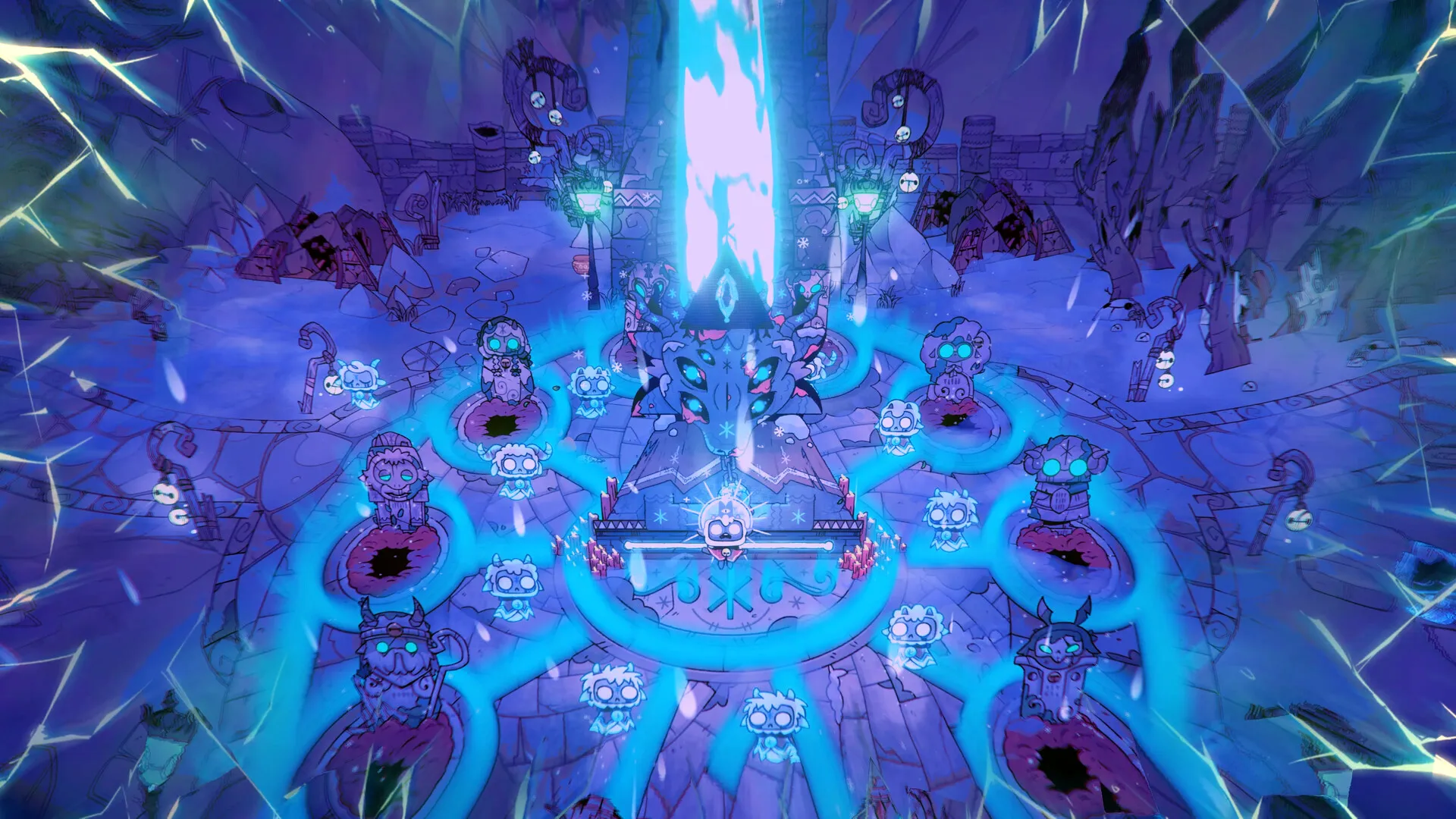
The animals feed multiple goals at once. Harvesting them supplies meat for the kitchen and produces wool, which becomes the key currency for restoring Woolhaven’s damaged buildings. The ranching loop also includes lighter interactions like riding the animals or taking them for walks. Movement stays slow since there is no dash option during these rides, so every trip feels measured and deliberate.
For a change of pace, Woolhaven adds Flockade, a strategy minigame that reframes rock-paper-scissors using chess pieces on a 2×2 grid. Learning it means collecting pieces with special effects, then using those effects to outplay opponents through positioning and prediction.
The expansion’s presentation ties these systems together with an eerie soundtrack that sells the isolation of the peaks. New NPC voice work lands with a more deliberate, weighty cadence, giving personality to the restoration arc. As you repair huts and clear daily challenges, the village gradually refills with life, and the steady rebuild provides a clear sense of progress against the cold.
The Review
Cult of the Lamb: Woolhaven
Woolhaven delivers a massive expansion that revitalizes the experience for veteran players. The winter mechanics introduce high-stakes management. The new flail weapon adds variety to the faster, more aggressive combat. While the grind for wool and legendary repairs feels heavy, the sheer volume of content justifies the return. It stands as a necessary addition for those who mastered the original regions.
PROS
- High-stakes survival mechanics
- Challenging new biomes
- Satisfying weapon variety
- Massive base expansion area
CONS
- Occasional repetitive grinding
- Rare performance hitches
- Steep difficulty for casual fans