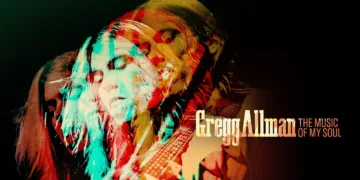






















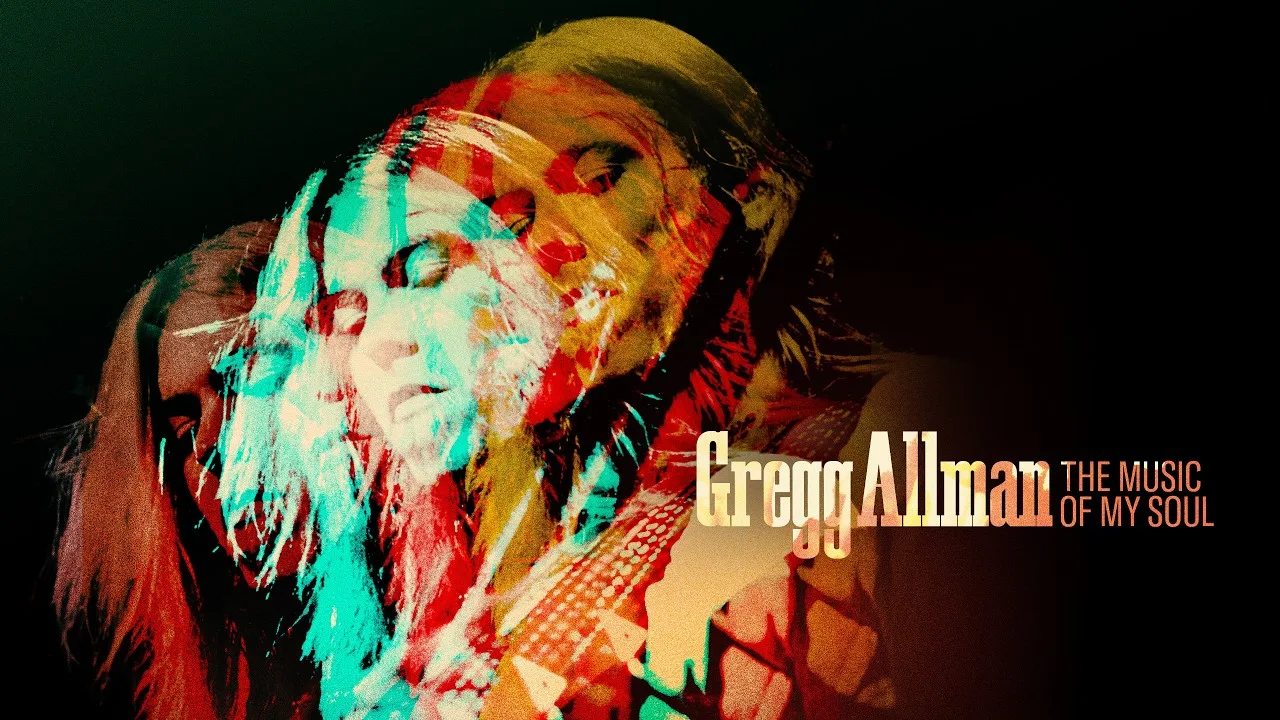

Gregg Allman: The Music of My Soul, James Keach’s ninety-six-minute documentary, opening in theaters June 17, begins from a strange premise: that a man can be summoned back into a room through footage and the people who loved him, and that the summoning might actually work. Keach, who has spent recent years building these resurrections (Glen Campbell, David Crosby, Linda Ronstadt), turns here to Allman’s full arc.
A father murdered when Gregg was a boy. A brother, Duane, found and then lost inside the same decade that made them famous. A band assembled in Macon, Georgia, that grew larger than any single grief it carried. Seven marriages, one of them to Cher. A liver transplant, a cancer, a death in 2017 at sixty-nine. The film’s true center, though, is something smaller and stranger than any of this: an unaired 2014 interview, recorded near the end, when Allman knew more than he was saying.
What the Camera Caught Before the Diagnosis
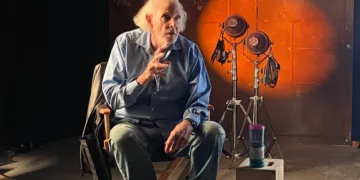
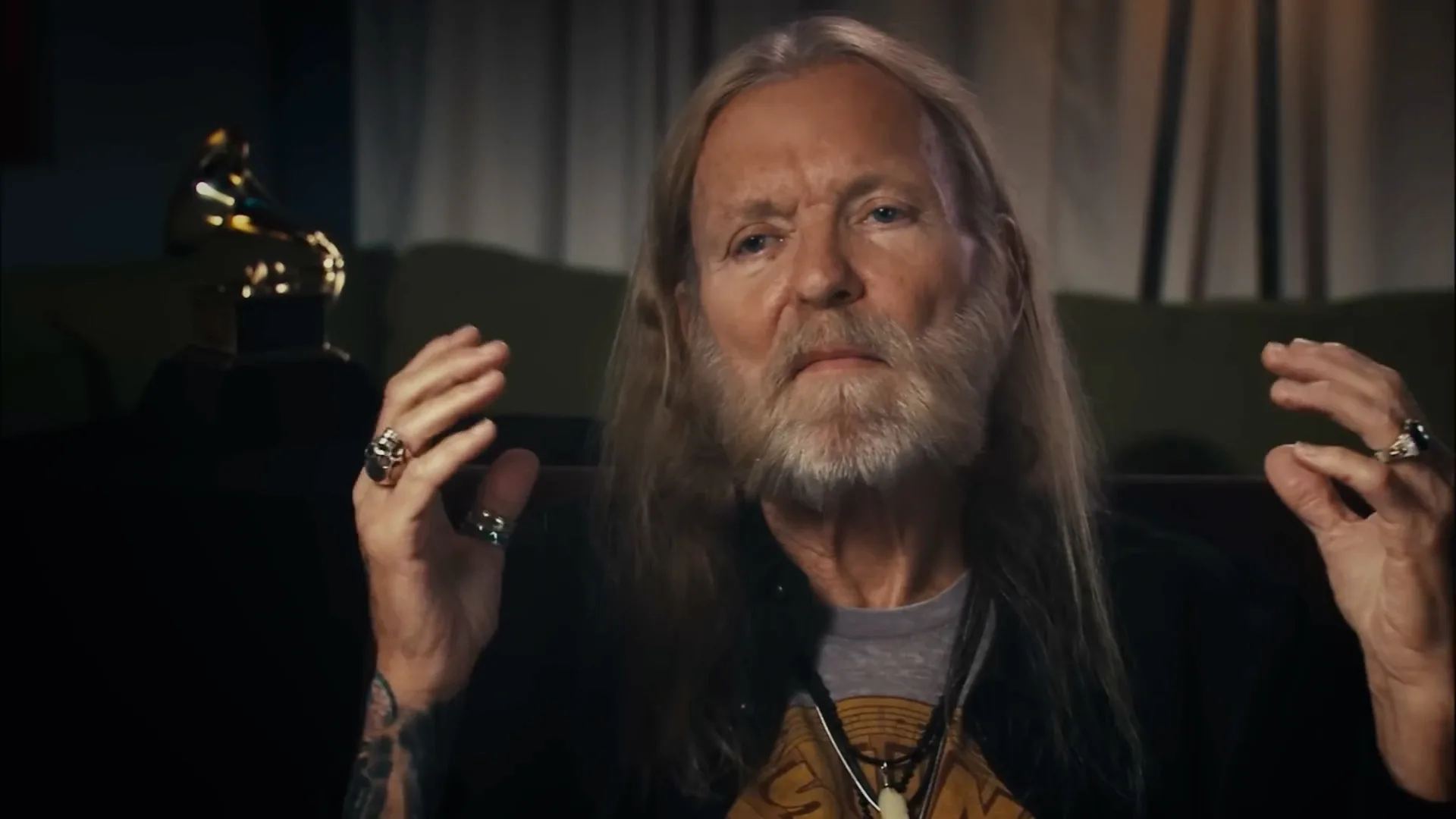
There is a particular quality to a man speaking before he has announced that he is dying, when he does not yet have to perform composure for an audience that already knows. The 2014 interview carries that quality the way certain rooms carry cold. Allman recalls, almost as an aside, the night of his Rock and Roll Hall of Fame induction in 1995, an evening he barely remembers because he was too far gone on whatever he was on.
He remembers a fragment: Willie Nelson telling him he didn’t look well, and not much else. He says he had to see the footage years later to understand how close to disappearing he had already come. About his brother, his story changes inside the same conversation. He used to rage, he says, that Duane was short-changed, robbed of decades he deserved. Then he grew up, and decided his brother simply had a blast and went.
I don’t know which version is true. Maybe neither is. Maybe grief just keeps revising its own verdict until the person carrying it is gone too. He says one more thing, about the women he married: that every one of them loved who they thought he was. He says it without bitterness. That absence of bitterness is its own kind of devastation.
The Brothers Who Almost Died Together
Death arrives early in this story and never quite leaves, circling back at intervals like something that has learned the address. Allman’s father is murdered when Gregg is still a small child, shot by a man who knew him only well enough to call him by his nickname. Then Duane, riding through Macon on October 29, 1971, swerves his motorcycle into a truck and dies hours later at twenty-four.
The detail the film cannot make ordinary, no matter how briskly it moves past it, is what happened after the hospital first told Gregg his brother would live. He and Chank Middleton left, believing the worst was behind them. They used heroin. Gregg overdosed that same night, the night his brother actually died, and Middleton, opening the door to a roadie’s face, knew before a word was spoken. There is a version of this story where both brothers die within hours of each other.
The film hands us that version and moves quickly past it, as if lingering would mean admitting how thin the line really was. A year later, Berry Oakley crashes a motorcycle three blocks from where Duane died and refuses treatment until it is too late. The band keeps playing. Of course they keep playing. What else, with no other language for a feeling that large, was there to do.
The Softness of a Story Too Careful to Hurt
A documentary that knows this much about loss and still flinches from its sharper edges is choosing something. Keach gives us Allman’s marriages selectively. Cher’s gets a dedicated stretch. Several of his seven wives, and some of his children, simply do not appear, as if a frame this careful about grief grows suddenly shy about ordinary human failure.
Allman himself says his last wife, Shannon, was his only real marriage because it was the one where he stayed sober, a line the film lets pass without asking what that says about the other six. The early years move fastest of all: a boy picks up a guitar, and somehow, with no visible labor between the two points, becomes the voice on “Whipping Post.” I find myself most alive in the film’s smaller, unscripted seconds.
Jackson Browne watching Allman bend “These Days” into something bluesier and sadder than he wrote it. Devon Allman saying his father lived a lifetime of apologies, that he knew his father was sorry without ever hearing the word. Those moments do not explain Gregg Allman. They let him stay unexplained, perhaps the only honest way to leave a man who spent his whole life being asked to perform himself.
Directed by James Keach, the visionary music documentary Gregg Allman: The Music of My Soul explores the groundbreaking life and enduring musical legacy of the Allman Brothers Band co-founder. The film premiered in select theaters nationwide just yesterday, June 17, 2026, through independent distributor Subtext in association with Rolling Stone Films. Built around a rarely seen 2014 interview, the narrative explores Allman’s journey through childhood tragedy, rock stardom, his marriage to Cher, and his ultimate redemption through sobriety.
Where to Watch Gregg Allman: The Music of My Soul Online




Full Credits
Title: Gregg Allman: The Music of My Soul
Distributor: Subtext
Release date: June 17, 2026
Rating: NR
Running time: 96 minutes
Director: James Keach
Writers: James Keach, Ian Coad
Producers and Executive Producers: James Keach, Michael Lehman, Alexandra Kamisaruk, Alexandra Dale, Justin Falvey, Darryl Frank, Douglas Banker, Michael Hughes, Greg C. Lake, Robert Stein, Brian Levy, Theodore Liouliakis
Cast: Gregg Allman, Duane Allman, Cher, Jackson Browne, Jaimoe, Chuck Leavell, Don Was, Devon Allman
Director of Photography (Cinematographer): James Keach
Editors: James Keach, Ian Coad
Composer: Julian Raymond, Bennett Salvay
The Review
Gregg Allman: The Music of My Soul
The film knows where the bodies are, literally, and still chooses to walk past most of them with its eyes lowered. Its honesty surfaces only when Allman speaks for himself, in the unaired hour from 2014, or when his son admits a father's silence was its own kind of apology. Everywhere else, grief gets smoothed into biography, and the smoothing costs the film its nerve. What remains is real, just smaller than the man it tries to hold.
PROS
- The unaired 2014 interview lets Allman's own voice carry the film's most honest stretches
- Devon Allman's line about a father's "lifetime of I'm sorry's" lands without sentimentality
- Jackson Browne's reflection on the "These Days" reinterpretation gives the film a rare moment of real insight
- Allman's shifting account of Duane's death, from rage to something gentler, captures grief as an unfinished process
CONS
- Glosses over Allman's early musical development, jumping from a boy with a guitar to a finished voice
- Selective about the marriages, leaving several wives and children unmentioned
- Moves quickly past the night of the near-double-tragedy rather than sitting inside its weight
- Flinches from Allman's harder edges in favor of a softened, careful portrait





Gregg & several others associated w/ ABB wrote books with lots of history. Well worth reading. And there is a Museum in Macon about them (The Big House). They carry those. RIP to Gregg and the other members who passed. But, “the road goes on forever”.