






















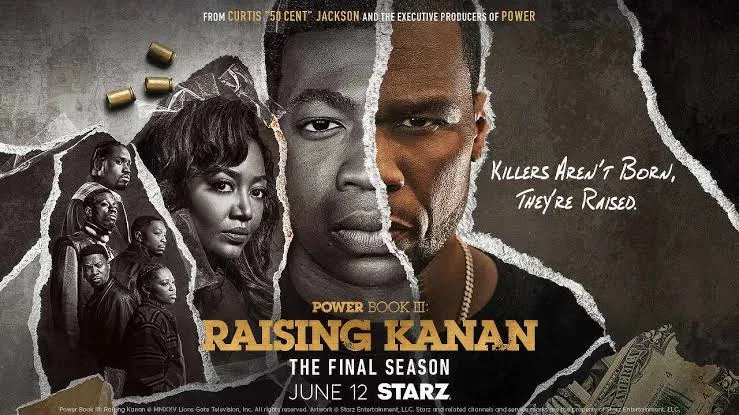

Power Book III: Raising Kanan returns to Starz for its fifth and final season, and here is the structural joke built into the premise: we already know how this ends. Kanan Stark becomes the man we met years earlier in Power, cold, capable, eventually dead. The show has spent four seasons explaining a foregone conclusion, which sounds, on paper, like a poor way to build suspense (it is not, and I will get to why).
Set in a 1990s South Jamaica, Queens that the production renders with real care for period texture, the prequel closes the gap between Kanan’s adolescence and Ghost and Tommy’s New York. The final season opens precisely where season four left it: Kanan, gun raised, pointed at his mother Raq. Patina Miller does not flinch. Neither, frankly, does the show. New arrivals, Shameik Moore’s long-mythologized Breeze chief among them, with Tony Danza’s Stefano Marchetti applying pressure from the Italian side, signal that the final stretch intends to widen the board before it closes it.
A Death the Plot Required (And the One the Family Did Not)
The gunshot that ended season four belongs, it turns out, to neither Raq nor Kanan. It belongs to Lou-Lou, Raq’s brother, shot by his nephew in the scramble of that kitchen standoff. Call this the show’s preferred move: deny the audience the death it primed them to expect, then deliver a worse one sideways. I found this clever on first viewing and slightly cheap on the second (these reactions can coexist, this is apparently what having a brain is like).
The timing carries its own cruelty. Lou-Lou had just returned to the family, had just made something like peace with his past, had just confessed to Kanan, in their final conversation, that he was the one who removed Dwiz, and that their grandmother’s death was not what the family believed. He even paid Raq the closest thing this show offers to a compliment, telling Kanan that his mother carries more weight than any man he knows. Then his nephew kills him by accident. The universe, or at least the writers’ room, has a sense of irony bordering on the cruel.
What follows is procedural in the most unglamorous sense. Raq disposes of her brother’s body to keep Kanan clear of suspicion, then kills Reuben to erase any remaining link to the night, then scrubs her own wall while grieving in something close to private. Patina Miller plays this without sentiment, which is the correct choice and also somewhat terrifying.
Marvin and Jukebox identify the body together and console each other, and the show earns that scene honestly: four seasons of father-daughter material cashed in at once. Kanan sits through his uncle’s funeral apparently unmoved, and later tells his cousin, “Nobody’s untouchable,” a line that functions as confession and threat at once. He means it about the world. He clearly does not mean it about himself yet. Give the season time.
The Corporation Absorbs the Business
Kanan spends the premiere short a supplier and short a connect, which means he spends the premiere doing what every small operator eventually does: looking for someone larger to attach himself to. Enter Breeze, played by Shameik Moore with menace that refuses to perform itself. Ten years of Power lore built this character up as a kind of off-screen myth. The temptation, when a myth finally appears on screen, is to overcorrect into spectacle. Moore does the harder thing and underplays it (mostly; the fight club he runs, where the loser of each bout dies, is not exactly subtle, but Moore’s stillness inside that chaos is the actual performance).
Breeze tells Kanan, “You was a business before, but now you a corporation,” and I want to sit with that line longer than the episode does. A business has an owner who can still recognize himself in the mirror. A corporation has shareholders, a board, obligations to people he has never met and may never like. Kanan is trading autonomy for scale, and the show seems aware that this trade rarely ends well for the smaller party (see also: most actual corporate mergers, a comparison the show never makes outright but invites anyway).
The hierarchy Breeze is assembling has its own internal logic. He tells Snaps and Pop that Unique is “redundant as hell” while calling Kanan “a special case,” the sound of a man sorting his new employees by utility before anyone has signed anything. And there is Taz, Breeze’s right hand, who looks at Kanan with open hostility before either man speaks a word at the fight club, and who by episode’s end has already compromised one of Breeze’s own supply lines. Taz has, in a piece of terminology I am minting for the occasion, written his own death warrant in chapter one and just doesn’t know it yet.
Everyone Else Is Also Running Out of Road
Subplots in a show like this tend to function as a chorus commenting on the lead’s tragedy, and the premiere keeps that structure intact. Unique, recovered from whatever season four did to him, spends the hour finishing his revenge against Beerilla: rescuing his family, learning that Beerilla fathered a child, and killing him anyway, a detail the show drops in almost as a dare to find sympathy where none is offered. He sends Pernessa and his son away early in the episode. Read that as a farewell. The show clearly wants you to.
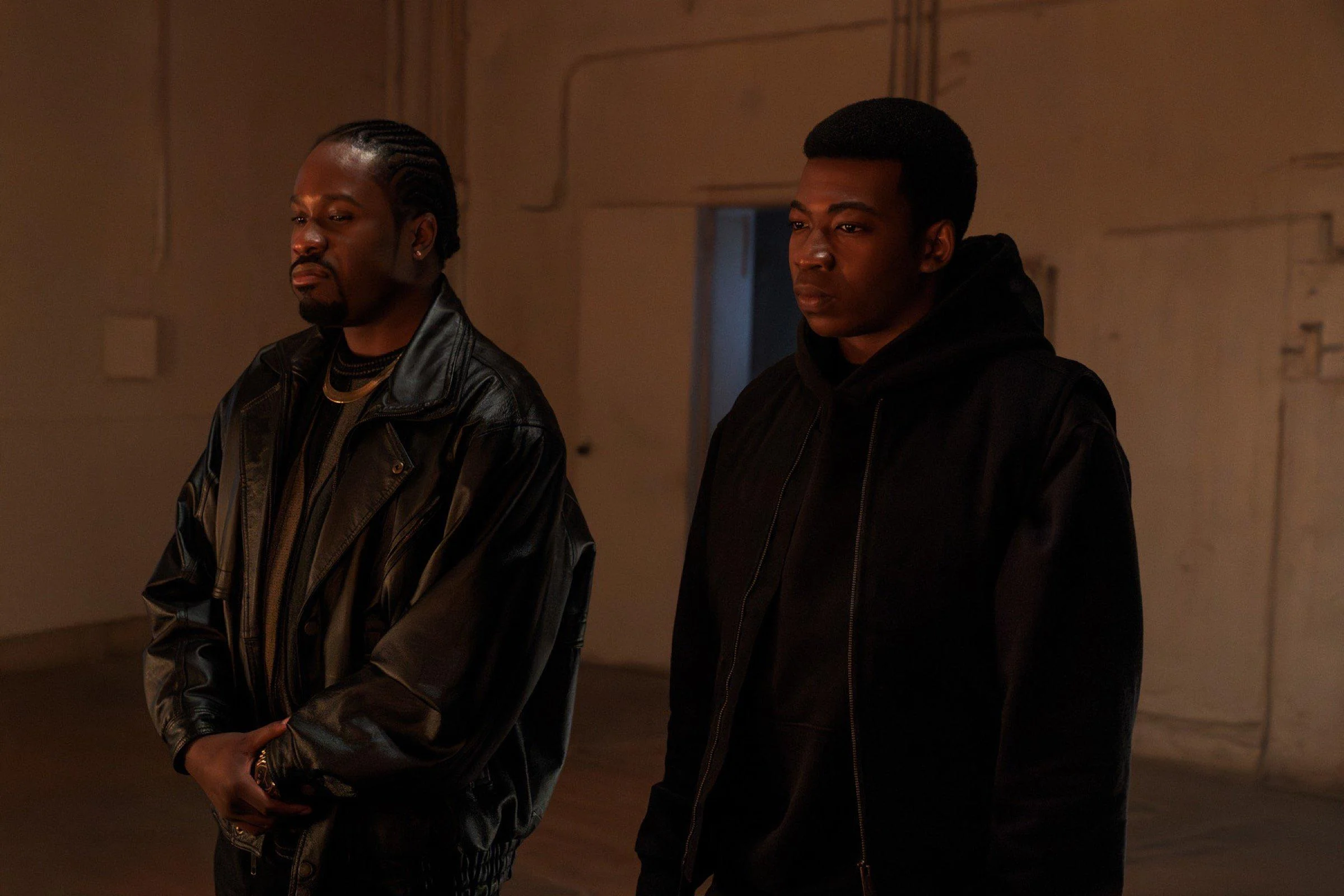
Nick’s arc runs in parallel, and rhymes with Unique’s harder than the episode admits outright. He hunts for Pranessa and his son Jerome, both held by Beerilla, kills the man, and gets his family back. His goodbye to his son (“I’m going to see you soon, Jay, all right”) lands on the boy’s face like a sentence he has already heard the end of. Nick and Kanan’s first meeting carries the tension of two men who each believe themselves unmatched and have never had to share a room with proof otherwise. I suspect the season intends to settle that dispute. I suspect it will not settle it kindly.
Meanwhile, the law keeps circling without quite landing. Detective Garcia leans on Amber over the deaths of her stepparents, and tails Aisha to find leverage on Jukebox, a slow squeeze rather than a dramatic one. Captain Baptiste prepares to retire from the NYPD, a beat so small it could pass unnoticed, except that the show keeps placing small retirements next to large deaths, as if to suggest the old order is leaving the stage by every available exit. Some characters get shot. Others just get pensions. The effect, oddly, lands the same.
Shadows, Funerals, and a Title That Means What It Says
Visually, the final season has gone darker, literally: the shadows sit longer in frame, the palette has lost whatever warmth it once allowed itself. This is not subtle filmmaking, and I do not think it is trying to be. A show this far into telegraphing its own ending does not need to whisper.
The pacing has tightened, too. A death and a funeral inside one episode is not how this series usually spends its premieres (season four took its time; season five does not have time to take). Mekai Curtis plays Kanan’s blankness at that funeral as the performance’s real center of gravity, a young man who has apparently decided that feeling things is a liability he can no longer afford. Patina Miller, meanwhile, gives Raq the opposite problem: too much to carry, and nowhere to set any of it down, business, son, brother, lie, repeat. Hailey Kilgore’s Jukebox absorbs the grief everyone else has scheduled around her, her connection to music visibly dimming alongside her connection to Lou-Lou, the show framing it as the same loss wearing two coats.
The episode is called “By Blood,” a twist on “by hook or crook,” meaning here that the family’s old promise to protect its own at any cost now includes spending family members to keep the rest standing. Kanan pays that price without appearing to notice he has paid it. I suspect he will notice eventually. The show has, after all, told us exactly how this story ends. It just hasn’t told us yet how much blood gets spent getting there.
The fifth and final season of the hit crime drama television series Power Book III: Raising Kanan premiered on June 12, 2026. The series serves as a popular prequel and spin-off to the original Power franchise, chronicling the early life and criminal evolution of Kanan Stark during the 1990s in Jamaica, Queens. In this explosive final chapter, the tense relationship between Kanan and his mother, Raquel “Raq” Thomas, hits a point of no return as the Thomas family’s street empire faces a total collapse. Audiences can watch the new eight-episode season on the Starz app at midnight on Fridays or catch it when it airs on the live Starz cable network channel.
Where to Watch Power Book III: Raising Kanan Season 5










Full Credits
Title: Power Book III: Raising Kanan, Season 5
Distributor: STARZ
Release date: June 12, 2026
Rating: TV-MA
Running time: 50-60 minutes
Director: Rob Hardy, Mario Van Peebles, Lisa Leone, Hernan Otaño, Eif Rivera, Kieron Hawkes, Bart Wenrich, Shana Stein, Monty DeGraff, Stacey Muhammad, Erica Watson, Brendan Walsh, Bobby Kennedy, Joy T. Lane, Cierra ‘Shooter’ Glaude, Dawn Wilkinson
Writers: Sascha Penn, Bashir Gavriel, Josef Sawyer, Santa Sierra, Mike Flynn, Dylan C. Brown, Nina Manni, Tash Gray, Matt K. Turner, Kevin Fox, Naja Rayne, Brian Walker, Albert Minnis
Producers and Executive Producers: Courtney A. Kemp, Curtis “50 Cent” Jackson, Sascha Penn, Mark Canton, Chris Selak, Kevin Fox, Santa Sierra, Tash Gray, Danielle De Jesus, Bart Wenrich, Shana Stein, Anita Gibson, Frank L. Fleming, Dorothy Canton, Tim Christenson, David Prace
Cast: Mekai Curtis, Patina Miller, London Brown, Malcolm Mays, Hailey Kilgore, Joey Bada$$, Shameik Moore, Wendell Pierce, Erika Woods, Tony Danza, Joe Pantoliano, Leslie Grossman, Paul Ben-Victor
Director of Photography (Cinematographer): Aaron Fullerton, David Franco
Editors: Shannon Baker Davis, Christopher Robin Bell, Spenser Reich, Sunny Hodge
Composer: Jeff Russo
The Review
Power Book III Raising Kanan Season 5
Raising Kanan's farewell premiere manages something rarer than simply killing off a character: it makes the death feel both inevitable and surprising (the trick, I suspect, is reconciling Lou-Lou with his family moments before ending him). The corporation metaphor, the funeral folded into the same runtime as the murder, Curtis's deliberate blankness, all of it argues that this final season knows exactly where it intends to walk. A few subplots arrive like homework assigned by the wider franchise rather than urgency the episode generates on its own. A minor complaint against a premiere this confident in its own dread.
PROS
- Lou-Lou's death lands with real weight and irony
- Breeze's introduction earns a decade of hype
- Tight pacing, death and funeral in one hour
- Curtis plays Kanan's coldness without overplaying it
- The "corporation" line reframes the whole partnership
CONS
- Taz's hostility telegraphs his fate too plainly
- Nick and Kanan's rivalry feels pre-written
- Garcia and Baptiste threads read as obligation, not urgency
- Visual darkness occasionally tips into heavy-handedness