



























The drone of the Van de Graaff generators supplies the pulse of Saint-Ouen-sur-Seine in 1928. Pierre Salvadori shapes the Parisian outskirts as a zone of fabricated lightning, where electricity obeys the blunt economy of spectacle. Suzanne, played by Anaïs Demoustier, becomes the chief circuit in this exhibition.
Her Venus Electrificata routine asks her to absorb high-voltage charges and offer her lips to men lined up for a literal shock. The labor is physical, public, and faintly grotesque. The fairground becomes an open-air laboratory of appetite and exhaustion. Titus, its predatory proprietor, watches these currents with the chill attention of an industrial foreman. Suzanne, in his eyes, belongs to the machinery.
Antoine enters as the destabilizing element. A painter emptied by drink and grief, he drifts into a nearby caravan seeking contact with the dead. He takes Suzanne for a medium. The mistake alters the voltage of the story. Antoine wants access to his deceased wife, Irène.
Suzanne sees immediate financial rescue in his confusion. She accepts the psychic role, moving from bodily conductor to spiritual intermediary. The passage from electricity to ectoplasm sounds absurd, which is part of Salvadori’s dry joke. Each role still asks Suzanne to vanish inside a constructed identity.
The Architecture of the Con
The film’s narrative mechanism runs with the icy discipline of a psychological thriller. Armand, the cynical art dealer played by Gilles Lellouche, becomes the engineer of the central fraud. He discovers Suzanne’s deception and spots its commercial value. If Antoine believes the ghost is present, Armand reasons, the painter’s artistic block may crack.
He makes an arrangement with Suzanne to sustain the illusion. The result is an ethical fog bank, dense enough to require a lantern, or perhaps a lawyer. High art here depends on a shabby scam performed by a woman with little social power. The dual timeline studies inspiration as a transaction, a haunting, and a trap. Flashbacks introduce Irène, copper-haired and fiercely self-directed.
Also Read






The deception receives a sharp technical treatment. Suzanne wears milky, opaque contact lenses to imitate trance, and the lenses become miniature screens of alienation. They seal her off visually, echoing the emotional distance she must keep if the fraud is to survive. She reads Irène’s journals and extracts the private fragments needed to make the apparition persuasive. The script links the two women with severe symmetry. Irène, once a model, escaped poverty by becoming the spark for Antoine’s talent.
Suzanne assumes a related function through the staged séance. Both women are drawn into the orbit of the male artist’s hunger. As Suzanne studies the journals, her feelings for Antoine begin to exceed calculation. The grift changes shape. The film asks if a bond built from repeated lying can still produce a recognizable truth. In this world, the mask starts to acquire skin.
The Psychography of the Muse
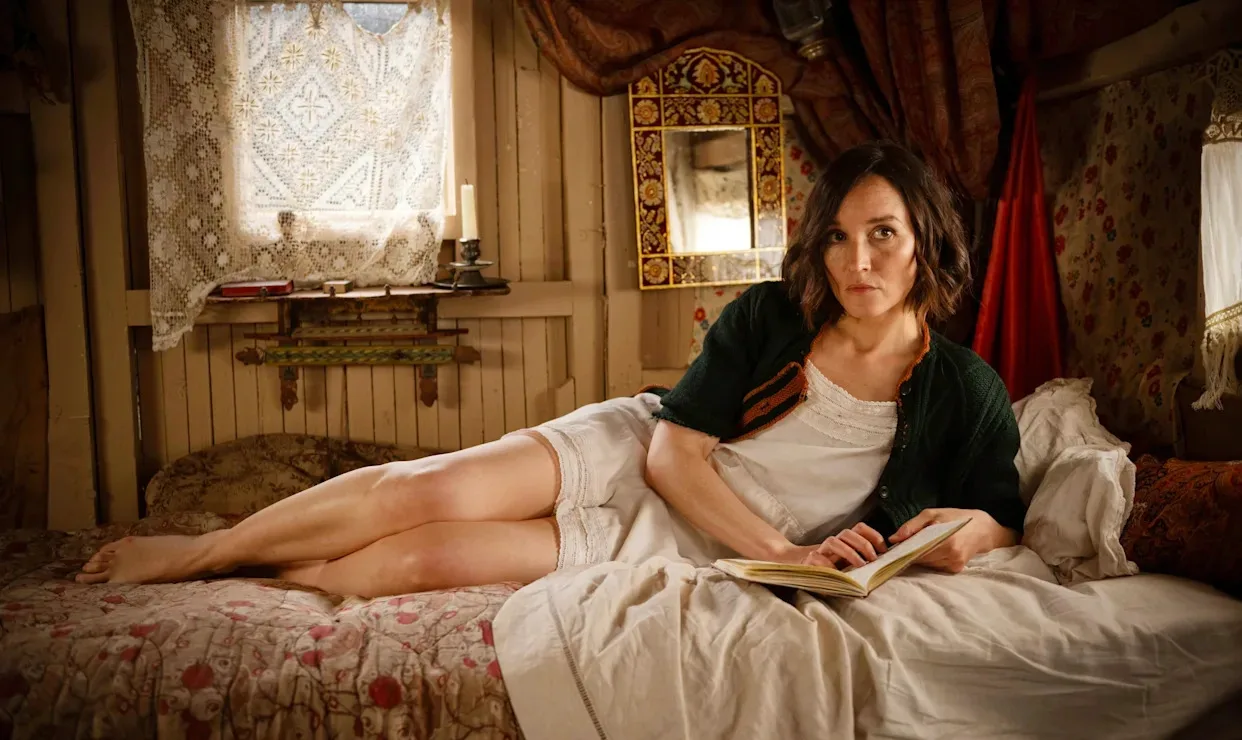
Anaïs Demoustier’s performance rests on exacting control. Her sharp features and Louise Brooks bob summon the visual grammar of silent-era cinema, a face made for observation, withholding, and sudden fracture. She moves from weary carny pragmatism to emotional entanglement with finely measured shifts of gaze and posture. Suzanne watches before she acts.
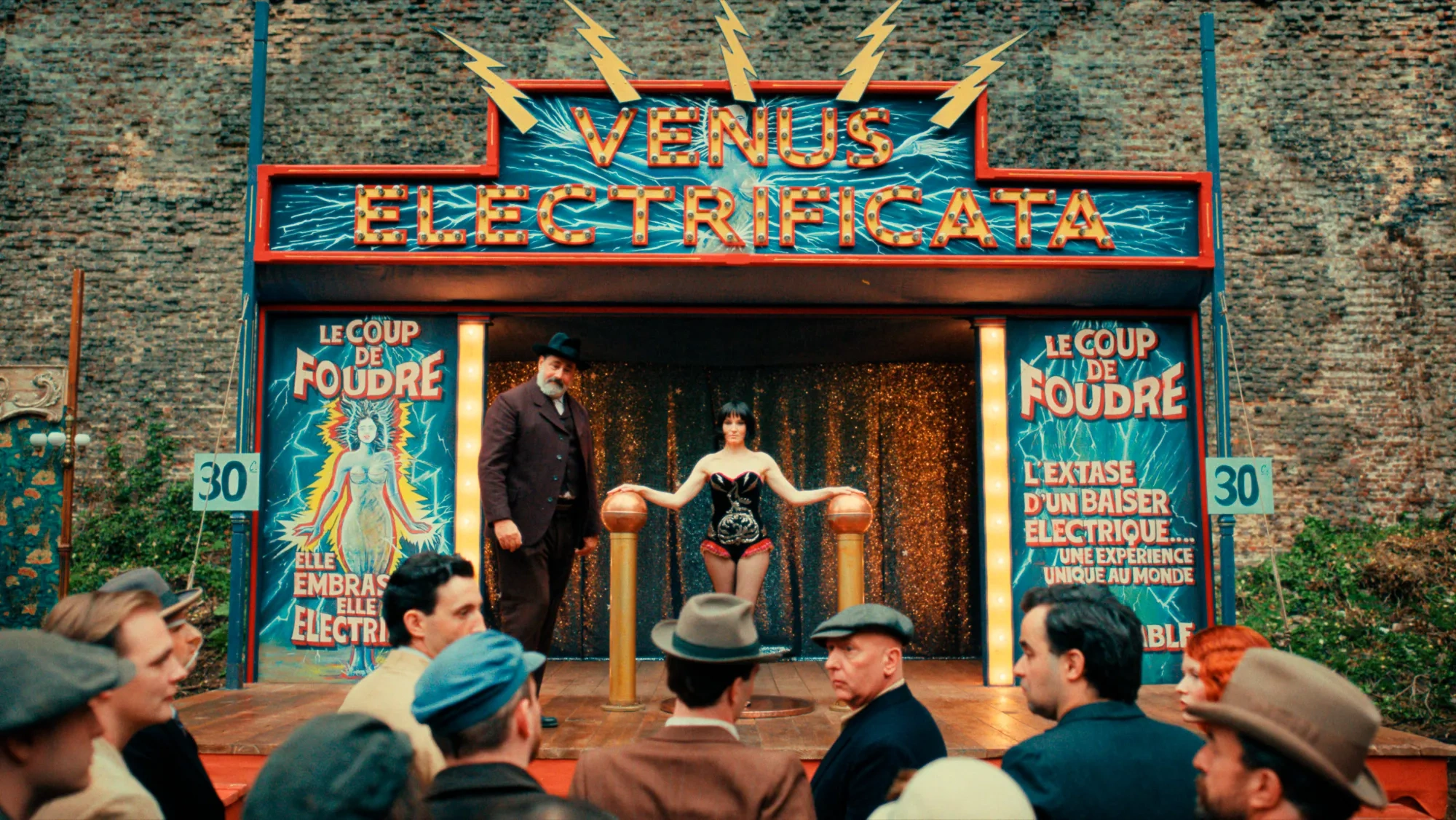
Her stillness has weight. Across from her, Pio Marmaï gives Antoine a volatile, feverish charge that threatens to blow the fuse in every scene. His grief is noisy, theatrical, and perilously sincere. He exists somewhere between romantic lead and full psychological collapse. His faith in the séance becomes a survival reflex.
Gilles Lellouche supplies the dry counterweight as the gallerist. The mustache and period tailoring place him in a noir lineage of cultivated operators, men who treat desire, grief, and need as figures on a ledger. He sees the human heart as an unstable variable, then tries to price it. Vimala Pons gives Irène an earthy immediacy that grounds the flashbacks. She rejects the limp decorative muse archetype and presents a woman with ambitions, secrets, and the right to remain difficult.
The cast chemistry depends on abrasion. Demoustier and Marmaï are especially strong together, since each scene carries the strain between her calculated mediumship and his ruinous belief. The film treats romance as a form of performance. The actors embrace that uncertainty, creating people who seem trapped in auditions for the selves they claim to be.
The Digital Belle Époque
The film’s visual design uses forceful color correction to separate itself from the usual period-piece lacquer. Angelo Zamparutti’s production design builds a crowded, tactile world. The fairground glows with harsh artificial light, a carnival version of chiaroscuro where pleasure and exploitation share the same bulb. Antoine’s villa offers a quieter counterspace. Its overgrown garden suggests refuge, stasis, and time left to rot politely. The cinematography’s digital sheen sharpens the artifice. The 1920s appear crisp, immediate, and mildly abrasive. Nostalgia gets very little oxygen. Expressionistic lighting casts elongated shadows that draw attention toward the more threatening regions of Suzanne’s history.
The soundscape follows the same deliberate pattern. Camille Bazbaz’s score keeps a jaunty, farcical motion, giving the film a comic spring even as the emotional machinery darkens. Shocking Blue’s “Venus” over the credits lands as a wry anachronistic punchline, returning us to Suzanne’s origin as the Electric Venus with a wink sharp enough to sting. Salvadori tries to fuse screwball buoyancy with psychological-thriller pressure.
The tram car accident makes that tonal experiment especially visible. Its stilted mise-en-scène feels designed to echo the mechanical quality of catastrophe. The pacing shifts between brisk comic passages and long, static exchanges with theatrical rigidity. That uneven rhythm keeps the audience slightly off balance. Sound and light bend perception, making fraud feel intimate and reality feel staged. The film becomes a study of falsehood’s strange capacity to produce a genuine response.
The Electric Kiss had its world premiere yesterday, May 12, 2026, as the opening night film of the 79th Cannes Film Festival. Simultaneously with its prestigious debut on the Croisette, the film was released in theaters across France, making it immediately accessible to domestic audiences. This period romantic comedy drama marks a significant return for director Pierre Salvadori to the festival circuit. Viewers can currently watch the film in cinemas throughout France and Belgium, with international distribution following its presentation at the Marché du Film.
Full Credits
Title: The Electric Kiss (La Vénus électrique)
Distributor: Diaphana Distribution, O’Brother Distribution, Goodfellas
Release date: May 12, 2026
Rating: Tous publics (France)
Running time: 122 minutes
Director: Pierre Salvadori
Writers: Benjamin Charbit, Benoît Graffin, Pierre Salvadori, Rebecca Zlotowski, Robin Campillo
Producers and Executive Producers: Philippe Martin, David Thion, Sandrine Dumas, Jacques-Henri Bronckart, Tatjana Kozar
Cast: Pio Marmaï, Anaïs Demoustier, Gilles Lellouche, Vimala Pons, Gustave Kervern, Madeleine Baudot
Director of Photography (Cinematographer): Julien Poupard
Editors: Anne-Sophie Bion
Composer: Camille Bazbaz
The Review
The Electric Kiss
The Electric Kiss operates as a peculiar experiment in digital artifice. It examines the transactional nature of inspiration through a lens of 1920s nostalgia. While the dual narratives occasionally struggle for structural cohesion, the performances of Demoustier and Pons provide a necessary emotional anchor. Salvadori captures a specific, frantic energy even when the script veers into theatrical stiffness. The film serves as a meditation on the masks we wear to survive grief and poverty. It remains a flawed, intellectually stimulating exploration of the fraudulent muse.
PROS
- Precise, era-evoking lead performances.
- Detailed and tactile production design.
- Analytical approach to the "muse" archetype.
CONS
- Jarring, overly processed digital aesthetic.
- Inconsistent narrative momentum.
- Theatrical stiffness in interior sequences.