


















Netflix’s streaming model thrives on novelty, serving up genre-bending experiments designed to capture attention in a saturated market. The platform’s latest Japanese import, Kiss or Die, is a prime example of this strategy. The series presents a high-concept format where unsuspecting comedians are thrust into a scripted television drama without a script, forced to improvise their way through the story.
Their central challenge is to resist the advances of their beautiful co-stars, who are tasked with tempting them. A premature or “cheap” kiss results in a comedian’s character being unceremoniously killed off, eliminating them from the competition. The goal is simple survival: navigate the escalating absurdity long enough to deliver the drama’s final, triumphant kiss. All of this chaos is observed by a panel of hosts who provide a running commentary, effectively watching the show along with the audience at home.
The Performance of Gender Under Pressure
The success of such a precarious format rests entirely on its performers, whose work transforms a gimmicky premise into a fascinating study of performance under duress. The improvisational skill on display is not the familiar, gag-a-minute style of a stage show; it is a form of high-stakes psychological survival.
Each comedian must invent a character, absorb baffling plot twists, and generate dialogue, all while fending off the very people with whom they are meant to be building a scene. This tension produces different strategies. Gekidan Hitori, for instance, operates as a master craftsman, building a believable, witty character who seems to exist within the drama’s strange logic.
He finds humor in his commitment. In contrast, other participants like Tetsuya Morita and Takashi Watanabe appear so genuinely flustered and tempted that their performances become a spectacle of raw, uncomfortable authenticity. Their struggle is palpable, making their scenes feel less like a comedy and more like a human experiment.
This experiment is built upon a foundation of deeply traditional gender dynamics. The show’s architecture positions its male and female cast members in starkly different roles that merit closer examination. The men are the active agents, the players whose journey we follow. Their interior struggle against desire is the show’s primary narrative engine.
Also Read






The women, including the impressively dedicated Nana Yagi, Mary Tachibana, and Kiho Kanematsu, are cast as seductive obstacles. Their function is to be beautiful, alluring, and ultimately, a threat. While they perform with an admirable commitment that anchors the scenes, their agency is limited to the act of temptation.
They are the game mechanic personified. This setup, presented under the guise of edgy, modern comedy, resurrects an old trope: the male protagonist tested by female sexuality. The show finds its entertainment value in the spectacle of male fallibility.
An interesting contradiction in the power structure develops from this dynamic. While the male comedians possess the narrative focus, the actresses control the outcome of the game. They are the gatekeepers of survival, wielding the “death kiss” with calculated precision. The men are disposable contestants; the women are constants of the show’s environment.
This subtle inversion complicates a simple reading of the show as purely regressive. The program creates a space where women hold a distinct, tangible power, even if that power is expressed through a narrow, sexualized lens. It forces a conversation about agency and control in performance, questioning who is truly directing the scene when one performer can eliminate another with a single action.
Deconstructing Drama with a Live Audience
Kiss or Die operates on two distinct, interacting levels that comment on the nature of television itself. The inner show, the improvised drama, is a meticulous parody of a specific television genre. The comedians are dropped into the world of Dagon Pharmaceuticals, a corporation helmed by the corrupt President Ogawara, played with gravitas by veteran actor Tokuma Nishioka.
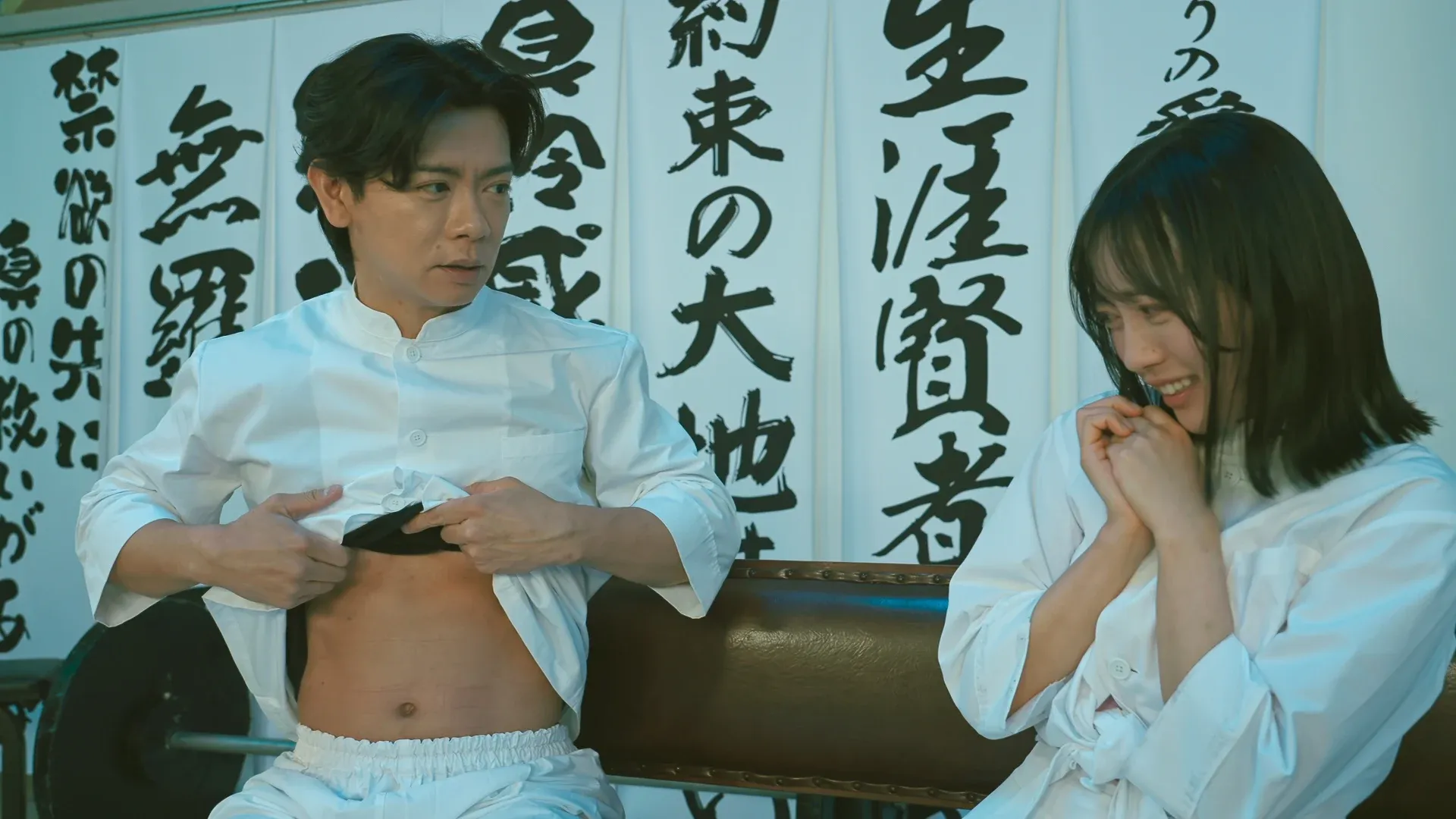
The plot is a whirlwind of Japanese drama conventions: one comedian is a new hire in sales, another is the chief of HR, and a third is a planning department head. They are immediately entangled in a story involving murder, secret human experiments, otherworldly powers, and sudden, sad childhood flashbacks. The narrative becomes a container for maximum absurdity, a self-serious framework designed to create the greatest possible friction with the comedians’ confused improvisation.
The show’s commitment to this parody is absolute, right down to ending an episode with a classic cliffhanger, as a grizzled detective, played by Jun Hashimoto, arrives at a crime scene to begin his investigation. This choice to spoof a J-drama is culturally specific, targeting a genre known for its intense sincerity and melodrama. The clash between the actors’ earnest delivery and the comedians’ frantic ad-libbing becomes a deconstruction of performance styles.
The show’s second layer is the commentary panel, a structural element that firmly places the series within contemporary media trends. The hosts, Ryota Yamasato, Ken Yahagi, and Miyu Ikeda, function as an in-house focus group. They model the exact behavior of a modern viewer, reacting with the shock, laughter, and secondhand embarrassment one might see in a YouTube reaction video. Miyu Ikeda’s exasperated question, “What are they making us watch?”
is a perfect meta-commentary on the often bewildering nature of streaming content algorithms. This panel is not a passive observer; it is an active participant in shaping the audience’s experience. It provides permission to be confused and validates the feeling that what is happening is truly bizarre.
By framing the chaos with a layer of controlled, humorous observation, the panel makes the show’s radical format feel safer and more consumable for a mainstream audience. It builds a sense of communal viewing for what is typically a solitary streaming experience, ensuring the viewer never feels completely lost in the madness.
A Divisive Reflection of Modern Entertainment
The humor in Kiss or Die is a volatile substance, derived from complete unpredictability and the raw discomfort of its participants. It is a chaotic and unhinged style of entertainment that will almost certainly polarize viewers, forcing a confrontation with one’s own comedic sensibilities.

The show’s TV-MA rating is a direct result of its core premise, which is fundamentally about the weaponization of sexual tension. These moments, designed for comedic effect, frequently land in a territory of profound awkwardness that can be difficult to watch. In an era of heightened sensitivity around gender and representation, the show’s entire concept feels like either a defiant piece of post-ironic art or a tone-deaf throwback.
Its presence on a global platform like Netflix means that what might play as familiar variety show antics in one cultural context can be interpreted as problematic in another. The improvised format also leads to an uneven structure; the pacing can lag considerably as the comedians search for a path forward, a feature that may frustrate viewers accustomed to the tightly edited rhythms of Western reality television.
The series belongs to a rich lineage of Japanese endurance comedy, which often tests the mental and physical limits of its performers. Its psychological torment is reminiscent of the Batsu (punishment) games from Gaki no Tsukai, where comedians face absurd penalties for breaking simple rules. The show’s central mechanic also echoes Hitoshi Matsumoto’s Documental, another high-stakes contest where comedians must suppress a natural human impulse—in that case, laughter—or face elimination.
While its format is distinctly Japanese, its meta-fictional elements resonate with Western productions like Nathan Fielder’s The Rehearsal, which similarly constructs artificial realities to provoke genuine reactions. Fielder, however, seeks to control every variable, whereas Kiss or Die creates a controlled environment only to unleash total chaos within it.
Imagining this format adapted for other markets presents an interesting thought experiment. Comedians who thrive on deconstruction and chaos, such as Eric André or Sacha Baron Cohen, seem perfectly suited for this brand of psychological warfare. Performers known for deep character work, like Bill Hader, could potentially build a compelling narrative from within the madness.
A comedian like James Acaster, whose style is built on applying intense logic to absurd premises, would offer a fascinating intellectual approach to surviving the show’s seductive traps. The existence of Kiss or Die on a global stage may signal a growing appetite for high-risk, format-breaking television. It represents a potential future for streaming content: increasingly strange, chaotic, and culturally specific productions that prioritize unforgettable spectacle over predictable storytelling.
“Kiss or Die” is a Japanese comedy series produced by Netflix. The show, which premiered on September 9, 2025, follows male comedians who participate in an improv game where they must resist seductive co-stars to deliver the ultimate kiss.
Full Credits
Director: Takashi Sumida
Writers: Date-san
Producers: Haruka Minobe, Seira Taniguchi, Rieko Saito
Executive Producer: Shinichi Takahashi
Cast: Gekidan Hitori, Tetsuya Morita, Takashi Watanabe, Crystal Noda, Kazuya Shimasa, Gunpee, Ken Yahagi, Ryota Yamasato, Miyu Ikeda, Mamoru Miyano, Terunosuke Takezai, Jun Hashimoto, Kosei Yuki, Toru Nomaguchi, Norito Yashima, Susumu Terajima, Tokuma Nishioka, Nana Yagi, Mary Tachibana, Kiho Kanematsu, Karin Touno, Ibuki Aoi, Mana Sakura, Luna Tsukino, MINAMO
The Review
Kiss or Die
Kiss or Die is a fascinating, frustrating, and truly singular television experiment. It succeeds as a showcase for incredible improvisational talent and as a bold, format-breaking piece of entertainment designed for the streaming age. Its reliance on dated gender tropes and its often uncomfortable brand of humor make it a difficult show to recommend without serious reservations. The series is a chaotic spectacle that is equal parts innovative and regressive, a memorable product of a platform that prioritizes novelty above all else.
PROS
- A genuinely original and unpredictable high-concept format.
- Showcases impressive improvisational skill under extreme pressure.
- The entire cast demonstrates a remarkable commitment to the absurd premise.
- The commentary panel cleverly grounds the chaotic action for the viewer.
CONS
- The central premise is built on questionable and dated gender dynamics.
- Its humor is polarizing and often relies on deep-seated awkwardness.
- The unscripted format leads to slow and uneven pacing at times.
- The constant focus on sexual temptation can feel reductive.