













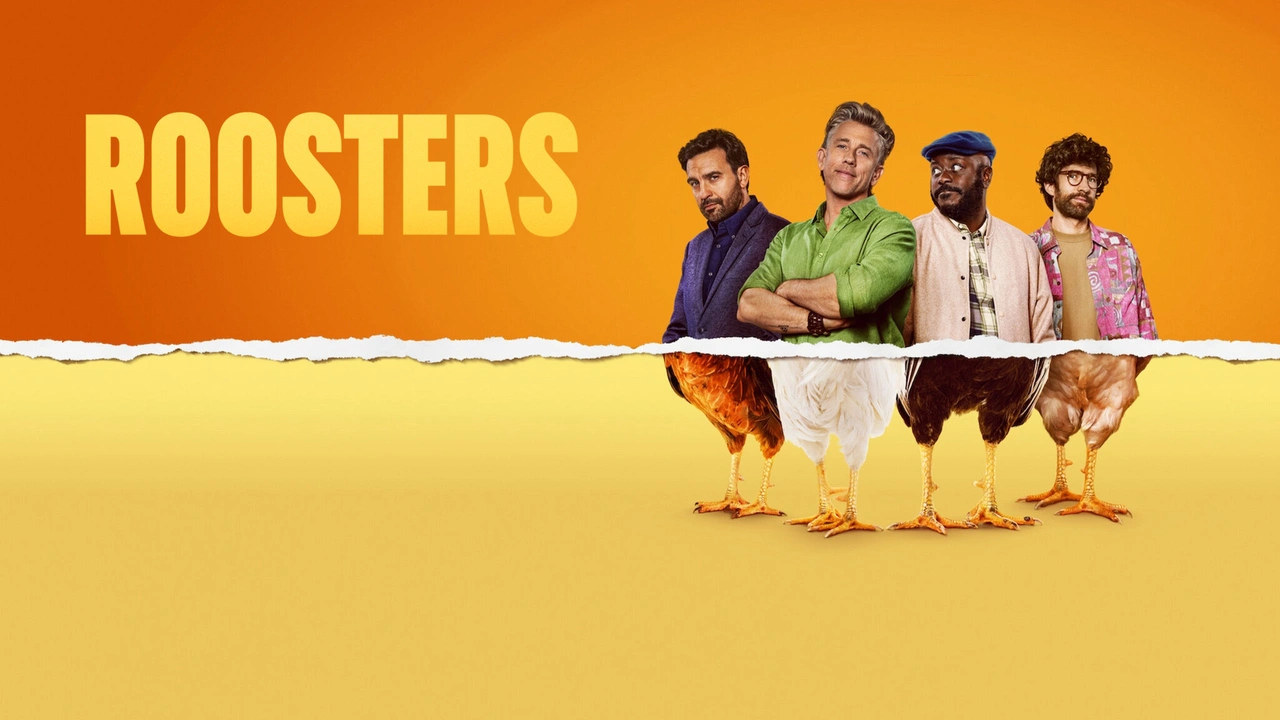

The Dutch satirical comedy Roosters trains its sharp eye on modern identity tracking, following four lifelong friends in their late forties as they attempt to reshape their personal and professional behaviors. This midlife recalibration arrives directly after their participation in an intensive, progressive behavioral re-education course.
The second season runs on a central dramatic irony. The course leaves these men stranded in a state of suspended social development, caught awkwardly between deeply ingrained routines and the fluid expectations of contemporary society. Liberation was advertised; paralysis was delivered.
The narrative opens with the group facing varying degrees of domestic displacement, domestic strain, and professional instability within a distinct, realistic Amsterdam setting. The series functions as an exploration of the performative aspects of personal evolution. Growth becomes a competitive sport where the rules keep changing, and these men are still wearing the wrong shoes. It is a study of what happens when the language of progress is used to mask a total lack of actual progress.
Midlife Relics and the Vulnerability Masquerade
Mike Mulder, played with wonderful desperation by Jeroen Spitzenberger, serves as the primary vehicle for career-based identity anxiety. Once a high-ranking television programmer who specialized in low-brow reality hits, Mike now occupies a lower rung in a collaborative, highly structured workplace.
Spitzenberger hits every comedic beat with precision, mastering the specific performance of projecting absolute external confidence while concealing profound internal confusion. His physical choices anchor the comedy: over-extended gestures, outdated industry jargon dropped into conversations with younger colleagues who prize collaboration and reject ego-driven hierarchies.
His workplace dynamic with his new superior, Kristel, played by Tanja Jess, avoids simple caricature. The script frames their interactions as a complex, two-sided professional misunderstanding. Kristel frequently crosses professional boundaries entirely without malice, simply living out loud, oblivious to her own impact. This leaves Mike with the uncomfortable responsibility of speaking up, a task that terrifies a man who assumes his career survival depends on passive compliance. Danny, Ivo, and Greg: Varieties of Domestic Stagnation
Also Read




The rest of the quartet fares no better in their respective spheres of domestic stagnation. Danny, portrayed by Waldemar Torenstra, represents spatial and social displacement: a bankrupt restaurateur crashing on Mike’s couch, drifting into a new business venture run by gay men. This fresh environment instantly challenges his traditional, casual ideas about attraction and shared social spaces.
Ivo, played by Benja Bruijning, attempts a domestic reconciliation with his ex-wife, Desirée, and avoids emotional clarity by converting every difficult personal conversation into a logistical or financial discussion. He treats household management like an appraisal task, using mortgage talk to shield himself from deep personal ambivalence.
Greg, played by André Dongelmans, finds his authority as a police officer completely detached from his chaotic home life. His marriage to the increasingly aggressive driving instructor, Merel, is a beautifully realized portrait of domestic disconnect. A younger, female professional partner at work sparks predictable, deeply felt domestic anxieties at home.
Lost in Translation and the Language of Convenience
Roosters derives its best satirical energy from the weaponization of modern therapeutic language. The characters do not actually desire genuine internal transformation. They quickly adopt a shiny new vocabulary of vulnerability to shield themselves from criticism and maintain their social standing. It is easier to say the right words than to do the hard work of changing.
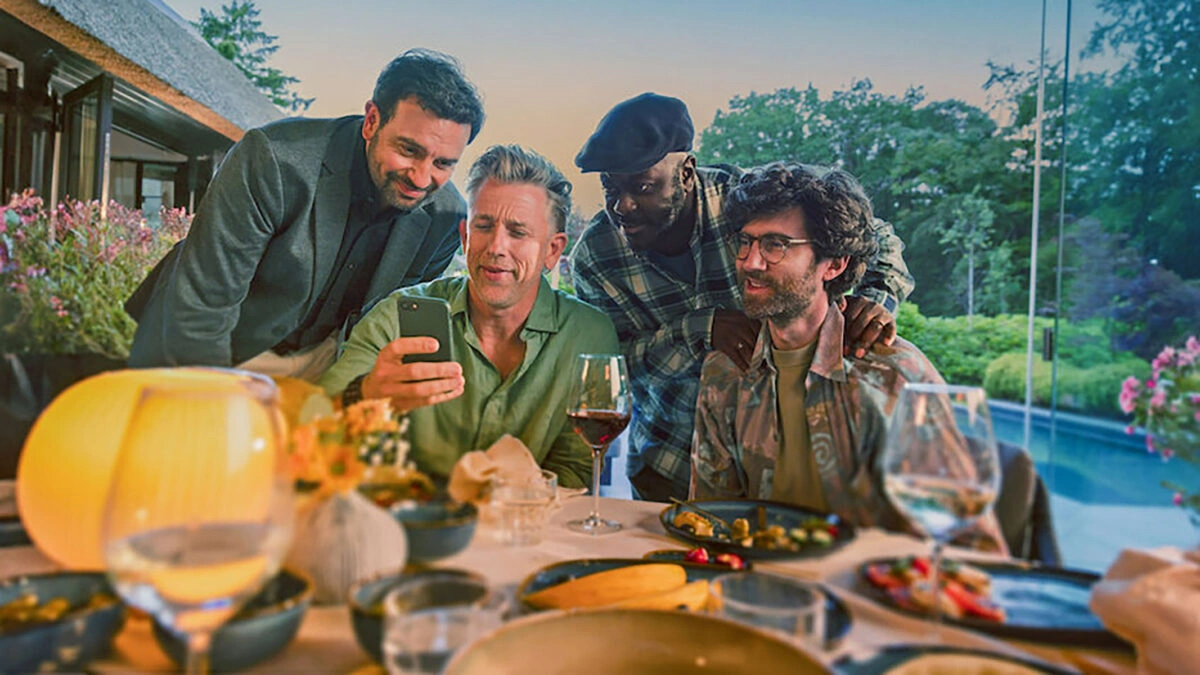
The production distributes its sharp critiques evenly across the ensemble. The writing successfully avoids the trap of delivering a preachy lecture, exposing the absurdities of characters of all genders trapped inside the rigid expectations of modern society. The women are frequently smarter and funnier than the dopey men, yet everyone remains caught in the same performative loop. Adaptation Mechanics and Contextual Friction
As an adaptation of the Spanish series Machos Alfa, the show encounters structural friction. It relies heavily on the specific scene structures, pacing, and comedic setups of its Mediterranean blueprint. This rigid adherence to the original framework creates a noticeable cultural disconnect. What feels entirely organic in a Spanish social context occasionally feels forced when imported into a Dutch setting.
The adaptation works best when it leans into regional nuances, focusing on northern European workplace hierarchies, generational gaps, and a distinct style of passive-aggressive confrontation. The moments of literal translation stand out. Certain heightened emotional outbursts and sudden public confrontations feel unnatural, clashing with the realistic, understated social behaviors typical of contemporary Amsterdam life.
Polished Rooms and Repetitive Rhythms
Visually, the series maintains a clean, warm, and highly polished aesthetic. The direction presents a lived-in version of Amsterdam, steering clear of tourist clichés. The cinematography uses functional framing and natural light to emphasize the physical environments: cramped, messy domestic interiors, sterile corporate offices, and overpriced local restaurants that feel entirely authentic.
The comedic timing relies heavily on the clever use of space and silence. The camera lingers on moments of intense social awkwardness, and the direction forces characters to sit silently with their mistakes, extracting humor from sustained, quiet discomfort. Pacing Challenges and Structural Repetition
A formulaic rhythm begins to emerge during the middle stretch of the season. The narrative structure settles into a highly predictable loop: a character tells a minor lie, his friends cover for him, a partner uncovers the truth, public embarrassment follows, and a brief emotional breakthrough occurs. This cycle is entertaining, but the mechanics behind the plot become a bit too visible by the fourth episode.
Certain narrative detours slow the seasonal momentum. Subplots involving massive generational gaps feel mechanical. Extended performative sequences, such as an overly long karaoke scene where adult men publicly process their feelings through outdated pop music, lean toward heavy-handed symbolism and shortchange genuine character progression. The series is an easy, engaging watch, but it occasionally parks exactly where you expect it to. Can these men truly evolve when the comedy requires them to remain permanently clueless?
The contemporary Dutch comedy series Roosters (originally titled Haantjes) premiered its highly anticipated second season on May 13, 2026. This modern satirical show follows a close-knit group of four friends navigating the humorous complexities of a masculinity crisis in modern Amsterdam. The entire second season is currently available for streaming exclusively on Netflix.
Full Credits
Title: Roosters (Haantjes) Season 2
Distributor: Netflix
Release date: May 13, 2026
Rating: TV-MA
Running time: 30–35 minutes per episode
Director: Anna van der Heide, Anna van Keimpema
Writers: Luuk van Bemmelen, Richard Kemper
Producers and Executive Producers: Hollands Licht, Warner Bros. International Television Production Nederland
Cast: Jeroen Spitzenberger, Waldemar Torenstra, André Dongelmans, Benja Bruijning, Jennifer Hoffman, Jelka van Houten, Eva Laurenssen, Fockeline Ouwerkerk, Tanja Jess, Freek Bartels
Director of Photography (Cinematographer): Coen Stroeve
Editors: Sandor Soeteman, Marc Bechtold
Composer: Merlijn Snitker
The Review
Roosters
Roosters Season 2 is a polished, frequently funny look at midlife masculinity in crisis, succeeding because it values behavioral reality over easy caricatures. While it relies a bit too heavily on its Spanish blueprint and falls into repetitive narrative loops in the middle episodes, the exceptional ensemble chemistry and sharp satire of therapeutic language keep the comedy grounded. It is an engaging, accessible watch that chooses light-hearted ridicule over heavy-handed lectures.
PROS
- Superb ensemble chemistry, anchored by Jeroen Spitzenberger’s excellent comic timing.
- Sharp, biting satire of characters using progressive vocabulary to mask a lack of actual personal growth.
- Polished visual direction that effectively uses space and silence to highlight social awkwardness.
CONS
- Overly rigid adherence to the original Spanish script creates occasional cultural disconnects.
- Formulaic plot structures that repeat the same narrative rhythms in the middle stretch.
- Slight pacing dips caused by self-indulgent, highly symbolic subplots.