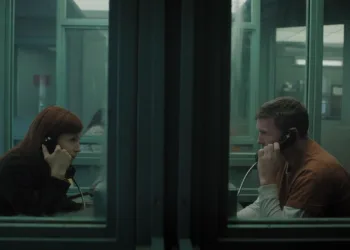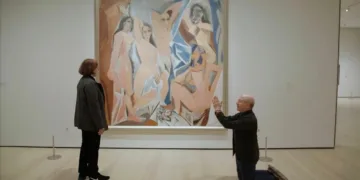



























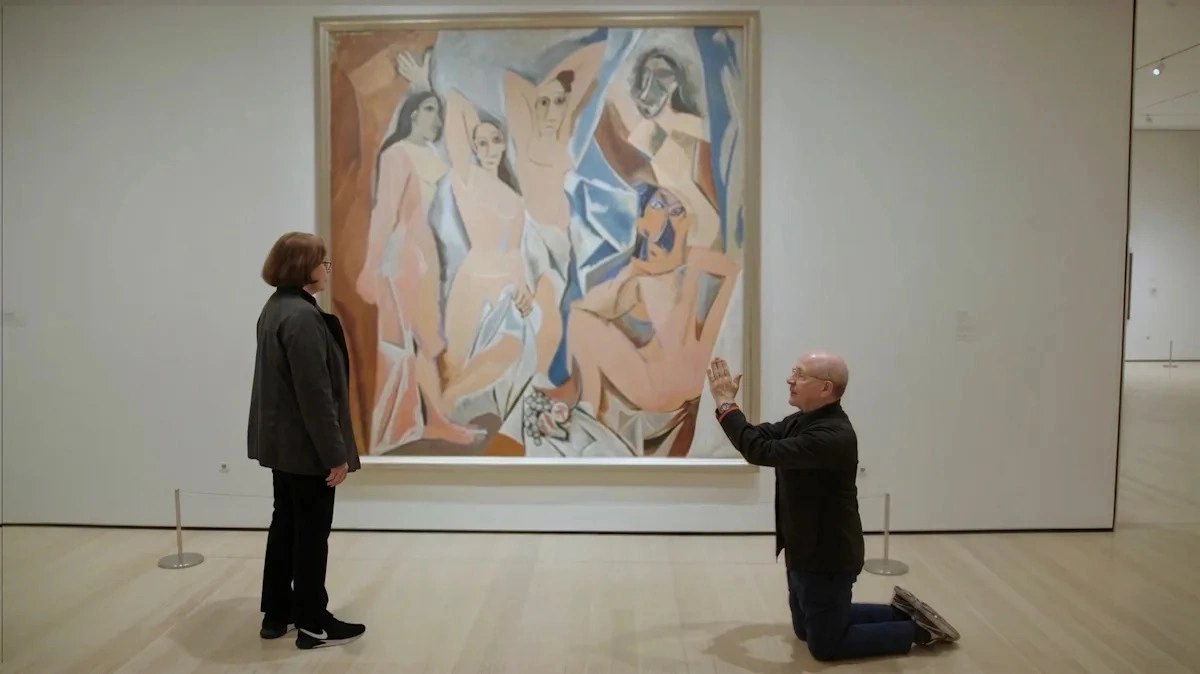

Alison Chernick’s House of Criticism turns the life of art criticism into something tactile: coffee cups, gallery floors, glowing laptop screens, midnight edits, and two voices calling across an apartment. In its 83 minutes, the documentary follows Jerry Saltz and Roberta Smith, married critics whose careers have shaped the way New York talks about art. He is restless, sociable, eager to speak before the thought cools. She is more contained, more exacting, slower to release judgment into the air.
The film’s charm comes from watching criticism lose its marble pedestal. Here, it becomes routine, argument, appetite, discipline, irritation, and love. Chernick places the couple in a New York built from museums, small galleries, bodegas, and overworked rooms. The result is a portrait of two people living inside a profession that feels increasingly rare: paid, sustained, public attention to art. That sounds noble. It also looks exhausting.
The Domestic Comedy of Disagreement
The strongest current running through House of Criticism is the comedy of two people who have spent decades disagreeing without turning disagreement into injury. Saltz and Smith do not approach art from the same angle. He moves through rooms with the charge of someone who wants art to hit him fast, then wants to tell someone about the bruise. Smith looks longer. She seems to distrust the first sentence that comes to mind, then distrust the second for good measure. Their differences give the film its pulse.

Chernick is especially good at finding affection where a lesser documentary might seek romance in softer lighting or rehearsed sentiment. Love here is practical and noisy. It is a coffee run. It is a giant cup refilled because work still needs doing.
It is a takeout meal that quietly punctures any fantasy of the art world as endless champagne and white walls. It is two people writing in different rooms, shouting half-shaped thoughts through the apartment, refining language by abrasion.
Also Read






Their banter has the rhythm of old theater, quick but never weightless. Saltz teases; Smith swats the comment away; he grins because the rebuke is part of the ritual. The film understands that a long marriage is often built from repeated gestures rather than grand statements.
In their case, the gestures are also professional. They are lovers, rivals, editors, witnesses. Each protects the other’s solitude while invading it with exactly the right amount of provocation. That balance gives the documentary its warmth.
Criticism as Attention, Not Authority
House of Criticism becomes most valuable when it treats criticism as labor rather than status. Saltz and Smith are cultural authorities, yes, yet the film keeps pressing past the public image toward the physical and mental strain beneath it. They see dozens of shows a week. They return home and wrestle with adjectives, deadlines, editors, fatigue, and the impossible task of converting visual experience into prose. Anyone who imagines criticism as casual preference dressed in better clothes will find that idea gently dismantled.
Saltz offers one of the film’s guiding principles: the question is not what art means, but what it does. That distinction matters. It pulls criticism away from decoding and toward encounter. Art acts on the viewer; the critic’s task is to describe that action with enough clarity, courage, and vulnerability to make the encounter public. Judgment remains necessary, but it grows from attention, not from a throne.
Smith’s reflections give the film its deeper ethical charge. Her willingness to reconsider an artist she once dismissed becomes a quiet argument for revision as a critical virtue. The published opinion can look fixed, almost carved in stone, yet the person who wrote it keeps changing. The critic ages, sees differently, learns where earlier certainty may have narrowed the view. Chernick handles this material with admirable restraint. Smith’s openness is never staged as confession. It feels closer to craft: the sharpening of sight over time.
The documentary also catches a profession under pressure. Full-time critics at legacy publications now seem like figures from a fading civic order, people paid to look slowly in a culture trained to react instantly. Saltz’s fluency on social media adds a modern wrinkle, while Smith’s quieter rigor suggests another model of attention. Between them, the film asks what cultural judgment can still mean in an age of likes, rankings, and instant noise. Its answer is simple, maybe unfashionably so: to criticize is to care enough to look again.
New York Rooms, Modest Form
Chernick’s filmmaking is at its best in motion and observation. The camera follows Saltz and Smith through New York galleries, from major institutions to smaller rooms where a critic’s presence can still feel like a small weather event. The city is not treated as scenery. It functions as their shared nervous system, feeding them images, arguments, errands, and deadlines. In museums, Saltz can appear almost devotional. In smaller spaces, both critics carry the alertness of people who know that importance does not always announce itself at scale.
The apartment scenes are even richer. Books, screens, papers, art reproductions, food containers, and ordinary clutter create a private architecture of thought. Chernick catches glances, pauses, jokes, and minor irritations that explain the marriage with more force than formal testimony. These moments give the film its best texture: criticism as a domestic craft performed beside another person who knows the stakes and the absurdity.
The documentary’s limitations are real. Its structure stays fairly conventional, and some appearances from famous friends feel less organic than the scenes of work, walking, and argument. Praise can gather a little too neatly around Saltz and Smith, softening the sharper film hidden inside the affectionate one. Smith’s possible retirement gives the final stretch a useful shape, yet the thread could have created stronger tension had it surfaced earlier.
Still, the film’s modesty suits its subjects. House of Criticism does not need grand formal invention to make its case. It thrives on access, wit, and the rare pleasure of watching two serious people think beside each other. Chernick has made a tender film about judgment, which sounds like a contradiction only until Saltz and Smith start talking.
The feature documentary premiered at the Tribeca Film Festival on June 12, 2026. Because it is fresh off its festival debut, it has not yet secured a wide theatrical or streaming platform release, meaning it is not currently available to watch at home. The film provides an intimate look into the careers and long-term marriage of legendary New York art critics Jerry Saltz and Roberta Smith.
Full Credits
Title: House of Criticism
Release date: June 12, 2026
Running time: 83 minutes
Director: Alison Chernick
Writers: Alison Chernick
Producers and Executive Producers: Alison Chernick
Cast: Jerry Saltz, Roberta Smith, Lena Dunham, Mickalene Thomas, Cindy Sherman, Adam Platt
The Review
House of Criticism
House of Criticism is a warm, intelligent documentary about love, labor, and the strange discipline of looking closely. Alison Chernick’s film is formally modest, yet its portrait of Jerry Saltz and Roberta Smith has texture, wit, and humane clarity. Some praise-heavy detours weaken its shape, but its best moments turn criticism into something intimate, difficult, and deeply alive.
PROS
- Tender portrait of Saltz and Smith’s marriage
- Smart exploration of criticism as craft
- Strong observational scenes in galleries and apartment spaces
- Witty, candid, emotionally grounded subject dynamic
- Captures a fading era of full-time arts criticism
CONS
- Conventional documentary structure
- Some celebrity appearances feel unnecessary
- Retirement thread arrives too late for full dramatic weight
- Occasional praise-heavy moments soften the sharper edges