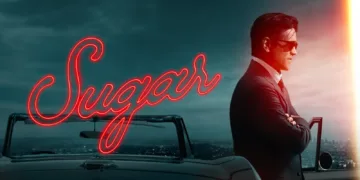












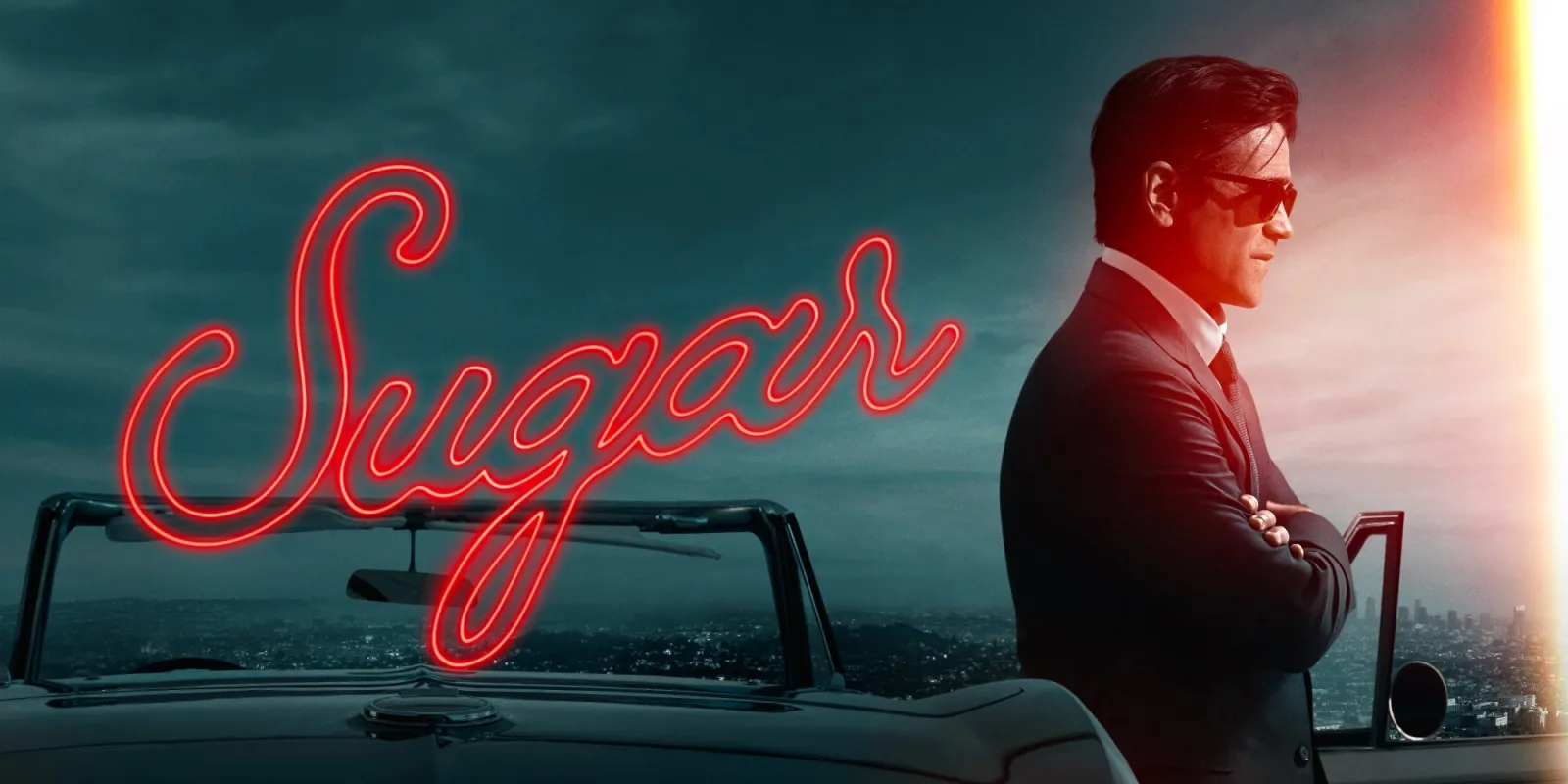

Sugar Season 2 picks up a question Season 1 detonated and then declines to answer with any real conviction. The premise, recall, is outrageous: John Sugar (Colin Farrell), Los Angeles private investigator and noir devotee, is revealed near the end of his debut season to be an extraterrestrial wearing a human face, one member of an observation mission that has since packed up and gone home.
He stayed. His sister, Djen, is missing, and he wants her found before he leaves Earth, if he leaves at all. Season 2 opens with him finishing old business in East Asia, watching Henry (Jason Butler Harner) die, then returning to Los Angeles, created by Mark Protosevich and now showrun by Sam Catlin, to take a new case involving a missing boxer’s brother. The bones are noir. The blood, allegedly, is something else. I want to test if the show still believes that.
(I should say, before I go further, that I went in rooting for it. A detective show that turns out to be about a stranded alien is the kind of premise philosophy departments wish they’d invented.)
A Case That Forgets Why It Started
The new case is, on paper, a good one. Danny Moon (Jin Ha), a boxer on the rise, hires Sugar to find his older brother Ji (Raymond Lee), whose last phone calls home were full of static and the kind of paranoid muttering that usually means either drugs or truth, often both. Sugar follows the thread from a missing addict into narcotics, the sheriff’s department, and the homeless encampments scattered through the parts of Los Angeles that the show’s first season never bothered to film. Season 1’s missing person led to a studio head’s mansion and a senator’s son with a body count. Season 2 leads to a tent city. This is, I think, the correct direction for the show to travel in, and I will say so, while admitting the show does not entirely earn the trip.
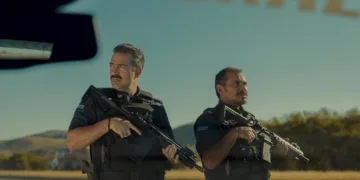
Sheriff Ray Vega (Tony Dalton) becomes the season’s organizing menace, a man whose badge functions as a kind of camouflage, not unlike Sugar’s own. The parallel is almost too neat: two disguised figures, one of them just trying to help. Danny Moon’s status as a Korean immigrant gets explicitly mirrored against Sugar’s own outsider condition. “An immigrant like me,” Sugar muses at one point, and the show clearly wants credit for the line. It has not, however, done the work to earn the comparison beyond stating it. (Call this “thematic name-dropping”: when a show announces its metaphor out loud because it suspects the metaphor will not survive contact with the plot.)
Sugar is, structurally, doing two jobs this season. He wants Ji found. He also wants to know who threatened to expose his people back in Season 1, the reveal that sent his entire mission packing. Two cases, one detective, and the show never quite decides which one it is actually interested in. The conspiracy sprawls in the right direction, narcotics into corrupt law enforcement into a population nobody in power wants to look at, but the finale resolves on something closer to a shrug than a gunshot. Even the matter of why Sugar’s species cannot tolerate cinnamon gets answered with the specificity of a man clearing his throat before changing the subject. A third season is implied. I am not certain the second one earned it.
Also Read




The Loneliest Word in the Script
The season opens with Sugar finding Henry dying in a hideout with “Beware Assimilation” painted across a wall, then burning the place down along with the body. It is the most direct the show ever gets about its actual subject, which is not aliens, not really. It is the fear of disappearing into the place you live. Sugar’s people apparently regard becoming too human as a kind of death, and the irony, never quite stated outright, is that Sugar has been chasing that death since episode one of Season 1.
I want to call this “assimilation dread” and treat it as a genuine philosophical premise, because it is one. What happens to identity under prolonged exposure to a culture that is not your own? The show gestures at an answer through small behavioral leaks: Sugar visits a dog park and uses his abilities there, recreationally, for no investigative reason at all. That detail does more work than any line of dialogue this season. A man hiding his nature does not play with strangers’ dogs unless some part of him has stopped hiding.
And yet. (Here is where I doubt myself, on schedule.) The show keeps telling us about Sugar’s isolation more than it shows us paying for it. “It’d be nice to talk to someone,” he says, more than once, and he sends messages out into the dark hoping another of his kind might hear them. Ruby, his handler from Season 1, is gone, and her absence is mentioned rather than felt. The search for Djen gets a partial resolution early, through Henry’s death, but mostly produces more fog: a flashback to a rogue alien, a hint that Djen’s own work was more secretive than Sugar understood. None of it accumulates into revelation. It accumulates into atmosphere.
The one place the loneliness lands is the romance with Charlotte (Laura Donnelly), a fellow hotel guest Sugar’s own cineliterate brain compares to Rita Hayworth in Gilda (of course it does; this is a show that cannot have a feeling without footnoting it). His reluctance to tell her what he is gives the show its only real stakes this season, because for once the cost of secrecy is a person rather than a planet. “Mr. Lonely” plays early as a needle drop, announcing the theme like a man holding up a sign. I appreciated the song. I am less sure the show needed to hold up the sign.
Farrell Carries; Everyone Else Visits
Colin Farrell is doing the unglamorous work of holding a show together by tone alone, and he is good enough at it that you almost do not notice how little plot some scenes contain. Watch him set up a punching bag at Danny’s gym, ostensibly to understand the brothers’ world, actually to work out something closer to grief. Watch him hustle a pool hall stranger for information while his attention visibly drifts to Paul Newman in The Hustler playing somewhere behind his eyes. Farrell has built a specific physical vocabulary for Sugar this season: a kind of inquisitive dismay, a stillness right before violence that suggests the violence costs him something each time, never less.
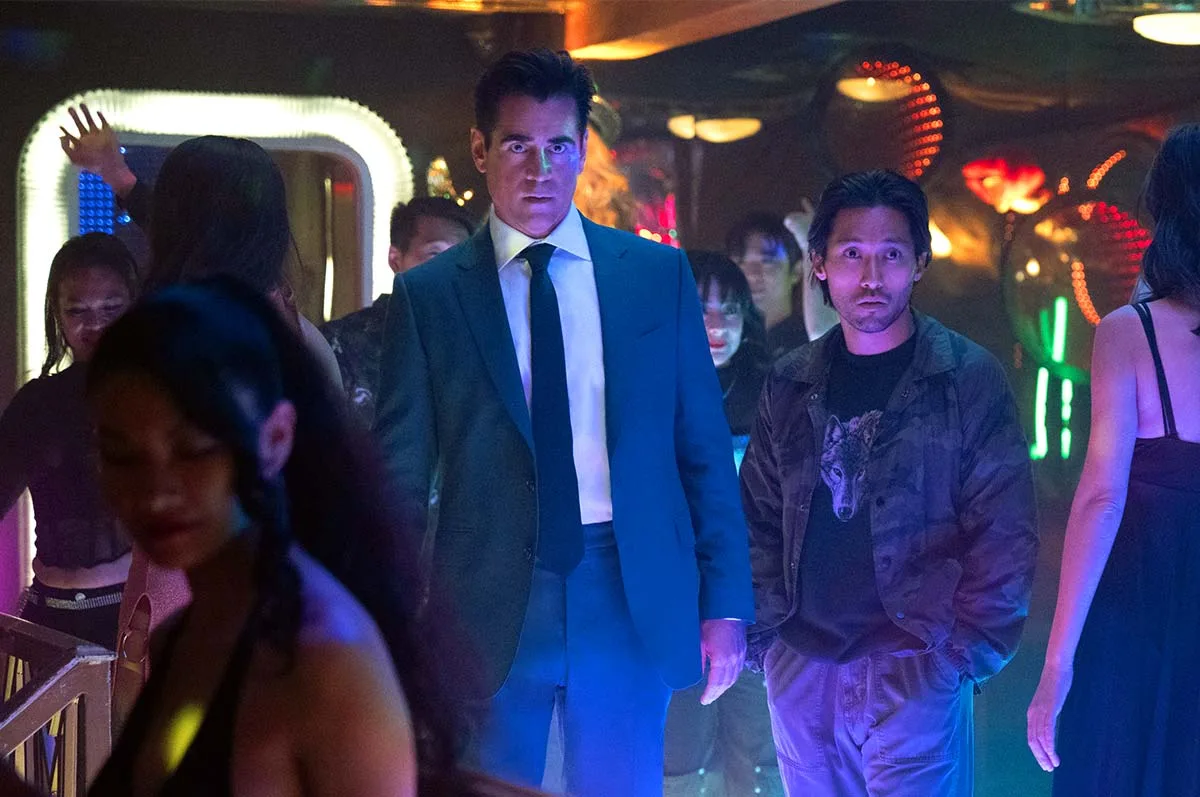
The supporting cast turned over almost completely from Season 1, and the new arrivals are, with one exception, an improvement. Tony Dalton’s Sheriff Vega has the menace the role requires and a sense of fun underneath it, the rare villain who seems to be enjoying his own corruption rather than suffering for it. Sasha Calle’s Val gives Sugar something Season 1 lacked entirely: an ally whose chemistry with him reads as earned rather than assigned. Shea Whigham, playing a cancer-stricken former client turned source, brings a bluntness that cuts through Sugar’s tendency toward reverie. Laura Donnelly gives Charlotte enough interiority that the romance does not feel decorative.
The exception is the Moon brothers themselves, which is a problem given that the entire case is built on them. Jin Ha and Raymond Lee both commit fully. Ha plays Danny’s hope and fear in the same register, which is harder than it sounds. Lee makes Ji’s spiral believable rather than performative. But the writing treats both men as instruments for Sugar’s arc rather than people whose own story matters on its own terms, and you can feel the show losing interest in them exactly when it should be leaning in. A detective show needs its cases to matter independently of the detective. Sugar, this season, only half believes that.
A Mood Board That Knows Its Own References
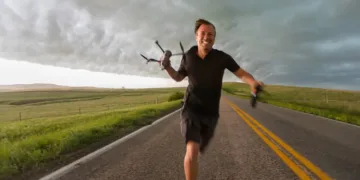
Visually, nobody is slacking. Directors including Michael Morris and Armat Escalante shoot Los Angeles the way the show has always wanted it shot: low angles, the occasional tilt, an eye for the kind of urban decay that photographs as glamour from a slight distance, peeling paint on a shuttered storefront, a wide road at dusk going nowhere in particular. The classic film insert technique returns intact. Paul Newman flickers through the pool hall. Humphrey Bogart shows up at the boxing gym. Ida Lupino sings in Sugar’s hotel room through an old television, and a security guard bonds with Sugar over Casablanca in the season’s smallest, warmest scene.
What is new is the addition of cosmic imagery alongside the noir furniture: cerulean galaxies, narration about side suns on Andromeda and terramorphs on a planet called Paloma. Call it “genre collage,” the practice of stacking visual languages on top of each other and hoping the seams read as meaning rather than decoration. Sometimes they do. The juxtaposition of a 1940s gumshoe aesthetic against literal galaxies is the closest the show gets to visualizing its actual thesis, that an alien lonely for his own kind and a detective lonely for connection are experiencing the same ache through different vocabularies. Sometimes the seams just show. A shot of a nebula does not automatically deepen a shot of a man brooding by a pool, no matter how good both shots look on their own.
The Corvette, the bespoke suits, the hotel with the pool and the room service: all present, all gorgeous, all sitting in increasingly uncomfortable proximity to a case set in tent encampments and gang territory this season. I do not think the show notices the discomfort. I think it should.
Sugar Season 2 is a stylized neo-noir detective drama that premiered its second season on June 19, 2026, and is available to stream globally on Apple TV+. The plot follows enigmatic private investigator John Sugar as he relocates to a new city and takes on a dangerous new case tracking down the troubled missing brother of a rising local boxer.
Where to Watch Sugar Season 2 Online


Full Credits
Title: Sugar (Season 2)
Distributor: Apple TV+
Release date: June 19, 2026
Rating: TV-MA
Running time: 35-50 minutes per episode
Director: Michael Morris, Amat Escalante, Adam Bernstein
Writers: Sam Catlin, Gary Tieche, Christopher C. Rogers, Jonny Gomez, Michael A. Bhim, Megan Ritchie, Sam Alper
Producers and Executive Producers: Colin Farrell, Sam Catlin, Audrey Chon, Simon Kinberg, Mark Protosevich, Scott Greenberg, Chip Vucelich
Cast: Colin Farrell, Tony Dalton, Laura Donnelly, Jin Ha, Raymond Lee, Sasha Calle, Shea Whigham, Mireille Enos, Jason Butler Harner, Nona Parker Johnson, Jack Topalian, Akrosia Samson, Catfish Jean, Erin Wu
Director of Photography (Cinematographer): Richard Rutkowski, Cesar Charlone
Editors: Fernando Stutz, John Coniglio
Composer: Ali Shaheed Muhammad, Adrian Younge
The Review
Sugar Season 2
Sugar Season 2 inherits a genuinely strange premise (a noir detective who is secretly an alien) and then spends eight episodes deciding not to use it. The case widens usefully into Los Angeles's margins, Farrell remains magnetic, and the new supporting cast outperforms the old one. But the show announces its loneliness and its dread of assimilation far more often than it dramatizes either. The finale resolves on a shrug rather than a revelation. I liked watching it. I am less sure I needed to.
PROS
- The case expands into Los Angeles's overlooked margins with real intent
- Farrell anchors the season through tone alone
- Sasha Calle and Tony Dalton elevate the new supporting cast
- The noir visual craft stays confident and specific (Newman, Bogart, Lupino, all present and accounted for)
CONS
- The finale resolves on a shrug instead of a payoff
- The Moon brothers stay underwritten despite carrying the central case
- The assimilation theme gets stated more often than it gets earned
- The cosmic imagery and the gritty new setting rarely speak to each other