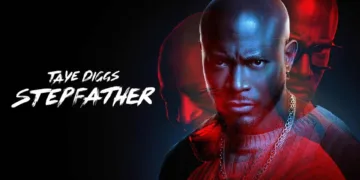
























A man who treats eye contact as a legal contract is already telling on himself. Darnell, played by Taye Diggs, tells his stepdaughter’s boyfriend to look him in the eyes because “that’s showing respect,” and the scene understands him better than much of the script does. Respect, for Darnell, is never mutual. It is architecture. He wants a house where every gaze, gesture, and title points back to him.
Stepfather builds its danger around that domestic fantasy. Asia, played by Tamar Braxton, is recovering from a marriage damaged by Timmy’s cruelty and infidelity. Darnell enters through a grocery-store flirtation, offering cooking advice about yellow peppers with the practiced ease of a man who has studied the warmth of ordinary life from a distance. Six months later, he is husband, host, and aspiring patriarch at a family party.
The film rushes through the courtship, which weakens the emotional trap. A thriller of replacement needs the seduction to breathe. Here, the door is open too fast, and Darnell walks in already carrying the knife.
Respect as a Threat
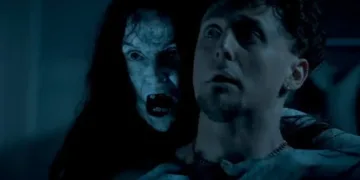
Darnell’s obsession with the perfect family gives Stepfather its clearest idea. He has worn other names, entered other homes, and killed other families after they failed the private audition taking place inside his head. The film spells this out with memories of his past murders and scenes where he talks to his other personalities, turning psychological fracture into literal conversation.
That choice is blunt, but it fits the film’s soap-thriller register. Darnell is not written as mystery. He is written as pressure. The question is not what he is, since the film tells us early. The question is how long Asia, Sasha, Melanie, and the others will keep mistaking control for care.
Asia’s past gives the plot some usable moral shading. Timmy wounds her with the oldest, ugliest domestic complaint: he wanted a housewife, then resented the housewife. That opening argument matters because it makes Darnell’s polish feel useful. He listens. He flatters. He supplies the shape of certainty. The film has a sharper version of itself hidden here, one about how authoritarian men often arrive disguised as relief.
The script keeps stepping on that sharper version. Characters announce feelings with the stiffness of depositions. Backstory arrives like paperwork. The detectives tracking Darnell’s previous crimes bring exposition, then more exposition, then the faint hope that one of them might locate a second facial expression before the credits.
Taye Diggs and the Theater of Fracture
Diggs is the reason the film remains watchable. He understands that Darnell should not be played as a realistic villain. He is a cracked performance of fatherhood, masculinity, romance, and old television advice about being “the man of the house.” Diggs leans into the artificiality without winking at the camera.
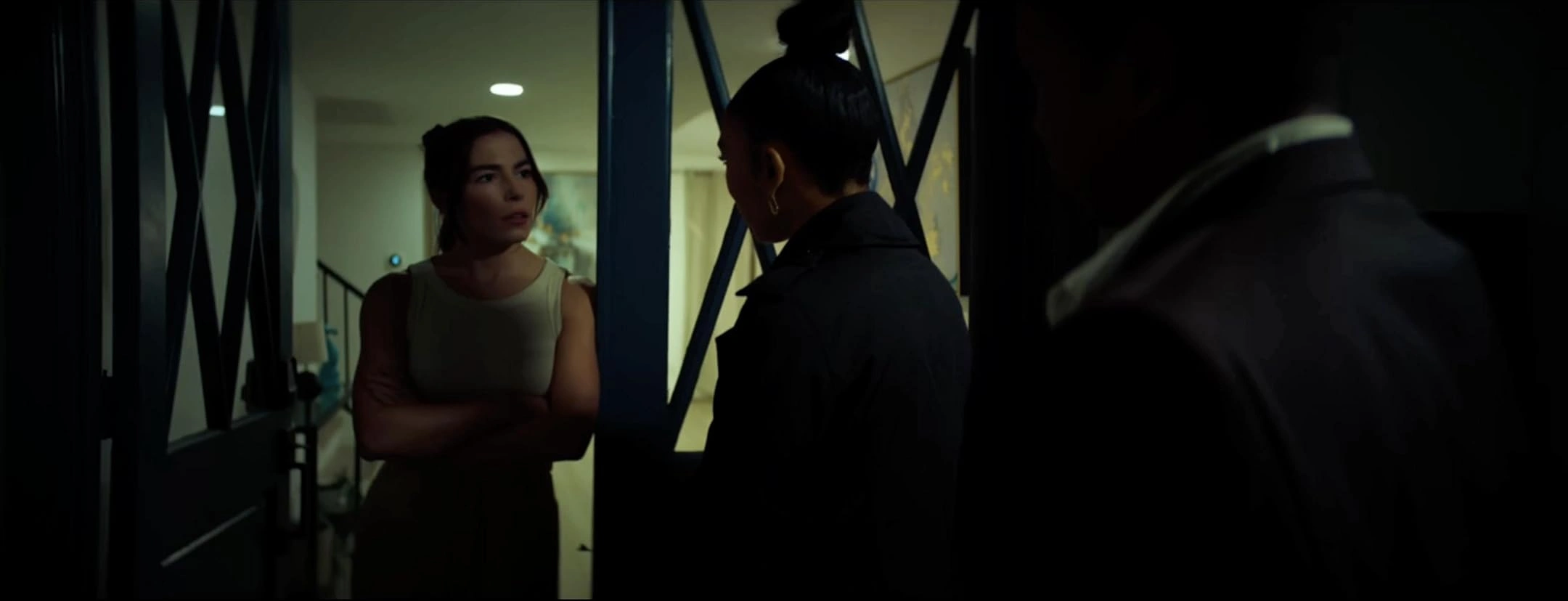
His grocery-store scene with Asia is a small study in predatory softness. The yellow-pepper advice sounds harmless, but Diggs times it like an intrusion rehearsed to seem spontaneous. His smile lands half a beat too long. His voice lowers into warmth, then hardens when he discusses order, respect, and family. The shift is not subtle. Subtlety has left the premises and may be filing a police report.
The internal-personality scenes are the film’s most theatrical material, and Diggs attacks them with craft. He changes speech rhythm, posture, and vocal placement for the voices arguing inside Darnell. One persona jabs, another controls, another seems to enjoy the violence as performance. The scenes border on absurdity, yet they reveal what the camera often fails to create: instability with shape.
The fantasy outbursts in the third act work for the same reason. The film imagines Darnell losing control, then snaps back to reality. It is a cheap device, but Diggs gives each eruption a nasty physical charge. His rage has choreography. His calm has calculation.
A Family Drawn in Heavy Lines
Braxton gives Asia a readable wound before the film turns her into a thriller target. Her early scenes with Timmy carry the exhaustion of someone being blamed for the life she was asked to live. When Darnell appears, Asia’s trust is not stupidity. It is fatigue with better lighting.
Her later scenes are less steady. The film asks her to miss too many obvious signs, then asks her to react at full volume once the danger can no longer be ignored. The infamous slap, where Asia spins across the room with almost balletic excess, belongs to another, trashier, possibly livelier film. For one glorious second, Stepfather discovers camp by accident.
Sasha’s refusal to call Darnell “dad” gives the family tension a needed edge. Her resistance punctures his performance. Melanie’s warmer response, shaped by anger toward Timmy, gives Darnell another route into the household. Brad, the boyfriend, exists largely to be measured and corrected by Darnell’s little rituals of manhood.
Brett, Asia’s brother, helps sell the dangerous speed with which the family accepts the new husband. The supporting characters function, then vanish into the machinery. That machinery is loud, predictable, and often badly oiled.
Cheap Light, Useful Shadows
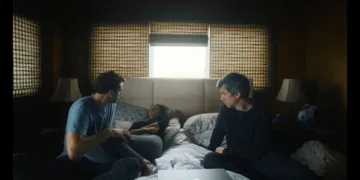
Chris Stokes directs Stepfather with basic clarity, then keeps making choices that blunt the menace. The shaky opening tries to place us inside Darnell’s disorder, yet the motion reads less like psychological subjectivity than a camera searching for its footing. Dark interiors should help a film like this. Chiaroscuro can make a living room feel like a confession booth. Here, the underlit scenes often flatten faces and swallow tension.
The detective subplot creates the largest structural drag. Every time the film returns to the investigation, the pressure inside Asia’s home leaks away. The officers explain Darnell’s past without deepening the present, and their scenes rarely carry visual threat. A procedural thread can tighten a domestic thriller. This one loosens the screws.
Still, a strange moral image survives: Darnell standing in the family home, smiling as if fatherhood were a costume tailored from other people’s fear. Diggs gives that image teeth. The camera should fear him; too often, it merely records him.
The psychological thriller Stepfather premiered exclusively on the free streaming platform Tubi on June 19, 2026. Directed by Chris Stokes, the plot follows Darnell (played by Taye Diggs), a deeply disturbed man determined to engineer the perfect family image at any cost. After marrying Asia (played by Tamar Braxton), his increasingly volatile behavior and unsettling past secrets force his new wife and stepdaughters into a terrifying battle to escape his deadly obsession.
Where to Watch Stepfather (2026) Online

Full Credits
Title: Stepfather
Distributor: Tubi
Release date: June 19, 2026
Rating: TV-MA
Running time: 1 hour 36 minutes
Director: Chris Stokes
Writers: Marques Houston, Chris Stokes
Producers and Executive Producers: Chris Stokes, Marques Houston, Jerome Jones, Jarell Houston
Cast: Taye Diggs, Tamar Braxton, Kalani Jules, Jessica Jarrell, Janeline Hayes, Dante Brown, Troy Brookins
Director of Photography (Cinematographer): Harvey Glen
Editors: Harvey White
Composer: Marlon McClain
The Review
Stepfather
Stepfather works best when it stops pretending to be a grave psychological thriller and lets Taye Diggs turn domestic order into stage-managed menace. The film is derivative, visually flat, and far too fond of exposition, yet Diggs gives Darnell a theatrical volatility the camera often fails to earn. The family drama has a sharper film hiding inside it, one about control disguised as protection. What remains is cheap, uneven, and oddly watchable whenever its villain enters the frame.
PROS
- Taye Diggs’ full-throttle menace
- Strong respect-as-control theme
- Sasha’s resistance adds tension
- Accidental camp value
- Clear domestic-thriller hook
CONS
- Rushed courtship
- Clunky exposition
- Underlit interiors
- Weak detective subplot
- Thin supporting characters