

























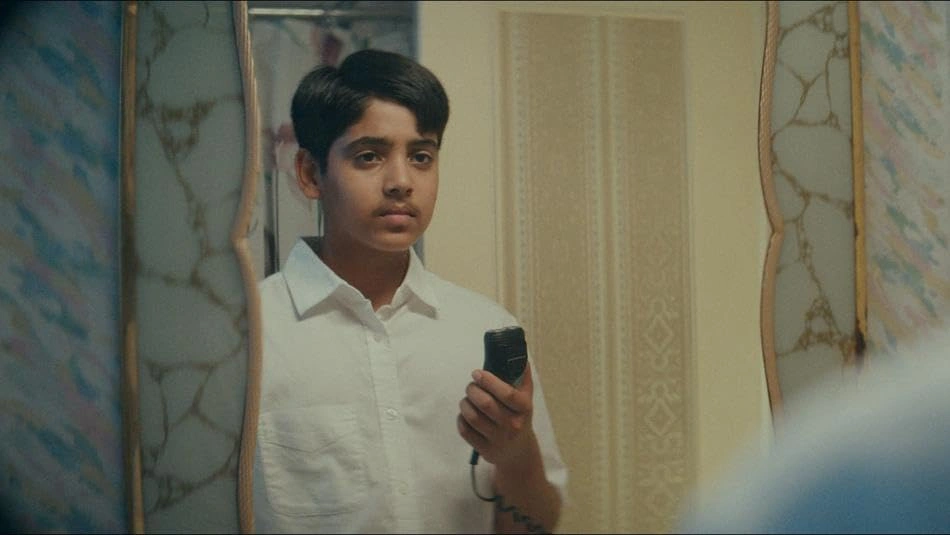

Ilyas has been negotiating with his upper lip since the age of ten. By thirteen, the negotiation has collapsed. The thin mustache above his mouth has become a source of humiliation at school, an object of discipline at home, and a visible sign of a body moving ahead without permission. Imran J. Khan treats this predicament with comic tenderness in Mustache, setting one boy’s embarrassment against the religious, economic, and generational pressures of a Pakistani-American household in mid-1990s San Jose.
Atharva Verma plays Ilyas as a child caught between several versions of himself. At his Islamic private school, he tries to survive classmates who mock his facial hair. At home, he must meet standards his parents rarely explain. His understanding of adulthood comes partly from films, leading him to connect Judgment Day with Terminator 2 and adolescent biology with Stargate. These references are funny because Ilyas uses popular cinema to translate subjects his family will not discuss.
A fight with a classmate costs him his scholarship. His father Hameed’s computer business is struggling, so private tuition becomes impossible. Ilyas is sent to public school, a place he imagines as a factory for producing bad Muslims. Khan situates this personal upheaval near the dot-com collapse, quietly linking the family’s cultural anxieties to financial precarity. Hameed presents the transfer as punishment because admitting economic weakness would require a kind of openness the household has never learned.
Rebellion With Conditions
Ilyas decides that the quickest route back to his former school is to become morally alarming. The joke is that he remains far too conscientious to commit himself to misconduct. When he uses McDonald’s packaging to frighten his parents, he replaces the meat with a halal patty. He tries to pass oregano off as marijuana. Each act of rebellion carries an invisible safety certificate.
These scenes give Mustache its most distinctive comic language. Khan does not treat Muslim practice as an exotic obstacle placed in front of a universal teenager. The religious rules shape the rhythm, limits, and absurdities of Ilyas’ schemes. His rebellion grows from a particular home, community, and vocabulary. The film’s humor works because Ilyas believes deeply enough to fear the very transgressions he hopes will save him.
His campaign expands after he befriends Arun and decides that a forbidden girlfriend will finally provoke his parents. Ilyas recruits Yasmeen, a sharp girl from his former school, to help create an online romance involving public-school classmate Liz Park. AOL Instant Messenger becomes a stage where identity can be rehearsed before anyone has to face its consequences.
Also Read



The arrangement exposes Ilyas’ moral blind spots. He resents adults who conceal financial problems and enforce rules selectively, then uses Yasmeen’s affection while pursuing Liz. Khan does not turn this hypocrisy into a lesson delivered from above. Ilyas has to recognize that growing up includes discovering the harm hidden inside one’s own panic.
Learning to Perform
Verma gives the film its emotional shape through small physical changes. Around authority figures, Ilyas’ gaze shifts and his shoulders contract. Online, he becomes briefly articulate. In front of Liz, his rehearsed confidence dissolves into nervous pauses. His frustration sometimes bursts outward, yet Verma keeps the anger connected to shame. Ilyas can behave selfishly without becoming cruel in the audience’s eyes.
Khan repeatedly cuts to facial hair and upper lips, converting the mustache into a visual refrain. These brief close-ups show how thoroughly Ilyas scans every room for evidence that people are staring at him. The device could have become a broad gag. Instead, it places the viewer inside the exhausting vigilance of adolescent insecurity.
Acting class offers Ilyas a rare setting where being watched can feel liberating. He initially joins to stay close to Liz, but Miss Martin notices his ability and welcomes him among the theater students. Alicia Silverstone plays the teacher with an attentive warmth that differs sharply from the adult authority surrounding Ilyas elsewhere. When he performs, embarrassment becomes material. The same body he wants to hide can hold a room.
The relationship needs further development. Miss Martin’s influence is asserted through a handful of exchanges, leaving the emotional shift from reluctant observer to engaged performer too compressed. The theater students register as possible friends rather than complete presences. Khan has found a persuasive setting for Ilyas’ self-discovery, then gives it the duration of a promising subplot.
What the Family Cannot Say
The richer film waiting inside Mustache appears during Ilyas’ scenes with his parents. Rizwan Manji gives Hameed a severity shaped by fear. His business is failing during a period that promised prosperity to anyone selling the future, and he cannot explain that failure to his son without disturbing his authority. His disappointment in Ilyas often lands as anger, yet Manji’s pauses suggest a man frightened by his declining ability to provide.
Meesha Shafi brings a quieter form of loss to Asiya. Ilyas learns that his mother once painted and asks why she stopped. Her short reply opens a history the film barely explores: creative ambition surrendered to domestic expectation, then sealed beneath routine. Ilyas’ attraction to theater gains extra weight beside this revelation. He is reaching for the expressive life his mother left behind.
The home interiors remain dim, with family members frequently separated by doorways, furniture, or patches of shadow. Public school brings confusion, yet it also brings visual space. Home offers certainty at the price of conversation. Khan refuses to cast faith itself as the source of repression. The tension comes from adults using tradition to manage fears they cannot name, leaving their children to mistake silence for certainty.
At roughly 80 minutes, the film moves too quickly past these fractures. Yasmeen’s hurt, Hameed’s financial anxiety, Asiya’s abandoned art, and Miss Martin’s mentorship each point toward deeper emotional territory. Mustache keeps returning to Ilyas because Verma can carry that attention, but the people shaping him often remain at the edge of the frame.
The final emotional release grows from a family that has spent years avoiding direct speech, and its awkwardness feels true: Ilyas has finally found a language for himself, while everyone around him is still learning how to listen.
Mustache is a coming-of-age comedy-drama film that originally premiered at the South by Southwest Film Festival on March 12, 2023, before receiving a digital release by Quiver Distribution on July 31, 2026. Set in 1990s Silicon Valley, the story follows a 14-year-old Pakistani-American boy adjusting to life after transferring from a private Islamic school to a public high school. Viewers can watch the film via digital platforms and video-on-demand services.
Where to Watch Mustache (2023) Online




Full Credits
Title: Mustache
Distributor: Quiver Distribution
Release date: March 12, 2023 (SXSW), July 31, 2026 (United States)
Running time: 83 minutes
Director: Imran J. Khan
Writers: Imran J. Khan
Producers and Executive Producers: Riz Ahmed, Christopher Storer, Christina Won, Jessica Sittig, Tyson Bidner, Josh Senior, Cooper Wehde, Allie Moore
Cast: Atharva Verma, Alicia Silverstone, Rizwan Manji, Meesha Shafi, Ayana Manji, Shaheryar Rana, Mojeane Sadr, Melody Cao
Director of Photography (Cinematographer): David Robert Jones
Editors: Harrison Atkins
Composer: Dan Romer
The Review
Mustache
Mustache finds its sharpest material in the gap between Ilyas’s private shame and the cultural rules shaping his public identity. Imran J. Khan treats faith, family duty, and teenage rebellion with affection, especially during Ilyas’s carefully halal attempts at delinquency. Atharva Verma gives the comedy its nervous pulse, while Rizwan Manji suggests a richer father-son drama than the brief runtime permits. The supporting relationships remain sketches, yet the film’s cultural precision keeps its familiar coming-of-age structure personal and warm.
PROS
- Atharva Verma’s anxious precision
- Culturally specific comedy
- Tender family tensions
- Smart facial-hair motif
CONS
- Underwritten supporting characters
- Miss Martin lacks screen time
- Compressed father-son conflict
- Emotional turns arrive quickly