The funniest idea in Drag is also its cruelest: escape depends on a body that can barely move. Raviv Ullman and Greg Yagolnitzer build their feature debut around that physical contradiction, turning an isolated luxury house in upstate New York into a machine for humiliating two thieves who entered expecting an easy night.
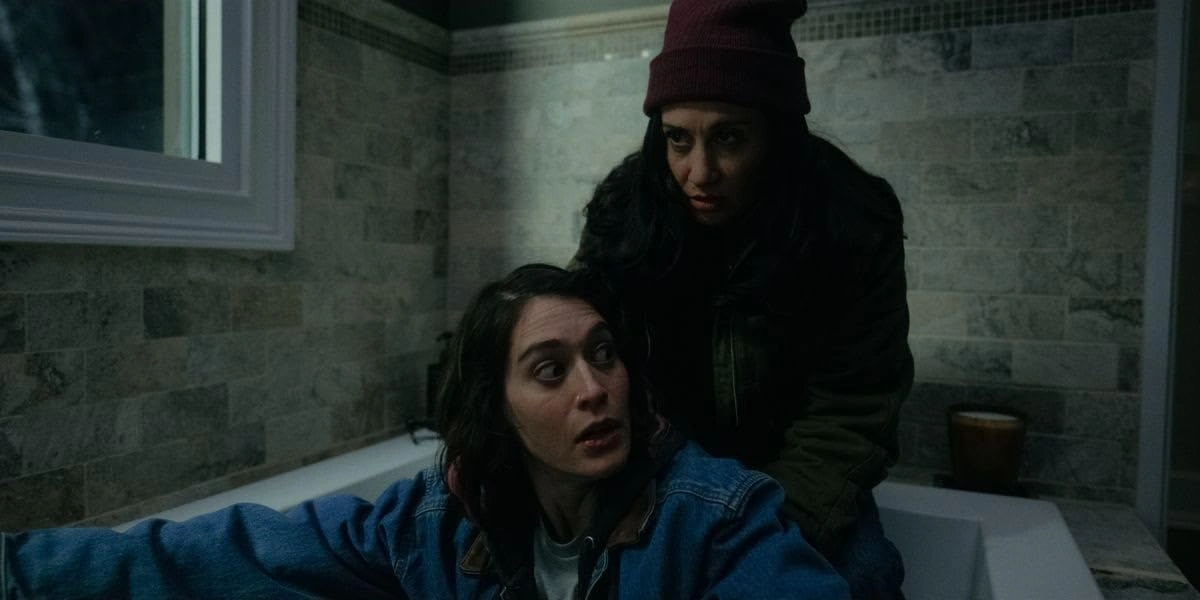
Lizzy Caplan plays the older sister, credited as Fuckup, whose claim that the homeowner owes her money barely persuades her younger sibling. Lucy DeVito’s Sister waits outside as the reluctant lookout until a scream pulls her into the house. Fuckup has slipped inside the upstairs bathtub and injured her back so badly that sitting up becomes a negotiation with her own nervous system.
The premise belongs to an American tradition of physical comedy stretching from silent cinema to splatter films, where pain becomes funny through precision and repetition. Yet Drag gives that tradition a home-invasion structure. Every minute spent pulling Fuckup toward the front door increases the chance that the owner will return.
A fall can produce laughter, then immediately become evidence that the sisters may never leave. At 86 minutes, the film remains lean by conventional standards. Its central joke still strains under repetition. There are only so many ways to move an injured person across a room, and the script tries nearly all of them.
Two Sisters, One Functional Spine
Caplan must perform most of her role from the floor, the bathtub, or some improvised dragging position. Her face becomes the film’s primary special effect. One tightened eyelid signals an approaching spasm. A half-open mouth becomes a warning that Sister has chosen the wrong angle. When a protruding nail slices into her torso, the reaction lands because Caplan has already established a detailed vocabulary of lesser pain.
The escalating injuries push the performance toward cartoon grotesquerie. Porcelain ends up embedded in Fuckup’s cheek. Her face accumulates cuts and bruises. Each wound remains present during the next obstacle, giving the violence a continuity that many splatter comedies neglect. The makeup department treats her body like a map of failed decisions.
DeVito has the less flamboyant task and, scene by scene, the heavier one. Sister drags, lifts, argues, improvises, and repeatedly returns when abandoning Fuckup would be safer. Her expressions move between resentment and calculation, especially when another attempt to cross the stairs produces fresh damage. The sisters’ history appears through rhythm rather than exposition. They interrupt each other too quickly for the quarrel to be new.
Their dynamic also gives the film a recognizably American strain of family comedy, built on the idea that affection is best expressed through complaint. Sister views her stable job and domestic life as proof that she escaped Fuckup’s chaos. Fuckup treats that stability as another accusation. The robbery forces both women back into an older arrangement: one sister creates the disaster, the other carries her out of it.
The House as an Imported Body Trap
Many contemporary home-invasion thrillers turn architecture into surveillance. Drag takes a different route. Its house resembles a piece of hostile installation art, filled with sharp pottery, stairs, narrow passages, glassware, exposed floorboards, and objects whose ugliness seems designed to cause injury.
Production designer Neil Patel makes the furnishings active participants in the comedy. Avant-garde ceramics stop functioning as decoration once one breaks against a face. Duct tape shifts from household utility to emergency medical equipment. A glass of ice water becomes dangerous because reaching it requires balance the sisters no longer possess.
Ullman and Yagolnitzer stage each obstacle through a clean visual sequence. First comes the geography of the problem. Then the sisters propose a solution. The camera holds long enough for the audience to identify the point of failure before the body reaches it. This resembles silent slapstick, where spatial clarity makes the impact funny. The gore changes the emotional temperature. Buster Keaton might have fallen through the floor; Fuckup is dragged across a nail and leaves blood behind.
The mixture reflects a broader exchange between American studio comedy, grindhouse brutality, and the body horror that now circulates freely through festival cinema. Drag borrows the clean mechanics of slapstick and the tactile wounds of modern splatter, yet its rural mansion carries the polished menace of films such as Don’t Breathe. The directors understand how these traditions fit together at the level of movement. Their weakness appears at the level of character. Fuckup and Sister are credited as functions because the screenplay rarely lets them become anything else.
The cheerful soundtrack sharpens the violence by refusing to acknowledge it. Bright songs continue while bodies are scraped, dropped, and struck. The contrast works at first, then becomes predictable. Once the film has taught us that every happy cue accompanies punishment, surprise gives way to scheduling.
The Man Who Moves Too Easily
John Stamos enters as the homeowner, credited as Man, and alters the film’s physical language. The sisters have spent half the night treating every doorway as a military operation. He glides through the same rooms, dances without caution, and handles the house as an extension of himself. His ease becomes threatening before the script confirms his intentions.
Stamos uses the familiarity of television charm with unusual discipline. His smile remains bright when his behavior turns predatory. He speaks and moves like a host determined to keep the evening pleasant, which makes his cruelty feel rehearsed rather than impulsive. Casting him connects the film’s nastiness to an image of American domestic comfort, then contaminates that image one grin at a time.
Christine Ko’s Woman arrives as his date and soon collapses into a drugged stupor while he sketches her. Her immobilized state mirrors Fuckup’s injury, creating two helpless women under very different forms of care. Fuckup has a sister who complains while pulling her toward safety. Woman is left with the person who removed her ability to resist.
Her presence also creates the film’s sharpest moral complication. Sister and Fuckup can attempt escape alone, or accept further danger by taking Woman with them. The debate is played for comedy, yet it reveals the limits of their self-interest. Sister has already proven that responsibility can survive resentment. Saving a stranger asks her to extend that obligation beyond family.
The pacing weakens during the long stretches focused on Man and Woman. Stamos supplies energy, but the detour pauses the immediate problem that gives the film its shape. Momentum returns when Fuckup must finally rise and fight. The directors stretch each attempted movement, making a few inches of standing feel punishing.
A late frying-pan attack embraces the film’s cartoon ancestry openly. The final shock gag reaches for one last festival gasp, then retreats before it can carry the emotional weight created by the sisters’ battered loyalty.
Drag is a dark comedy thriller film that premiered at the SXSW Film Festival on March 13, 2026. The plot follows two amateur burglars whose routine heist spirals out of control when one of them throws out her back inside the house just as the unpredictable homeowner returns. Viewers can look forward to its theatrical release distributed by Briarcliff Entertainment.
Full Credits
Title:Drag
Distributor:Briarcliff Entertainment
Release date:March 13, 2026 (SXSW)
Running time: 86 minutes
Director:Raviv Ullman, Greg Yagolnitzer
Writers:Raviv Ullman, Greg Yagolnitzer
Producers and Executive Producers:Danny DeVito, Lucy DeVito, Jake DeVito, Lizzy Caplan, John Stamos
Cast:Lizzy Caplan, Lucy DeVito, John Stamos, Christine Ko
Director of Photography (Cinematographer):Ben Goodman
Editors:Malinda-Zehner Guerra
Composer:Patrick Stump
The Review
Drag
7Score
Drag fuses American slapstick with home-invasion horror, turning back pain, exposed nails, ugly pottery, and sibling resentment into a vicious physical comedy. Lizzy Caplan and Lucy DeVito give the thin premise enough friction to survive its repetitive stretches, while John Stamos twists familiar television charm into grinning menace. The characters remain closer to genre functions than fully formed people, and the final gag cheapens the preceding struggle. Still, few films make crossing a hallway feel this dangerous or this funny.
When you login first time using a Social Login button, we collect your account public profile information shared by Social Login provider, based on your privacy settings. We also get your email address to automatically create an account for you in our website. Once your account is created, you'll be logged-in to this account.
DisagreeAgree
Connect with
I allow to create an account
When you login first time using a Social Login button, we collect your account public profile information shared by Social Login provider, based on your privacy settings. We also get your email address to automatically create an account for you in our website. Once your account is created, you'll be logged-in to this account.