

























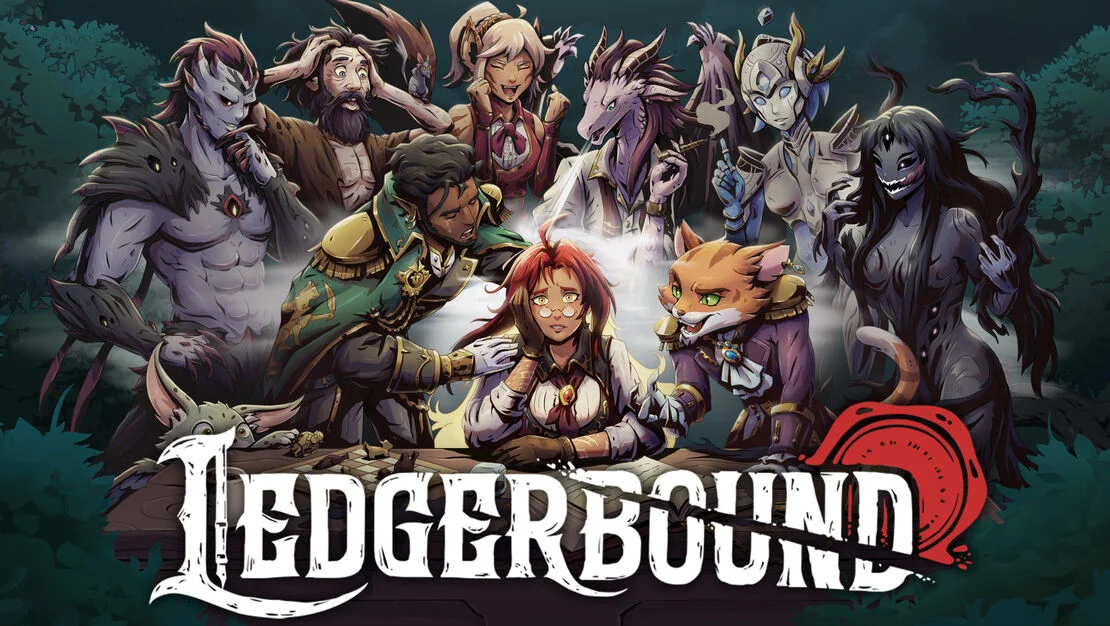

Rayna can reconstruct the deaths of celebrated adventurers like an accountant replaying a bad quarter. Her job at Heroes Unite Life Group is to prove that fallen heroes caused their own demise, giving the company grounds to reject insurance payouts. It is an absurd foundation for a fantasy RPG, yet Ledgerbound commits to the bureaucracy with admirable discipline.
The problem arrives when the Regulators, the Queendom’s strongest heroes and some of HULG’s most heavily insured clients, are killed by the invading Vacari. Rayna runs their battle through every scenario she can devise and still cannot demonstrate negligence.
A trip to the site leaves her bonded to a mysterious relic and caught inside a prophecy, forcing this dedicated claims adjuster into fieldwork. Her solution to the pending payout is perfectly corporate: become a hero, save the world, and prove the Regulators failed.
Developer OmniMegaSuperCorp builds much of its identity from incompatible traditions rubbing against each other. The adventure borrows the party structure and tactical rhythms of Japanese strategy RPGs, then fills that framework with Western workplace satire, dating-game intimacy, HR bureaucracy, and a distinctly contemporary appetite for sexual comedy. The collision rarely feels accidental.
Workplace Fantasy After Hours
Rayna remains funny because her corporate devotion has consequences. Her closest companion at the office is a hat rack, which eventually becomes something she can summon into combat. That detail initially plays like a gag about an employee who has stayed late once too often. As her party grows, it becomes evidence of just how little life she had outside HULG.
Her companions are equally strange. Hobknob travels with rats that regularly appear sharper than he is. Prince Avarice arrives with aristocratic swagger and his servant Grigsby. Jazz, the dragon working in HR, wants independence from her father. Sylvie carries enough anxiety to turn minor uncertainty into panic. Cazian begins his relationship with the group in literal restraints.
Also Read




The writing gives those personalities space during Resterludes, the limited breaks between missions. Talking with Jazz exposes the friction with her father. Spending time with Avarice gradually cracks his pompous performance. Sylvie’s nervous energy becomes painful rather than merely comic once her history with the casters surfaces.
Sex is everywhere, sometimes verbally, sometimes through romance options, yet Ledgerbound filters desire through the same corporate machinery governing everything else. Characters list relationship preferences in employee information. Pursuing certain partners requires respecting monogamous commitments.
Romantic escalation can involve HR paperwork. Global fantasy RPGs have spent years absorbing dating-sim structures, especially from Japanese games, while Western titles have increasingly treated party romance as expected player expression. Ledgerbound takes those converging traditions and files them under company policy.
Fire Emblem With Shareholders
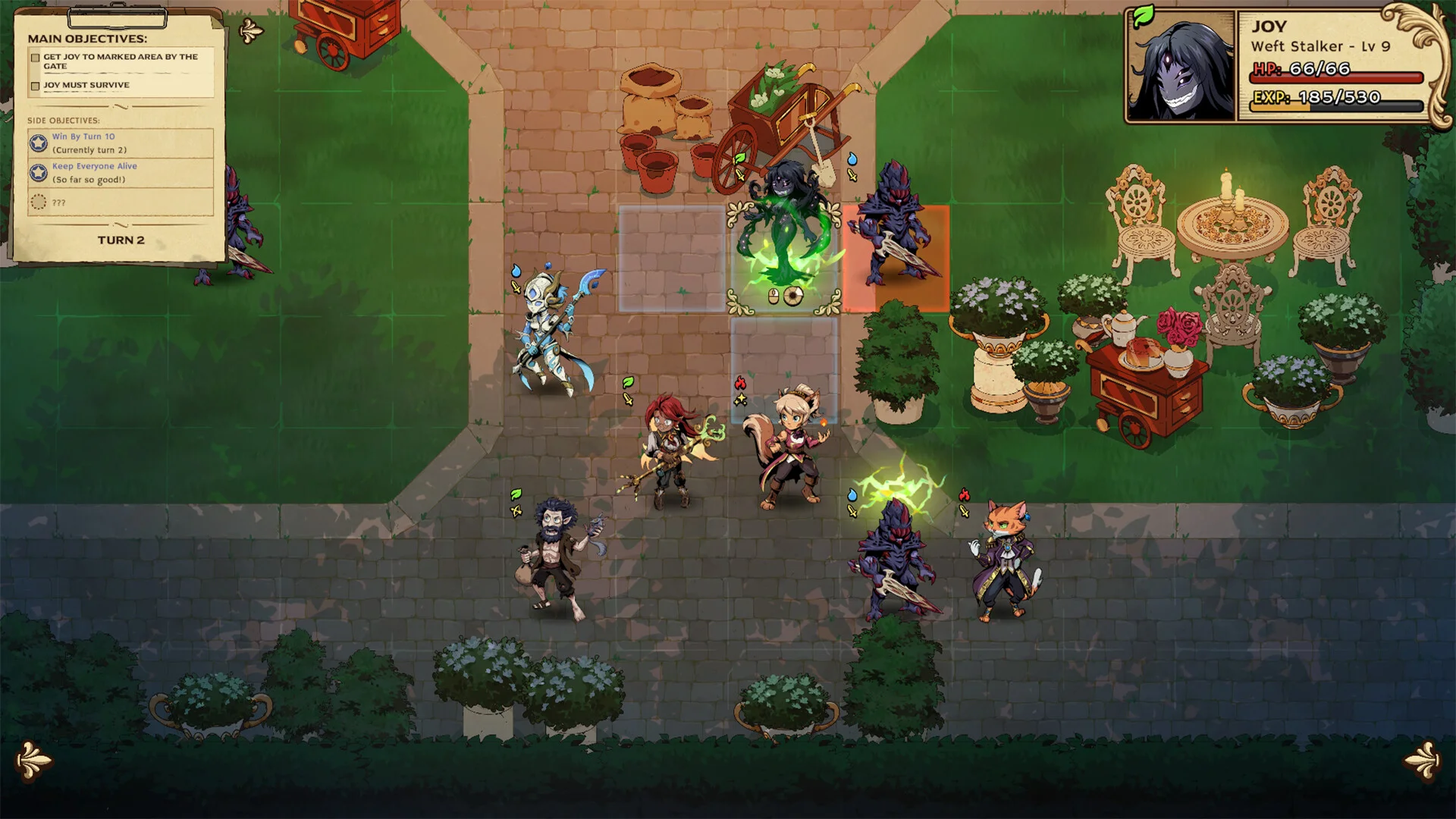
The combat owes an obvious debt to Fire Emblem, though it trims much of that series’ army management. Every party member enters battle, each unit moves and performs an action, and enemies counter ordinary attacks when they survive and remain within range. Experience comes from participation, so leaving somebody idle means leaving their development behind.
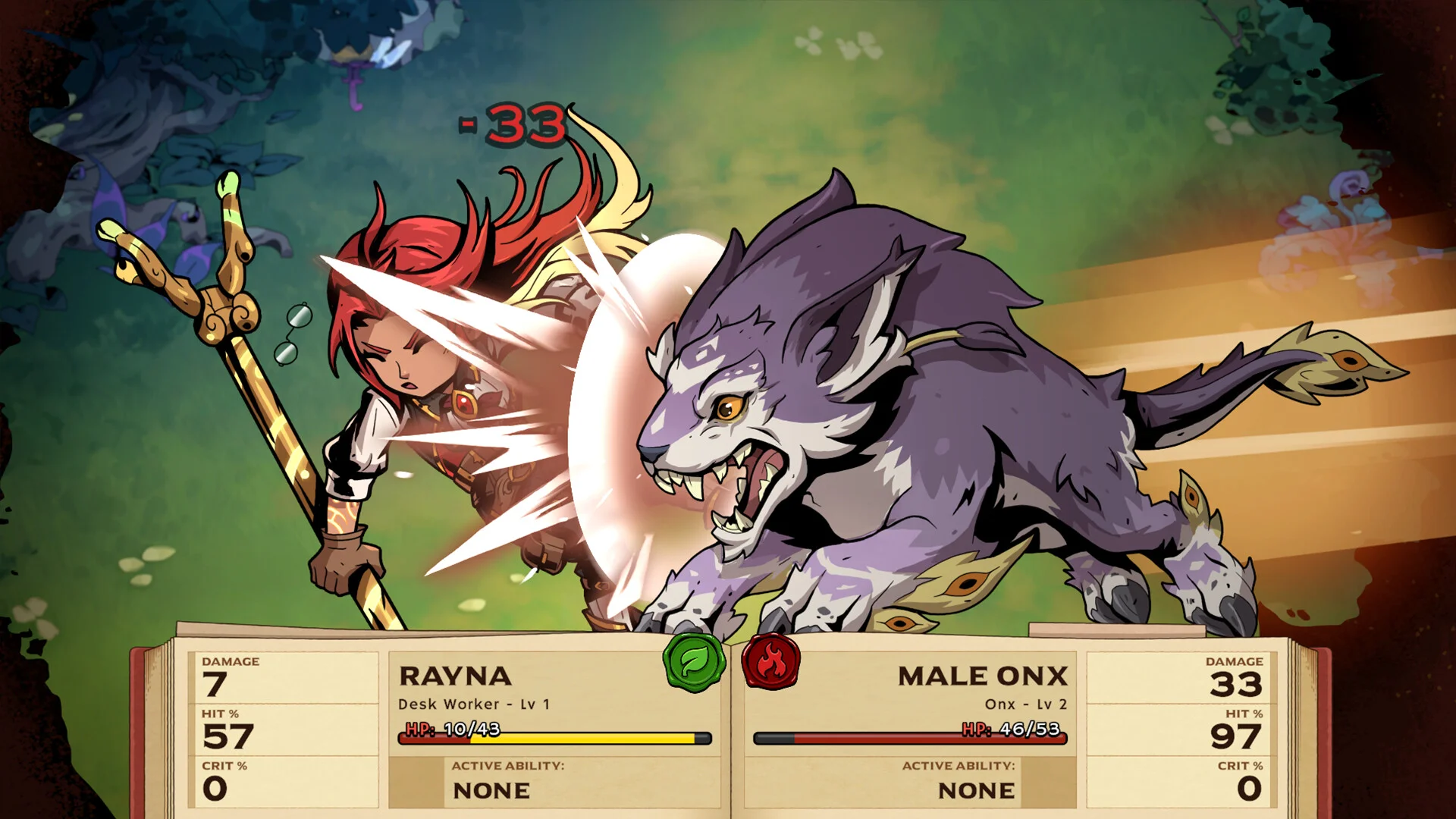
Weapon matchups are replaced by an elemental triangle: water defeats fire, fire defeats earth, and earth defeats water. Ground glyphs can amplify those relationships, creating spaces worth contesting before anybody swings a weapon. Strength and Magic target Armor and Resistance respectively, while individual skills keep units distinct. Avarice can summon Grigsby to stand in harm’s way, for instance, turning the loyal servant into a very literal tactical resource.
The system favors clarity over intricate simulation. That suits the smaller fixed party, since battles can ask players to think about positioning instead of roster administration. Optional objectives supply extra pressure. One encounter may demand a turn-limit finish, another may require everyone to survive, while a third condition can force a particular character away from the killing blow. Completing these tasks earns rewards for the company’s swag exchange and improves Shareholder Reputation.
Failed objectives can be revisited through Rayna’s tabletop recreations of past battles. It is a clever point where story and mechanics meet: grinding an old map becomes another claims investigation performed with miniature pieces. Equipment follows the same joke. Stat-boosting gear is “swag,” while abilities and passive effects arrive as “liabilities” constrained by insurance coverage. Even optimization gets processed by HULG.
Burnout Has a Clock
Resterludes place a strict resource around everything outside combat. Bonding conversations consume time. Changing swag consumes time. Equipping liabilities consumes time. Replaying battles consumes time. HR training can improve efficiency, while procrastinating can recover minutes at the cost of increasing Rayna’s burnout.
It is one of the game’s smartest adaptations of office culture into RPG design. Many role-playing games allow players to exhaust every conversation before advancing. Here, attention itself becomes scarce, reflecting the habits of a protagonist who has spent years measuring her worth through productivity.
The permanent autosave system applies similar pressure to decisions. Romance commitments can close other paths, promotion choices can reshape how somebody fights, and multiple endings make another playthrough the price of curiosity. Choosing a route that turns Sylvie from ranged support toward melee cannot simply be erased by loading an earlier file.
That philosophy becomes harder to defend when technical problems intervene. Review builds contained freezes, mismatches between spoken dialogue and on-screen text, missing recordings, and placeholder events. One reported combat bug could halt progression after an enemy died to a rat trap, precisely the kind of problem made worse by constant saving. Patches arrived quickly, yet the design leaves almost no buffer between intentional permanence and technical accident.
Ledgerbound is strongest inside that strange tension. Its hands speak the language of Japanese tactical RPGs, its dialogue speaks contemporary Western workplace comedy, and its relationship systems borrow freely from dating games and party-driven CRPGs. Rayna can save civilization, flirt with coworkers, manage burnout, appease supernatural shareholders, and deny an insurance claim without the game treating any one of those activities as belonging to a different universe. Somehow, HR approved the whole thing.
The Review
Ledgerbound
Ledgerbound turns the discipline of Japanese tactical RPGs into fuel for a distinctly Western corporate fantasy farce, where elemental positioning, insurance terminology, sexual chaos, and workplace burnout somehow share the same desk. Rayna’s Resterludes give its eccentric party room to become people rather than combat pieces, while optional battle objectives keep its streamlined grid fights pleasantly demanding. The permanent autosave system fits the game’s interest in consequence, yet technical problems can make that commitment sting for the wrong reasons. Its audience may be specific, but OmniMegaSuperCorp understands exactly who sits inside it.
PROS
- Excellent eccentric cast
- Strong voice performances
- Satisfying tactical combat
- Clever corporate fantasy satire
- Meaningful Resterlude choices
CONS
- Pre-release technical problems
- Autosaves can punish bugs
- Crude humor may exhaust some players
- Battle environments lack visual distinction