
























![Kingdom Hearts Collection [I-III] Review](https://gazettely.com/wp-content/uploads/2026/10/Kingdom-Hearts-Collection-I-III-1-360x180.webp "Kingdom Hearts Collection [I-III] Review: KHII Holds Steady as Newer Entries Fluctuate 37")





A sudden slap, crisp as winter air, cracks the veneer of a placid family tableau and grants thirteen-year-old Marielle an impossible gift: she hears and sees every hidden motion of her parents’ lives. In this darkly comic meditation, director Frédéric Hambalek threads satire through a shaft of magical realism, turning a simple schoolyard scuffle into a haunting experiment in unwanted omniscience. Marielle’s new sight inverts the familiar trope of parental surveillance, casting her as both observer and judge in a world where truth hides behind polished façades.
Set against the geometric coldness of a modern German suburb—its boxy homes and glass-walled offices bathed in pale, wintry light—the film places human frailty at the center of an otherwise sterile environment. Laeni Geiseler anchors the piece with a muted intensity, her taciturn gaze reflecting the weight of unwelcome knowledge. Julia Jentsch and Felix Kramer, as the parents caught in their own half-truths, navigate the delicate balance between comic timing and raw vulnerability.
Premiering in competition at the Berlinale, this work positions Hambalek as a thoughtful provocateur, capable of probing the fissures in bourgeois comfort. What begins as a nimble thought experiment quietly unfurls into a satirical critique of the price exacted by perfect façades and the invisible prison of everyday deceit.
Anatomy of Unwanted Omniscience
A single, resounding slap in the schoolyard—born of petty cruelty and whispered accusations—shatters Marielle’s world and bestows upon her an uncanny gift: the power to see and hear every hidden exchange of her parents. In that bruise-marked instant, the film’s premise crystallizes, setting into motion an inquiry into the ethics of knowledge and the terror of exposure.
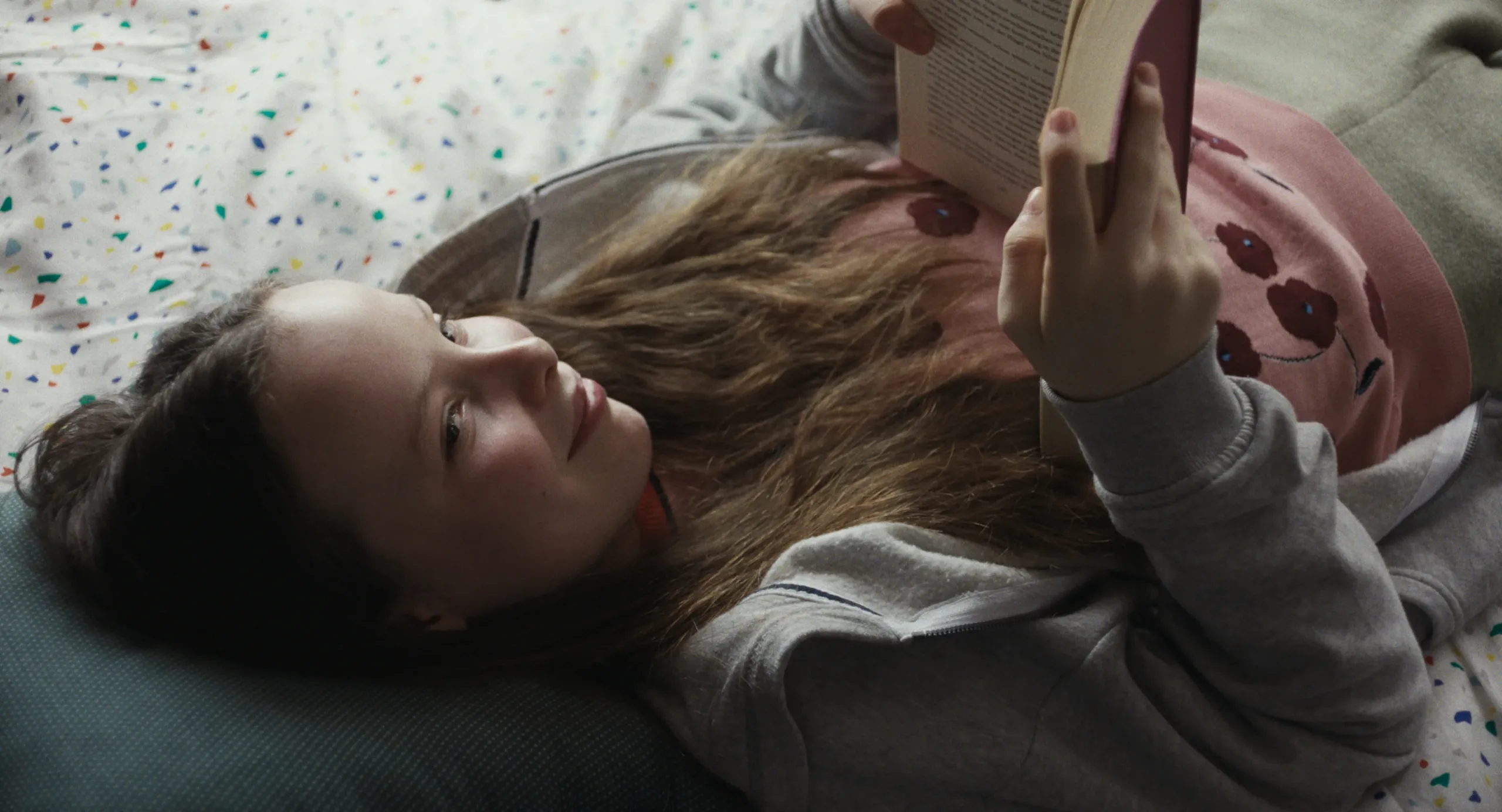
Back home, Marielle tentatively explores her new reality. Leaning against the cold hallway wall, she perceives her mother’s clandestine smoke break with Max—Julia’s hushed laughter trembling between each inhalation. In the sterile glow of Tobias’s office, Marielle eavesdrops on his professional undoing: muted jeers, clipped corrections, a man’s dignity unraveling in real time. Her parents oscillate between disbelief and dread, as if awakening to a panoptic gaze they themselves once wielded.
The rising tension mimics a slow-burning fuse. Julia and Tobias resort to absurd measures—switching to French, the language Marielle’s power cannot decode, and staging rehearsals of “acceptable” versions of themselves. Tobias replays a fabricated boardroom triumph, a hollow performance meant to restore paternal authority; Julia negotiates the return of her daughter’s tablet in exchange for silence, a grim barter of love.
Emotion crescendos in a raw, stuttered sex-education lesson, where mother and daughter stumble over anatomical truths and ashamed confessions, each revelation chiseling away at familial façades. Tobias and Julia find their identities unmoored—roles they thought secure dissolve under Marielle’s relentless watch.
At the pivot of narrative gravity, Marielle recoils: the weight of omniscience becomes unbearable. Her tears echo a universal question—can the bearer of truth also bear its cost? The parents, confronted by the wreckage of their hypocrisy, must reckon with lives unapologetically laid bare.
In the film’s ambiguous resolution, we glimpse either tentative healing or the inception of new deceptions. Marielle’s silent gaze holds both promise and despair: once seen, can truth ever be unseen?
Portraits of Concealed Truths
Laeni Geiseler’s Marielle occupies the frame like a silent question—her muted gaze a conduit for every unspoken desire and hidden shame buzzing through her parents’ lives. At first, she is a wallflower, retreating behind oversized sweaters and hushed sorrow. Then, overnight, she becomes an omniscient witness, each blink heavy with the burden of unwanted knowledge. Geiseler never overplays the part; her performance lingers in half-smiles and stifled breaths, as if she’s constantly gauging whether to intervene or vanish back into adolescence’s protective shadow.
Julia Jentsch brings a poised dissonance to her role. She moves with polished grace—an image of cultured confidence—only to shatter it with furtive puffs of smoke and hushed flirtations. In her hands, every cigarette becomes a secret prayer for rediscovered passion, every stolen glance a confession. Jentsch modulates her voice like a tightrope walker balancing between genuine remorse and social performance, reminding us that authenticity can fracture under the weight of expectation.
Felix Kramer’s Tobias is a study in professional fragility, his every gesture betraying years of self-doubt masquerading as authority. He strides into meetings with the swagger of an actor playing a part, only to cave at the slightest challenge. Under Marielle’s gaze, his mask slips, revealing a man adrift—clutching at rehearsed speeches and staged victories. Kramer’s physical comedy, the twitch of a shoulder here, the hollow laugh there, underscores how easily power dissolves when stripped of illusion.
Around them, supporting figures flicker in and out like ghosts of temptation and scorn. Mehmet Atesci’s Max fuels Julia’s inner revolt; Moritz Treuenfels’s Sören cuts Tobias down with casual malice. Even Marielle’s friend—the unseen hand that ignites it all—haunts the edges of the story, a reminder that a single act can unspool the tightest of facades.
Veils of Sight and Echoes of Sound
Inverting Bentham’s panopticon, Marielle stands at the center of her parents’ lives, not as the watched but the watcher. Each whispered confession, each furtive craving is laid bare beneath her gaze, transforming ordinary domestic moments into acts of exposure. This reversal of roles unspools the film’s meditation on modern surveillance: our devices, like Marielle’s mind, record every furtive glance, every half-finished sentence, until privacy dissolves into a spectacle of living.

Beneath the veneer of bourgeois respectability, truth fights a losing battle with appearance. Julia’s cigarette breaks and Tobias’s carefully polished speeches become performances aimed at preserving a myth of perfection. Yet under Marielle’s scrutiny, self-censorship gives way to conscious artifice—an existential masquerade in which authenticity is sacrificed on the altar of familial harmony. The parents, once arbiters of hidden limits, become actors trapped on their own stage.
Family dynamics emerge as a delicate balance of power and perception. Adolescence, typically a time of silent rebellion, here becomes a lens sharpening every adult contradiction. Marielle’s burden of knowing forces Julia and Tobias to confront what they assumed remained concealed. Their unspoken resentments—years of small neglect, withheld affection—burst into the open, revealing how teenage intuition often surpasses adult self-delusion.
Hypocrisy weaves through both mother and father: Julia’s denial of her infidelity mirrors Tobias’s reconstructed memories of triumph at work. Each lie, once designed to soothe their own conscience, rebounds back upon them when Marielle refuses to unhear or unsee. In this uncanny experiment, deceit becomes a mirror reflecting personal failure, challenging the idea that self-deception can ever be benign.
The film casts its classical score—Beethoven and Schubert quartets—as chapter markers, each movement slicing through the narrative like a moral scalpel. The measured order of string quartets stands in sharp relief against the family’s dissonant unraveling, suggesting that even art’s highest form may falter when confronted with the chaos of human truth.
Through Glass and Frost: Hambalek’s Visual Symphony
Hambalek steers his tale with a steady hand, weaving sharp humor into taut drama. He allows scenes to breathe—an accidental glance at a smoke-stained window stretching into uneasy silence—before ratcheting up to full-blown domestic absurdity. The pacing feels organic: the absurdity seeps in slowly, like ice gathering on a pane, until the tension beneath the polished surface can no longer be contained.
Visually, the film exploits glass walls and wide-open rooms to turn every hallway into a stage for covert revelations. The camera often lingers at odd angles, as if straining to peer around corners, reinforcing the sense that privacy has become a brittle illusion. A muted palette of ashen whites and steel grays washes over each frame, bathing characters in a wintry light that underscores their emotional detachment.
In close quarters, Hambalek favors handheld shots, drawing us into stifled kitchens and silent stairwells. When Marielle’s power flickers to life, time seems to stretch; slow-motion close-ups of her face transform the mundane into something uncanny, as though the world itself has paused to reveal its hidden seams.
Production design mirrors this tension: the family’s home is a study in geometric precision, its clean lines and cold surfaces offering no refuge for warmth. Office scenes, too, feel deliberately antiseptic—glass-walled conference rooms echoing with hollow politeness. Costumes and props underscore inner turmoil: Julia’s tailored suits are immaculate until a stray cigarette butt betrays her restraint, while Tobias’s slightly rumpled jackets speak of a man striving to fit a role that no longer suits him.
Echoes of Unseen Truths
Strings swell like a distant confession, Beethoven and Schubert quartets slicing the narrative into trembling chapters. Their elegiac tones feel both reverent and ironic—classical order imposed upon a family unraveling. In contrast, the sparse underscore drifts quietly, punctuating stillness until the next tremor of revelation snaps us back to heightened awareness.
Sound design blurs internal and external worlds: hushed dialogue carries an uncanny weight, whispers bouncing in echo-laced corridors, as if Marielle’s telepathy amplifies every secret. Off-screen murmurs slip through walls, and we strain to catch clipped phrases that were never meant to escape.
Editing alternates between brisk, staccato cuts in comic smoke-break interludes and lingering, painterly takes during moments of raw vulnerability. A sudden burst of rapid montage—replayed conversations, repeated actions—mirrors the cyclical trap of surveillance. Each musical cue and cut feels deliberate, guiding us from one act of exposure to the next, until silence itself becomes a charged absence.
Shadows of Revelation
This film wields a high-concept premise as both mirror and scalpel, extracting humor and insight from domestic exposure. The ensemble, anchored by Jentsch’s taut vulnerability and Geiseler’s muted intensity, carries each revelation with grace.
At times, Marielle’s interior world feels underexplored, and the rules of her perception slip into odd ambiguity. Yet the satire’s gaze on privacy, trust, and deceit echoes beyond the narrative chamber. Art-house and crossover viewers drawn to European high-concept drama will find an unsettling critique of everyday facades. A single question lingers: if every secret were revealed, could we endure the burden?
Full Credits
Director: Frédéric Hambalek
Writer: Frédéric Hambalek
Producers: Philipp Worm, Tobias Walker
Cast: Julia Jentsch (Julia), Felix Kramer (Tobias), Laeni Geiseler (Marielle), Mehmet Ateşçi (Max), Moritz Treuenfels (Dr. Sören Marx)
Director of Photography (Cinematographer): Alexander Griesser
Editor: Anne Fabini
Composer: Steffen Pfauth
The Review
What Marielle Knows
In its chilly precision and darkly comic heart, What Marielle Knows holds a mirror to every hidden fissure of family life, mining its high-concept premise for both laughter and uneasy insight. While Marielle’s inner world occasionally feels just out of reach and the mechanics of her power blur, the film’s sharp satire and strong performances leave an indelible impression.
PROS
- Inventive premise that flips parental surveillance
- Poignant, dark humor woven through tense drama
- Standout performances by Laeni Geiseler and Julia Jentsch
- Striking visual design and wintry atmosphere
- Thought-provoking exploration of honesty and privacy
CONS
- Marielle’s inner life remains somewhat opaque
- Occasional uncertainty around the “rules” of her ability
- Pacing dips in the middle act
- Limited screen time for supporting characters







