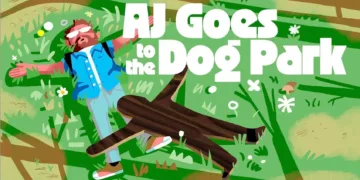





















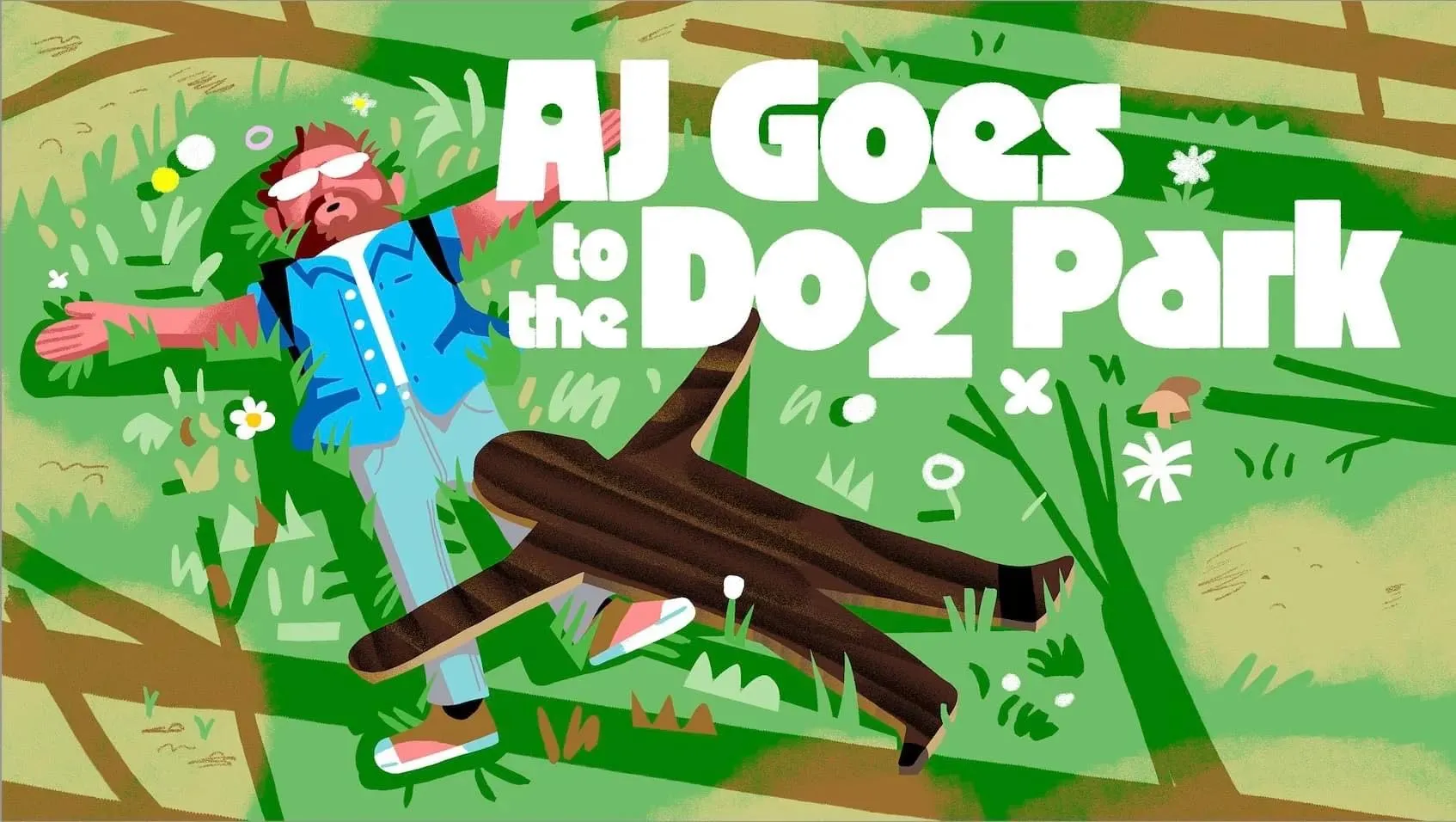

There’s a quiet comfort in a perfectly established routine. For AJ, the Fargo man at the center of AJ Goes to the Dog Park, life is a series of these small comforts: a low-stakes job at his father’s company, buttered toast for breakfast, and the daily ritual of taking his two tiny dogs, Diddy and Biff, to the local park.
This isn’t a life of ambition; it’s a life of contentment, a carefully constructed peace built on predictability. That peace is shattered when he arrives at the park one day to find it has been commandeered. It is no longer a dog park, but a “blog park,” a bizarre open-air office for laptop-wielding writers.
This single, absurd change sets off a chain reaction in AJ’s life, pushing him toward a decision that is as strange as the problem itself. To get his park back, he must run for mayor, embarking on a quest not for power, but for the restoration of his simple happiness.
A Reality Drawn with Different Rules
Director Toby Jones comes from the world of television animation, and he directs this film as if the rules of physics and filmmaking convention are merely suggestions. The movie proudly wears a lo-fi, DIY aesthetic that reminds me of the public access shows I used to find late at night as a kid—shows made with more passion than money.
This is a feature, not a bug. The camera often remains static, creating a flat, presentational stage for pure absurdity, almost like watching a diorama of strange events. This choice rejects the immersive, polished look of mainstream cinema and instead embraces a style that feels immediate and unvarnished, akin to the internet videos that have shaped a new visual language for a generation. The sound design follows suit, punctuating gags with cheap, cheerful musical stings that feel pulled from a 1990s children’s program.
In this world, AJ’s real dogs can be swapped mid-scene for unconvincing stuffed animals, and nobody bats an eye. A character can be thrown from a moving van as a person and land on the pavement as a floppy, legless dummy. The humor is a constant stream of non-sequiturs, punctuated by a deadpan delivery from most of the cast.
Also Read





The film even winks at its own potential to wear out its welcome, with a scene where AJ reads the story to a group of children who quickly grow bored. It’s a filmmaking style that intentionally rejects slickness for a handcrafted, almost folk-art charm, finding its strength in the blatant artificiality of it all.
A Hero’s Journey in a Funhouse Mirror
The story abandons a traditional political plot for a structure that feels like a video game quest filtered through a fever dream. To become mayor, AJ must out-perform the incumbent in five specific tasks: fighting, fishing, scrapping, scraping, and sapping.

This framework borrows the grandeur of a mythological epic, like the Labors of Hercules, but applies it to a profoundly mundane goal. The comedy arises from this mismatch—an epic structure for a trivial pursuit. This approach to storytelling feels distinctly contemporary, reflecting a cultural moment where we often build our own small, strange quests to find meaning.
Each task introduces a new oddball character into AJ’s orbit. His fighting coach is a man whose formal education seems to have been limited to the history of hazelnuts. Captain Seastab, the fishing mentor, is a man who commits so fully to his pirate persona that he feels teleported in from a different, more theatrical movie.
His dedicated performance, full of salty jargon, makes the flat delivery of everyone else even funnier. The narrative happily detours and derails for a joke, its flimsy plot serving as an excuse for increasingly bizarre scenarios. This culminates in a wild, out-of-nowhere climax with a giant monster, a moment where the film fully abandons narrative logic and gives itself over completely to the joy of pure, nonsensical spectacle.
The Sincere Silliness Manifesto
In an age saturated with irony and cynical humor, the film’s greatest strength is its complete lack of meanness. Its comedy is built on a foundation of earnest, good-natured silliness that feels genuinely refreshing. It is a small act of rebellion against the detached snark that defines so much of modern entertainment.

AJ Thompson’s performance as the title character is the anchor for all the chaos. He projects a genuine sweetness and vulnerability, making his odd mission feel relatable. You don’t just laugh at his predicament; you find yourself wanting him to succeed, to reclaim his small patch of happiness in a world that won’t stop changing.
The film’s message about change is gently paradoxical. AJ’s entire mission is to stop his life from being altered, yet to do so he must engage with a host of new people and bizarre challenges. His quest to preserve his routine forces him out of it. While some of the jokes don’t land and the acting is often intentionally stilted, these qualities are part of the film’s unique texture.
They are reminders that you are watching something made by friends on nights and weekends, fueled by a shared, goofy vision. It stands as proof that a film does not need a big budget or technical perfection to possess a clear voice and a genuine, beating heart.
AJ Goes to the Dog Park Released in the US on July 25, 2025.
Full Credits
Director: Toby Jones
Writers: Toby Jones
Producers and Executive Producers: Ben Hanson, James Belfer, Owen Dennis, John Jones, Toby Jones, Tucker Lucas, AJ Thompson
Cast: AJ Thompson, Greg Carlson, Danny Davy, Morgan Hoyt Davy, Jason Ehlert, Jacob Hartje, Crystal Cossette Knight
Director of Photography (Cinematographer): Tucker Lucas
Editors: Toby Jones
Composer: Secret Cities
The Review
AJ Goes to the Dog Park
AJ Goes to the Dog Park is a triumph of handcrafted charm and sincere silliness. While its relentless barrage of gags doesn't always hit the mark and its lo-fi aesthetic will not appeal to everyone, the film's undeniable heart and refreshingly uncynical spirit make it a strange, memorable, and often hilarious watch. It’s a loving ode to the absurdity of fighting for our small comforts in a world that won’t stop changing.
PROS
- A genuinely original and creative comedic voice.
- Its good-natured, sweet spirit is a refreshing change of pace.
- Endearing central performance from star AJ Thompson.
- The deliberate lo-fi, DIY aesthetic is used to charming effect.
CONS
- The rapid-fire humor is very hit-or-miss.
- Intentionally flat acting style may not work for all viewers.
- The plot is exceptionally thin, existing only to set up jokes.
- Its extreme absurdity could alienate those seeking a conventional narrative.