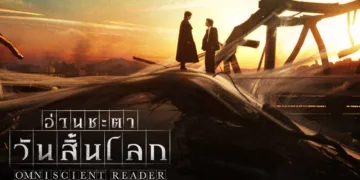




















We often seek refuge in stories, finding in their structured worlds an escape from our own. For Kim Dok-ja, a quiet office worker, that refuge is a sprawling, decade-long web novel called Three Ways to Survive the Apocalypse. He is its last, most loyal reader. The movie opens on his familiar, mundane reality, a life of little distinction. Then, on a crowded subway train, fiction violently asserts itself.
A small, floating creature, a mythical dokkaebi, appears before the terrified passengers. It announces the start of a series of deadly “scenarios” where survival is a reward. The world has not just ended; it has been rebooted with a new set of rules, the very rules Dok-ja has spent thirteen years memorizing. He alone knows the plot twists, the hidden items, and the character flaws of this new reality.
As the sole possessor of the apocalypse’s instruction manual, he sets out to find the novel’s original protagonist, Yoo Joong-hyuk, and use his unique foresight to steer humanity away from the bad ending he knows is coming. The film presents this as a grand fantasy, the ultimate reader-insert story come to life.
The Soul of the Story, Excised
An adaptation’s first duty is to understand its source. Omniscient Reader: The Prophecy fails this primary task in spectacular fashion. The film’s Kim Dok-ja is not the character fans know. He supposedly hates the novel he dedicated his life to, a baffling inversion that demolishes the story’s foundation. This choice reveals a deep misunderstanding of what made the character resonate; his morally ambiguous, often selfish survival instincts reflected a modern cynicism that felt authentic.
The movie discards this complexity for a generic hero on a tired mission to “save the world.” His backstory is scrubbed clean; a history of abuse and bullying is inexplicably swapped for a past where he was the bully, now from a loving home. This sanitization creates a protagonist with no texture, no believable motivation, a relic from a simpler era of storytelling. To compound the error, the filmmakers even strip him of his signature skill, the “Omniscient Reader’s Viewpoint,” rendering the movie’s very title an empty, ironic phrase.
This hollowness extends to the entire cast, representing a troubling step backward in on-screen representation. Yoo Joong-hyuk, the novel’s tormented hero, becomes a nonsensical side character, a master swordsman who bafflingly uses firearms in a world where they are useless. The female characters suffer the most from this simplification. Yoo Sang-ah, originally a powerful figure proficient in multiple languages and possessing deep historical knowledge, is reduced to the tired trope of a simple healer.
All her intellect and capability are stripped away for a passive role. Jung Hui-won and Lee Ji-hye, two other formidable women, have their iconic weapons changed. Hui-won’s kendo sword is replaced with daggers, while Ji-hye’s dual swords—a manifestation of her bond with a historical Korean naval hero—are swapped for a generic rifle.
These choices feel less like creative decisions and more like concessions, simplifying characters to either accommodate the perceived limitations of idol actresses or to appeal to a perceived global audience unfamiliar with Korean history. It is a profound miscalculation that misses the very point of adaptation: to translate, not erase, cultural specificity. The central theme, a love letter to the power of reading, is gone. In its place is a film that erases the novel’s thoughtful explorations of trauma and sexism, choosing a safe, sterile, and soulless path.
A Blockbuster Budget, A B-Movie Sheen
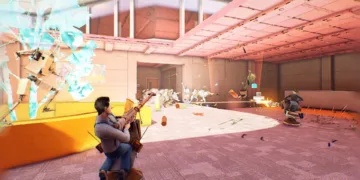
For a film with blockbuster aspirations and a cast of popular stars, Omniscient Reader: The Prophecy looks astonishingly cheap, a case study in how money cannot purchase vision. The special effects are unconvincing, with CGI monsters that lack weight and menace, appearing as digital sludge smeared across the screen. The much-anticipated river dragon and the key creature Bihyung, the dokkaebi, are particularly disappointing. The latter’s design is a complete departure from his description, appearing as a generic cartoonish being that evokes no sense of the mischievous menace he should possess.

The visual palette is flat, the cinematography amateurish and visually incoherent, making it difficult to track action within the frame. The production design is equally uninspired; the apocalyptic Seoul lacks any distinct character, feeling like a generic backdrop for poorly rendered mayhem. Action sequences, which should be the film’s lifeblood, are inert and confusing, edited like clumsy video game cutscenes that fail to build any real tension or spatial awareness.
The technical shortcomings are matched by wooden performances. The star-studded cast moves through the film with a pervasive stiffness, a clear symptom of cynical “stunt casting” where marketing buzz is prioritized over artistic fit. The practice results in a film that often feels like an extended commercial for its stars rather than a cohesive narrative. Lee Min-ho’s Yoo Joong-hyuk is a portrait of stoic inaction, while Blackpink’s Jisoo is remarkably inert as the sharpshooter Lee Ji-hye.
There is no spark of chemistry between the leads. The supposedly profound bond between Dok-ja and Joong-hyuk, the very heart of the novel, is reduced to a series of awkward, antagonistic encounters. They are hollow because the script gives them nothing to work with. The screenplay feels artificial, its dialogue purely functional, moving characters from one set piece to the next without revealing personality or building relationships.
It creates baffling narrative holes, like the complete absence of the “Constellations,” the god-like beings whose spectatorship formed a sharp satire of media consumption. Removing them is not just a plot hole; it is a thematic lobotomy. The film was seemingly assembled, not directed, its parts failing to cohere into a believable whole.
An Echo in an Empty Hall
Judged entirely on its own, separated from its source, the film is a confusing and derivative piece of work. It arrives late to the Korean high-concept genre boom, borrowing liberally from the aesthetics of superior films without understanding what made them effective.

Its death-game structure feels like a less imaginative version of countless other stories, while its game-like interface and coin rewards have been done better elsewhere. By mimicking so many other works, the film fails to establish any identity of its own, becoming lost in the noise of a saturated global market. It is a follower, not a trendsetter, a cinematic echo in an already crowded hall.
The world-building is hopelessly muddled, a critical failure for any fantasy film. A confused audience cannot become invested, and this film’s audience is given every reason for confusion. It never clarifies its own rules, leaving any viewer not already familiar with the lore to wonder if these events are happening in the real world or inside a book. This ambiguity is not intellectually stimulating; it is just sloppy writing.
Consequently, any attempt at a deeper message, such as a faintly articulated theme of “together we are strong,” lands with a thud. The sentiment feels entirely unearned. The characters are such thin archetypes that the bonds between them are unbelievable, making the promotion of unity feel deeply ironic. What remains is a loud, frantic, and ultimately vacuous spectacle—a torrent of derivative media content desperately searching for a story to tell.
Full Credits
Director: Byung-woo Kim
Writers: Umi, singNsong
Producers and Executive Producers: Won Dong-yun, Jeong Mun-gu
Cast: Ahn Hyo-seop, Lee Min-ho, Kim Jisoo, Chae Soo-bin, Nana, Shin Seung-ho, Kwon Eun-seong
Director of Photography (Cinematographer): Jeon Hye-jin
Editors: Han Mi-yeon
Composer: Mowg
The Review
Omniscient Reader: The Prophecy
Omniscient Reader: The Prophecy is a catastrophic failure on every conceivable level. It functions neither as a faithful adaptation nor as a coherent standalone film. By systematically stripping the source material of its soul, complexity, and beloved characters, the filmmakers have produced a hollow, generic spectacle. Plagued by cheap visuals, stiff performances, and a nonsensical script, this movie is a profound disappointment—a cynical cash-grab that disrespects its audience and the story it claims to tell. It is a masterclass in how not to adapt a beloved work for the screen.
PROS
- An ambitious high-concept premise that merges fantasy with a modern-day apocalypse.
- Features a cast of popular K-pop and screen stars, which may attract a broad audience.
CONS
- Completely betrays the core themes and character arcs of the source material.
- Reduces complex, morally gray characters into one-dimensional stereotypes.
- Implements regressive changes to its strong female characters, undermining their original agency.
- Subpar CGI and uninspired cinematography make the film look cheap despite its budget.
- The star-studded cast delivers wooden, unconvincing performances.
- A confusing and illogical script filled with plot holes.
- Derivative plot that borrows heavily from other, better films in the genre.