





















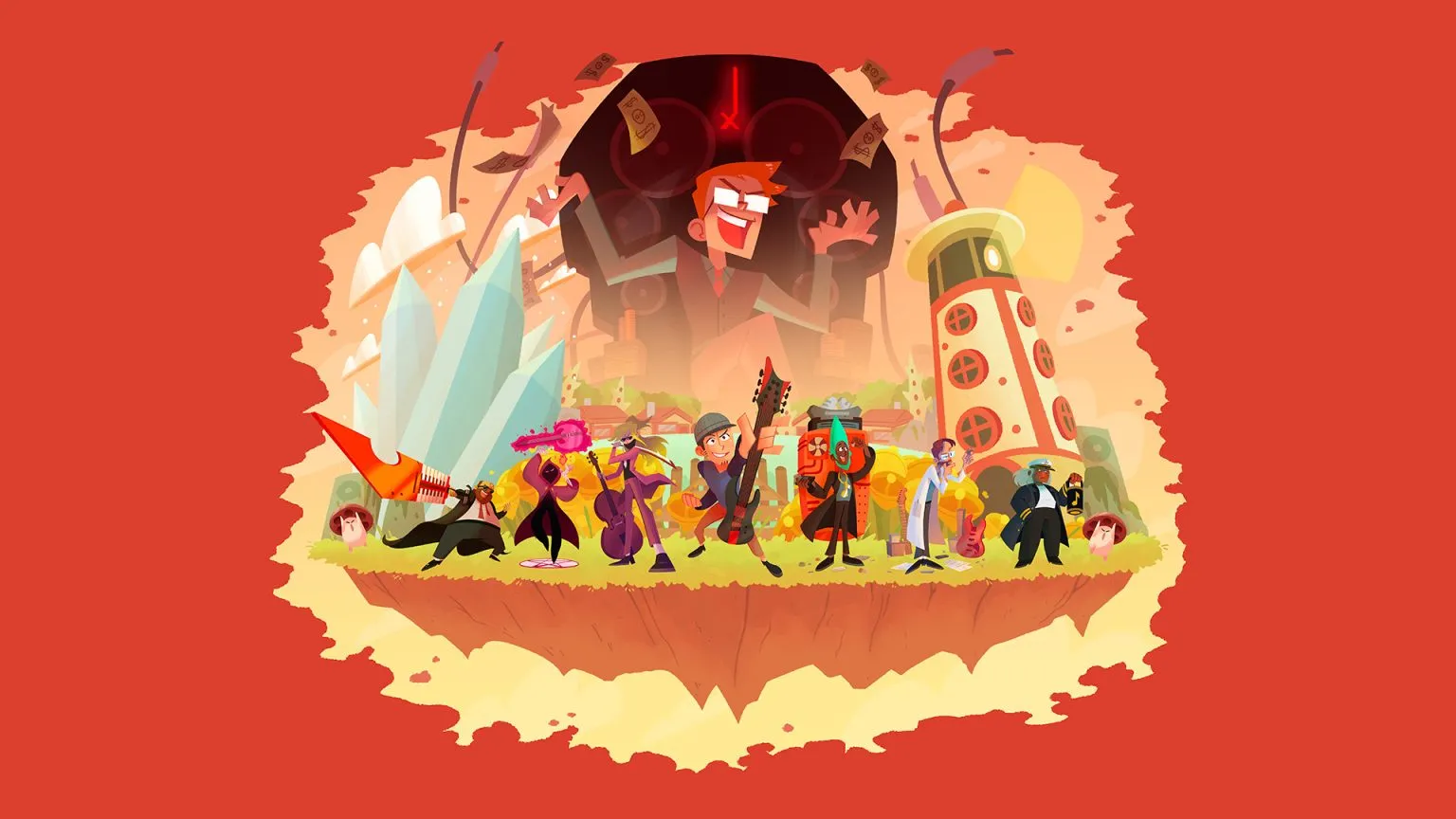

Role-playing games built around music are a rare breed. Fretless – The Wrath of Riffson tunes into this concept with confidence, casting you as Rob, an aspiring musician with dreams of making it big. His ticket to stardom appears to be a Battle of the Bands contest, but there’s a catch.
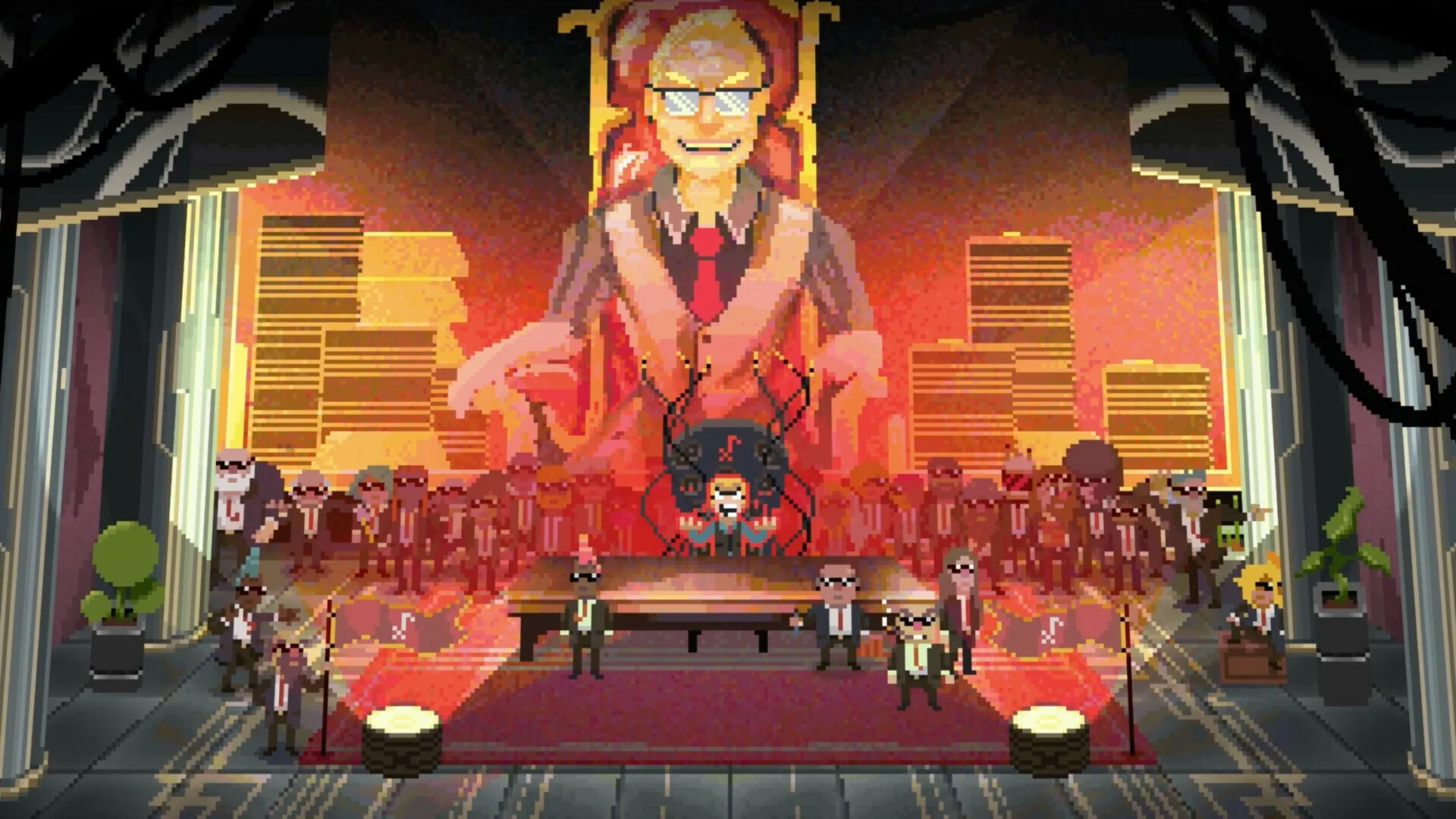
The event is run by the corrupt Super Metal Records and its CEO, Rick Riffson, who uses the competition as a front to lock artists into soul-binding contracts. What begins as a simple quest for fame becomes a fight to save music itself, armed with an arsenal of weaponized instruments in a charming turn-based RPG.
The game’s story is lighthearted and consistently amusing, never taking itself too seriously. The script is packed with witty dialogue and clever music-industry puns, with game titles like “Resonant Evil 2” and “Metalcore Gear Solid” appearing as knowing winks to the player. This humor complements a cozy pixel art aesthetic that brings to mind the welcoming world of Stardew Valley.
Every corner of the world reinforces the central theme; enemies are bizarre instrument-creature hybrids, and even running through a patch of flowers produces a plucking sound. Rob is a perfectly likable hero, an underdog fighting against a comically greedy record executive, a classic setup that works wonderfully here.
Face the Music: Combat’s Killer Rhythm
The combat system is where Fretless truly finds its groove, transforming what could be a standard turn-based affair into an active and engaging performance. While its foundation is familiar, the execution is anything but passive. Each turn, you are presented with a randomized hand of “riffs,” which function as your abilities.
You can select up to three to play in any order, creating combos of attacks, defensive shields, self-buffs, or enemy debuffs. This design, which feels heavily inspired by deck-building games like Slay the Spire, forces tactical thinking on the fly.
Also Read






You cannot rely on a single optimal rotation of moves; you must adapt to what the shuffle gives you, assessing the battlefield and constructing the best possible sequence from your available notes. Some riffs even allow you to steal an opponent’s shield, adding a welcome layer of tactical counters.
Where the system truly comes alive is with its rhythm integration. Every action, both offensive and defensive, is tied to the beat of the phenomenal background music. As Rob prepares an attack, his character model will flash yellow in perfect time with the song.
A well-timed button press at that moment amplifies the damage dealt. This same principle applies to defense; timing a block correctly just as an enemy strike lands will significantly reduce the damage taken. This is not merely a bonus mechanic; it is the core of efficient play.
Mastering this timing becomes essential, especially in later stages and against bosses. It keeps you perpetually engaged, physically tapping your foot or nodding your head to internalize the beat, transforming each battle from a menu-based affair into a participatory musical experience.
This culminates in the “Crescendo” attacks. As you land successful hits and blocks, a meter fills, which, when full, allows you to execute a powerful special move. Activating a Crescendo launches a stylish mini-game that looks and feels like a segment from Guitar Hero or Rock Band. A fretboard appears, and you must hit a sequence of notes as they scroll toward you, with each successful press contributing to a massive damage payoff.
These sequences are visually spectacular and aurally satisfying, feeling like a true instrumental solo. Bosses have their own Crescendo attacks, which you can weaken by successfully playing their malicious melody back at them, turning a moment of extreme danger into an interactive test of skill.
The decision to have the player always fight alone as Rob further sharpens this focus. Without party members to manage, success and failure rest entirely on your ability to master the rhythm and build Rob into an effective solo artist.
Building Your Sound: From Garage Band to Arena Rock
The game’s progression systems are thoughtfully designed and deeply tied to the musical theme, allowing for extensive customization of your playstyle. Your primary tools are four distinct instruments that you unlock over time, and each one functions as a separate class with its own strengths and strategic applications.
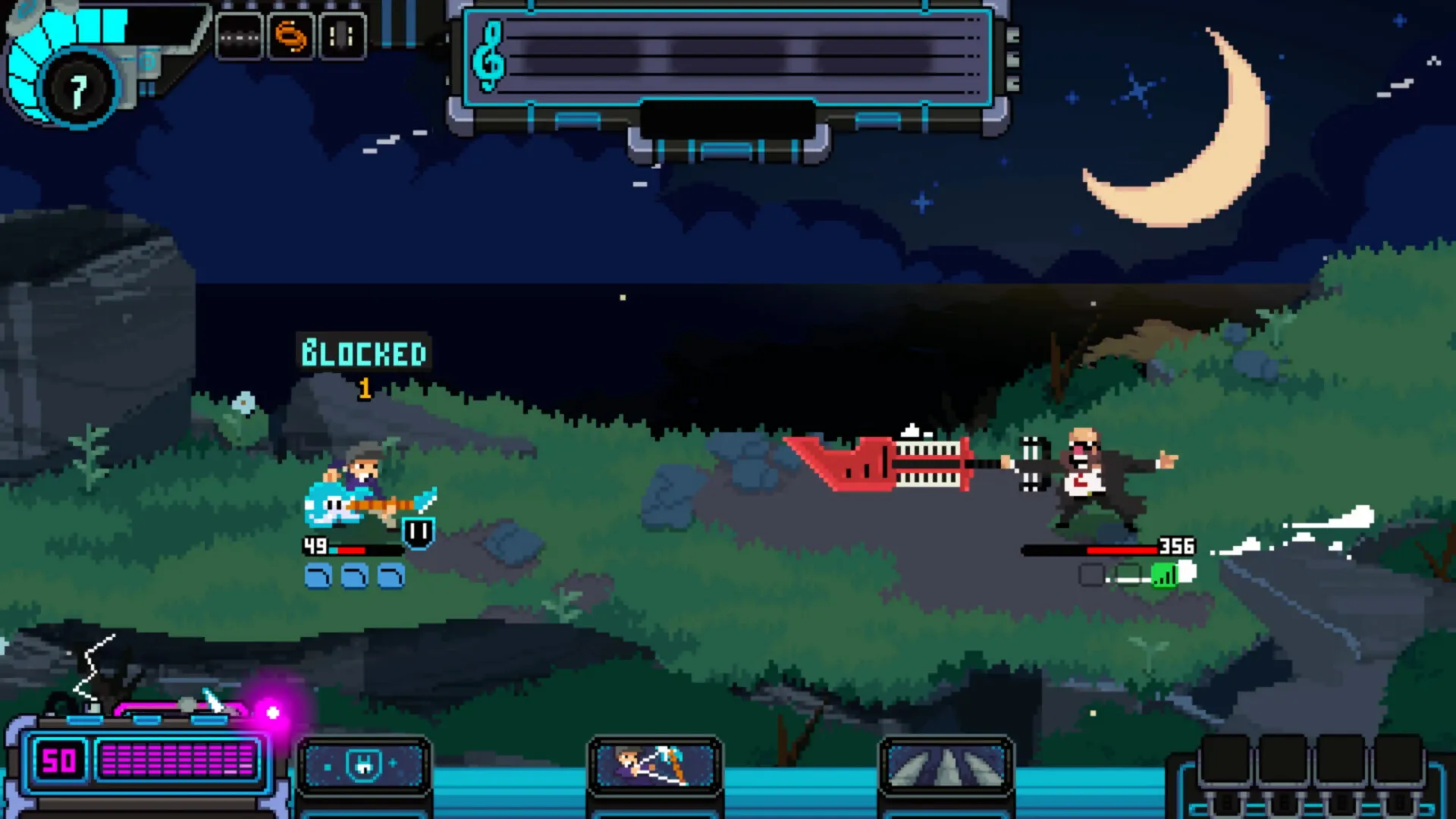
You begin with the trusty acoustic guitar, a well-rounded starting point that specializes in building defensive shields, allowing for a more durable and forgiving approach to combat. Soon you might acquire the bass guitar, which introduces the “slap” mechanic, a system for empowering other riffs in your hand, rewarding careful sequencing and tactical foresight.
The synthesizer shifts the focus to status effects, allowing you to poison, stun, or otherwise debilitate your foes from a distance. Finally, the 8-string electric guitar offers a high-risk, high-reward playstyle, encouraging you to sacrifice your own health for immense damage output. Swapping between these instruments is key to overcoming different challenges and keeps the combat experience varied throughout the game.
Beyond your choice of instrument, you can fine-tune your capabilities through a robust upgrade system. Defeating enemies and opening chests rewards you with currencies like “guitar picks” and “riff scraps,” which can be spent at workbenches. Here, you can modify your instruments with new pickups and strings to boost their base statistics, a thematic equivalent to sharpening a sword in a traditional fantasy RPG. This is complemented by the pedalboard, a critical piece of your loadout.
You can collect a wide variety of effect pedals, each granting a passive bonus, and equip up to three at once. These pedals offer perks like increased maximum health, bonus damage, or improved shield generation, letting you craft a build that suits your preferred instrument and strategy. Finding a rare pedal that perfectly synergizes with your moveset is one of the game’s great joys.
The final piece of the progression puzzle is the collection of new riffs. These are found throughout the world or purchased from vendors, constantly expanding your library of moves. You customize your “deck” for each instrument, deciding which riffs to keep active.
This constant growth is paced exceptionally well. The game avoids overwhelming you by introducing new systems and upgrade paths gradually. Just as you feel you have mastered one set of tools, the game presents another, ensuring a consistent and rewarding sense of forward momentum. You begin as a musician with a few simple chords and, by the end, feel like a maestro with a vast songbook of destructive power at your fingertips.
The Final Mix: Soundtrack, Stage Design, and Difficulty
A discussion of Fretless would be incomplete without focusing on its soundtrack, which is not merely background dressing but a central pillar of the entire experience. The quality is exceptional, featuring impressive contributions from real-world musicians like YouTube personality Rob Scallon, metalcore act Northlane, post-metal band Cult of Luna, and bassist Davie504.
The announced vinyl release of the soundtrack speaks to its quality and importance. The most brilliant aspect of the audio design is how it is woven into the gameplay itself. The battle music is dynamic; when you switch from the acoustic guitar to the 8-string, the song’s instrumentation seamlessly shifts from a folk-rock melody to a driving metal assault. This direct connection between player choice and the soundscape is a remarkable achievement.
The world itself is presented through a series of distinct biomes, from frozen tundras to volcanic mountains. These areas are visually charming in their pixel-art style but are structurally quite linear. For the most part, you are on a set path from point A to point B. This straightforward approach keeps the pace moving, though players seeking sprawling, open-ended exploration might find it simple.
The designers have included occasional branching paths that lead to treasure, useful items, or even optional boss fights, providing just enough incentive to stray from the main road. You will also encounter a handful of simple puzzles, such as basic block-sliding challenges, which serve as pleasant but brief diversions from combat. One late-game forced stealth section feels less polished and somewhat out of place compared to the strength of the core combat loop, but it is short-lived.
The game’s difficulty is tuned to be enjoyable rather than punishing. Most standard enemy encounters are relatively easy, which works in the game’s favor. Combat is so fun that you will likely find yourself seeking out fights instead of avoiding them, as is common in many other RPGs. Boss battles, however, represent a significant spike in challenge.
These encounters demand a much deeper understanding of your abilities, requiring you to make smart use of different instruments, buffs, and defensive timing. This contrast can be jarring, but it makes victory over a tough boss feel like a genuine accomplishment.
For those who do struggle, the game includes thoughtful accessibility options, such as an assist for timing QTEs and full control remapping for both keyboard and controller. Fretless is a standout title that succeeds on the strength of its creative ideas and sheer fun factor. The addictive rhythm combat and phenomenal music create an experience that is easy to recommend to RPG fans and music lovers alike.
The Review
Fretless - The Wrath of Riffson
Fretless - The Wrath of Riffson is a masterful fusion of rhythm and role-playing. Its combat is an absolute joy, turning every battle into a high-energy musical performance. Paired with a killer, dynamic soundtrack and surprisingly deep customization, the game's immense charm and creativity easily outshine its linear level design and minor structural flaws. This is a must-play indie gem that hits all the right notes.
PROS
- Engaging combat system that cleverly mixes turn-based strategy, deck-building, and rhythm mechanics.
- An exceptional and dynamic soundtrack that changes based on the player's actions.
- Deep and satisfying progression with four unique instruments and extensive customization.
- Charming pixel art, witty writing, and a world overflowing with personality.
CONS
- Level design is mostly linear with limited exploration.
- The difficulty can spike sharply during boss battles compared to regular encounters.
- A brief, out-of-place stealth section detracts from the core gameplay loop.