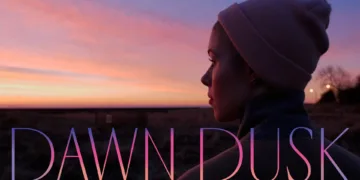








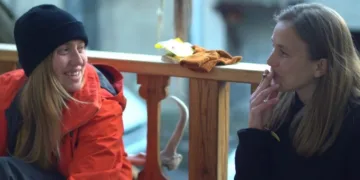











Documentaries about artists often follow a predictable path, but Dawn Dusk chooses a quieter, more contemplative route. The film introduces us to Chelli Look, a designer of minimalist leather handbags in Chicago. Her life, and the film’s narrative, is shaped by an immense tragedy: the murder of her sister.
Instead of becoming a true-crime story, the film uses this event as a catalyst for a deep exploration of the creative process. It poses a profound question about how we channel pain into our work. The film operates less like a biography and more like an observational study of resilience.
It prepares you for a patient viewing experience, one focused on the quiet, meticulous work of making something beautiful in the wake of something terrible, exploring how loss can fundamentally reshape a person’s art and identity.
Process as Portrait
The strongest moments in Dawn Dusk are when it simply watches Chelli work. The camera lingers in her pristine, white studio, creating a stark canvas for her craft. The cinematography here is deliberate and intimate, framing her hands, her tools, and the raw materials with a reverence typically reserved for fine art.
We are invited to appreciate the sensory details of creation; the rhythmic hum of her industrial Juki sewing machine has an almost hypnotic, ASMR-like quality, while close-ups on the leather emphasize its texture and imperfections. In these scenes, the act of making is presented as a constructive, almost liberatory force. It’s a space where control is possible.
The Florence sequence expands on this, serving as more than just a training montage. It is a necessary change of scenery, removing Chelli from the emotional geography of Chicago and placing her in a city where craft is history. The visual language shifts, soaking in the warm, ancient light of Italy, and this change seems to offer her a new creative vocabulary.
The film keeps Chelli herself at a slight distance. She is a self-described introvert, and her character can feel opaque, much like a silent protagonist in a video game onto whom the player projects emotion. This directorial choice is effective, shifting the focus from a simple personality study to a deeper look at her internal journey as expressed through her craft. The art becomes the character.
Grief Without a Roadmap
Many films about trauma offer clean, inspirational arcs that move from A to B. Dawn Dusk actively rejects this. It presents a portrait of grief that is messy, cyclical, and ongoing, much like the non-linear narratives found in games like What Remains of Edith Finch. The film does not chart a straightforward path from pain to recovery.

Its structure suggests that grief is a space you inhabit, not a problem you solve. Certain memories or moments can trigger a return to an earlier emotional state, mirroring the design of rogue-like games where you are sent back to the beginning, but armed with new knowledge for the next attempt. The film handles the central tragedy with immense sensitivity, avoiding exploitative details and instead letting a quiet haziness settle over the event.
This forces the viewer to concentrate on the aftermath. Forgiveness becomes a pivotal theme, a single decision that reorients her life. The film explores this not as a simple act of absolution but as a complex, continuous process that she must live with.
Her subsequent work with survivors of domestic violence is a key development, showing how her internal healing process is externalized into a mission. This moves her story from the purely personal to the communal, transforming her pain into a source of solidarity and strength for others.
An Ending Without an End
The film’s structure mixes lush, observational cinematography with conventional talking-head interviews. This creates a distinct rhythm, an ebb and flow between immersive experience and objective information. The observational scenes are slow and meditative, inviting you to get lost in the process.

The interviews are brisk and informative, but they can sometimes break the spell, feeling like a tutorial level interrupting the main gameplay. In its best moments, the film’s style is reminiscent of documentarian Frederick Wiseman, who trusts his audience to find meaning in long, uninterrupted takes without narration.
The most significant structural choice in Dawn Dusk is its ending. It denies the audience the simple satisfaction of seeing Chelli’s brand achieve widespread commercial success. This subversion of the expected “win state” is powerful. It refuses to equate healing with a tidy, capitalist victory, a resolution so common in American storytelling.
Instead, the film’s conclusion is quiet, ambiguous, and thoughtful. It suggests that moving forward is not about reaching a final destination or achieving a certain metric of success. It is a continuous process of becoming. The film leaves you with a question, not an answer, about what it means to build a life and a legacy after it has been irrevocably broken.
Full Credits
Directors: Jason Gerber, Sarah Blue Winslow Gerber
Producers: Sarah Blue Winslow Gerber, Jason Gerber
Executive Producers: Matthew Helderman, Luke Taylor
Cast: Chelli Look, Bridget Botchway Bradley, Jon Colon, Dave Look, Peg Harms
Director of Photography (Cinematographer): Jason Gerber
Editors: Meredith Mantik
Composer: Silas Hite
The Review
Dawn Dusk
Dawn Dusk is a beautifully crafted, patient documentary that finds profound meaning in the quiet act of creation. It thoughtfully sidesteps sensationalism to offer a sensitive, unconventional portrait of how an artist processes grief. While its reserved approach may keep some viewers at a distance, its refusal to provide easy answers makes it a memorable and deeply resonant study of resilience and the healing power of craft.
PROS
- Beautiful, contemplative cinematography that focuses on the artistic process.
- A sensitive and non-exploitative approach to a difficult subject.
- Rejects standard documentary tropes for a more realistic, cyclical portrayal of grief.
- The subversion of a typical success-story ending provides a thoughtful, ambiguous conclusion.
CONS
- The subject's reserved nature can make her feel opaque and distant.
- The use of conventional talking-head interviews occasionally disrupts the film's immersive, observational flow.
- Its slow, meditative pace might not engage all viewers.