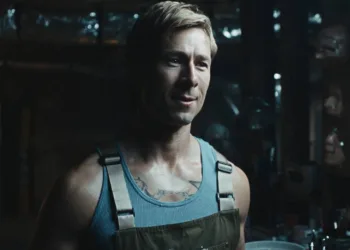












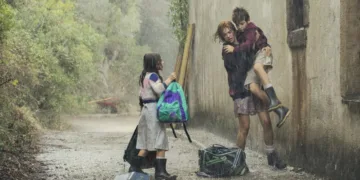



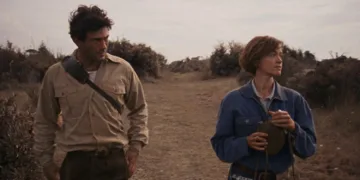











In an era of filmmaking defined by spectacle, a simple story told with unadorned sincerity can feel like a minor revelation. Guitar Lessons offers just that, planting its narrative firmly in the soil of northwestern Alberta. Against a backdrop of oilfields and quiet rural towns, the film introduces its two solitary figures.
Ray is a reclusive oilfield contractor, a man whose grumpy demeanor acts as a shield for a past life as a musician. Into his orbit comes Leland, a 15-year-old Métis boy, who has inherited a guitar from a father he never knew.
Leland’s request for lessons from the reluctant Ray is the simple event that sets their story in motion. This is not a grand quest, but the quiet beginning of an unexpected and tentative relationship between two people in need of a new direction.
The Central Duet: An Uneasy Alliance
The film’s architecture rests on the developing bond between teacher and student, a familiar cinematic trope that depends entirely on the chemistry and conviction of its leads. Corb Lund gives Ray a guarded authenticity that elevates the character beyond a simple curmudgeon archetype.
He is a man who deals in hard, unyielding materials in his daily work, and his personality reflects that—he is blunt, weathered, and resistant to pressure. Lund’s performance is wonderfully physical; his reluctance is visible in his posture and his gruff delivery of spare dialogue, which only barely conceals a deeper conflict between his chosen isolation and a buried instinct to connect. This is a man who has built a fortress around himself, and he seems genuinely annoyed that a teenager has found the gate.
Opposite him, Kaden Noskiye portrays Leland with a quiet persistence that is more than just youthful stubbornness; it is a form of observational wisdom. He seems to understand that he cannot force Ray’s defenses down, but must instead wait patiently for the cracks to appear. This makes his character feel active in his pursuit, not merely passive.
The narrative decision to use the titular lessons as a device for broader life instruction is clear, with the guitar itself acting as a powerful symbol—a legacy from an unknown father and a potential bridge to a different future. The script, however, occasionally takes a shortcut where a longer path would have been more rewarding.
Their relationship’s growth is sometimes compressed into montages, a narrative convenience that prevents their connection from achieving the full depth it might have. A montage can show us progress, but it denies us the small, awkward, and pivotal moments where trust is actually built.
We miss the shared frustration over a difficult chord, the first comfortable silence, or the subtle glance that signals a genuine breakthrough. We see the bond forming, but we are not always allowed to feel its roots taking hold.
The Ensemble: Stray Notes and Subplots
Beyond its central pairing, the film’s narrative focus begins to fray, with supporting characters and their stories feeling less like integrated parts of a whole and more like adjacent narratives. The most significant example is Ernie, played with considerable charm and weight by Conway Kootenay.

He functions initially as welcome comic relief, a talkative and humorous counterpoint to Ray’s severe disposition. Yet, his character is given a serious and potent arc involving a gambling problem, which culminates in some of the film’s most affecting scenes. One monologue on the performative nature of land acknowledgements is particularly memorable for its wit and insight.
The issue is that this entire storyline feels structurally detached from Ray and Leland’s journey. It operates with its own distinct beginning, middle, and end, almost like a self-contained short film was embedded within the feature. This creates a kind of tonal whiplash for the audience, shifting them from a quiet character study to a more urgent story about addiction and cultural commentary.
The fragmentation is a strong indicator of the project’s rumored origins as a television series; it feels episodic by nature, a relic of a different narrative form. This feeling is amplified by the way other characters are handled. Figures like Ray’s girlfriend Denise appear abruptly, with little introduction or context for their emotional state.
We are dropped into the middle of their crisis without a map, forcing us to ask “Who is this person?” instead of allowing us to feel “What is she going through?” This disrupts the narrative immersion and undermines the film’s own primary goal of building a slow, intimate world around its characters.
The Final Arrangement: Sincerity Meets Shaky Structure
The film’s intentions are undeniably noble; it wants to explore ideas of redemption, unconventional family, and the difficult path of confronting addiction. Its genuine heart is never in doubt, and in the current cinematic landscape, this kind of sincerity—a complete lack of irony or winking at the audience—is refreshing.

This earnestness, however, is frequently let down by a shaky and inconsistent narrative structure. The tone shifts unsteadily between light comedy and heavy drama, with the transitions feeling less like a natural flow and more like a sudden, jarring gear change.
The script meanders, with certain scenes feeling underdeveloped or emotionally unearned. An odd outburst from Ray at a bank, for example, comes without sufficient buildup, making his actions seem more like a puzzling character inconsistency than a moment of genuine catharsis.
Yet, for all its structural faults, the movie does find its footing for the final act. It’s here that the story’s disparate threads are finally pulled together. The meandering ceases, the dialogue becomes sharper, and the emotional stakes are given the clarity they lacked earlier.
The film’s focus narrows to its characters, allowing them to have the meaningful, dialogue-driven conversations that provide a satisfying sense of closure. This strong finish demonstrates that the filmmakers are quite capable of powerful drama; they just struggled with the narrative scaffolding required to support it throughout the entire runtime.
The result is a film whose individual parts are often stronger than their arrangement. It is a work of flawed but worthwhile cinema, a collection of beautiful, heartfelt notes played on an imperfectly tuned instrument.
Guitar Lessons is a Canadian drama film that premiered in Canada on September 23, 2022. It was later released on video-on-demand and digital platforms in the US on July 1, 2025, distributed by Freestyle Digital Media.
Full Credits
Director: Aaron James Sorensen
Writers: Aaron James Sorensen
Producers: Aaron James Sorensen, Jared Snyder, Cheryll Welke, Kat Winter, OJ Blanchette (Executive Producer), Dave Borle (Executive Producer), Jonathan Parenteau (Executive Producer), Leslie Snyder (Executive Producer)
Cast: Corb Lund, Roseanne Supernault, Kaden Noskiye, Marie Zydek, Conway Kootenay, Lianna Makuch, Kirsten Lankester, Kat Winter
Director of Photography (Cinematographer): Justin Godlien
Editors: Mason McConnell
Composer: Geoffrey Burch
The Review
Guitar Lessons
While Guitar Lessons struggles with a fragmented structure and an uneven tone, its genuine sincerity and the strength of its core performances make for a worthwhile watch. The film's emotional payoff in the final act is significant, rewarding the viewer's patience through its rougher patches. It is a heartfelt project whose ambition is more commendable than its final arrangement, resulting in a movie that is easy to admire, even when it is difficult to love completely.
PROS
- Features a sincere, heartfelt tone that is a refreshing change of pace.
- Strong and authentic lead performances from Corb Lund as the gruff mentor and Kaden Noskiye as the determined student.
- Conway Kootenay's supporting role as Ernie is a standout, providing both humor and deep pathos.
- The film's final act is emotionally effective and provides a satisfying resolution.
CONS
- The narrative structure is choppy and fragmented, likely due to its origins as a series.
- An uneven tone that shifts awkwardly between light comedy and serious drama.
- Key relationship moments are sometimes rushed through the use of montages.
- Supporting characters are often introduced abruptly with little context, disrupting the story's flow.